 Serving Ventura and LA County
 Years of Experience
With Southern California electricity rates climbing 11% since 2024, your aging cooling system isn’t just a comfort issue; it’s a growing financial liability. You likely feel the pressure of these rising utility bills while trying to decipher the complex technical jargon of the current SEER2 efficiency mandates. It’s frustrating to face a major investment like ac replacement when you’re worried about aggressive sales tactics or choosing a system that might not actually lower your monthly overhead.
This guide provides a factual, unbiased framework to help you secure a high-efficiency system that meets California’s 2026 building standards without the typical showroom pressure. We’ll break down the specific costs for Los Angeles neighborhoods, explain the mechanical benefits of variable-speed compressors, and show you how to verify duct integrity to ensure your new unit delivers the 20% energy savings it promises. From verifying Title 24 compliance to selecting whisper-quiet hardware, you’ll gain the technical clarity needed to protect your home’s value and your long-term peace of mind.
Key Takeaways
- Learn how to calculate the true ROI of a new system by factoring in the 2026 Southern California electricity rate hikes against aging unit repair costs.
- Discover why modern heat pumps and ductless mini-splits are replacing traditional central air as the standard for efficiency in Los Angeles homes.
- Understand why a neutral, pre-replacement inspection is essential to verify ductwork integrity and prevent common “sales-first” installation errors.
- Navigate the financial landscape of ac replacement by leveraging Federal 25C tax credits and local utility rebates to offset total installation costs.
- Identify the critical technical steps of a professional installation, from eco-friendly refrigerant disposal to the precision mounting of high-efficiency condensers.
Signs You Need AC Replacement in Los Angeles: The 2026 Evaluation
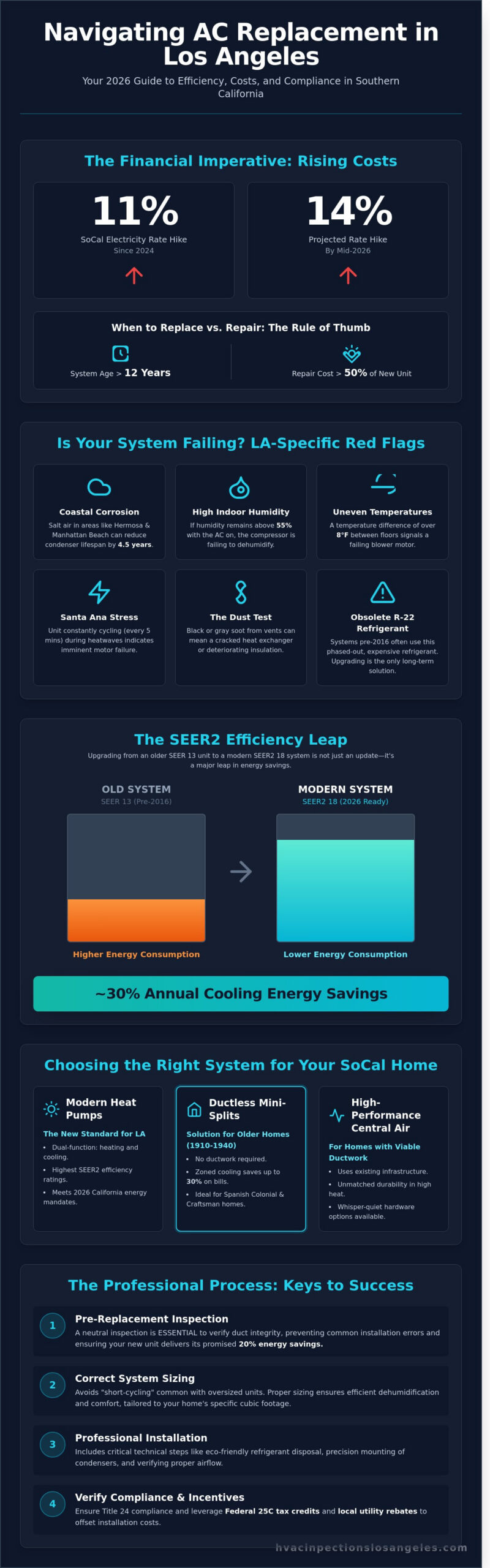
Homeowners in Los Angeles face a unique set of mechanical stressors that dictate the timeline for ac replacement. Deciding whether to fix an aging unit or invest in a new one requires a cold look at the numbers. If a repair quote exceeds 50% of the system’s value or the unit has passed the 12-year mark, the math favors a new installation. This is especially true as Southern California electricity rates are projected to rise by 14% by mid-2026. An inefficient system doesn’t just run poorly; it actively drains your bank account during peak demand months.
Geography plays a major role in system degradation. In coastal areas like Hermosa Beach and Manhattan Beach, salt air causes coil pitting and accelerated corrosion. This marine layer can reduce the lifespan of a standard condenser by 4.5 years compared to units in the San Fernando Valley. We also see many “zombie” systems across the South Bay. These units continue to blow cool air but fail to pull moisture from the environment. If your indoor humidity remains above 55% despite the air running, the compressor is likely losing its volumetric efficiency. When evaluating ac replacement, homeowners should understand how different types of AC systems, such as high-efficiency heat pumps or traditional split systems, interact with the specific humidity levels of the Pacific coast.
The 10-Year Rule and SEER2 Efficiency Standards
Systems manufactured before 2016 weren’t designed for the rigorous California energy mandates of 2026. Most older units operate on R-22 refrigerant, which is now obsolete and prohibitively expensive to recharge. Moving to a modern system ensures compliance with current environmental laws while slashing monthly utility bills. SEER2 is the current benchmark for energy efficiency in 2026. Upgrading from a SEER 13 unit to a SEER2 18 system can reduce cooling-related energy consumption by approximately 30% annually.
Performance Red Flags in the LA Climate
- Santa Ana Stress: If your unit cycles on and off every 5 minutes during 90-degree Santa Ana wind events, the motor is likely nearing a critical failure point.
- The Dust Test: Check your supply vents for gray or black soot. This often indicates a cracked heat exchanger or deteriorating internal insulation that compromises safety.
- Thermal Variance: In traditional two-story South Bay homes, a temperature difference of more than 8 degrees between floors usually signals that the blower motor can no longer handle the static pressure of the ductwork.
Mechanical failures in Los Angeles are rarely sudden. They’re usually preceded by these specific performance dips. Identifying them early prevents an emergency outage during a July heatwave.
Choosing the Best AC System for Southern California Homes
Selecting the right hardware for an ac replacement in 2026 requires a technical balance between upfront investment and long-term thermal performance. Modern heat pumps have effectively become the primary standard for Los Angeles residential projects. This transition is largely driven by their dual-function capability and compliance with the latest federal energy efficiency standards, which emphasize higher SEER2 ratings to reduce grid strain during Stage 3 heat emergencies.
System sizing remains the most critical factor for comfort. A common error in the San Fernando Valley involves installing a 5-ton unit where a 3.5-ton system is sufficient. Oversized units short-cycle; they reach the target temperature too quickly and shut off before they can properly dehumidify the air. This leaves the interior feeling clammy even at 72 degrees. A professional mechanical assessment ensures your new system is sized to the exact cubic footage and insulation values of your specific property.
Ductless Mini-Splits: The Solution for Older LA Homes
Mitsubishi ductless systems are the preferred choice for Spanish Colonial and Craftsman homes built between 1910 and 1940. These properties often lack the attic clearance or crawlspace required for traditional 12-inch diameter ductwork. By utilizing small refrigerant lines, these systems provide high-efficiency cooling without invasive structural changes. Zoned cooling allows you to deactivate air flow in unoccupied guest rooms, which can reduce monthly utility costs by up to 30%. Modern aesthetics have also evolved; homeowners can now choose between slim wall-mount units or low-profile floor consoles that mimic the look of traditional radiators.
High-Performance Central Air: The Trane Advantage
For homes with existing, viable ductwork, Trane high-performance central systems offer unmatched durability in high-heat environments like Woodland Hills or Santa Clarita. The Trane XV20i features a variable speed compressor that adjusts its output in 1% increments. This prevents the “all-or-nothing” blasts of cold air common in older single-stage units. These systems integrate seamlessly with existing gas furnaces to create a dual-fuel solution. This setup uses the electric heat pump for moderate temperatures and switches to gas heat only when temperatures drop below 40 degrees. This hybrid approach maximizes equipment longevity while ensuring your ac replacement provides year-round reliability.
- Durability: Trane units undergo 16 weeks of “Snowman” testing to simulate extreme environmental stress.
- Precision: Mitsubishi INVERTER technology maintains temperatures within 0.5 degrees of your setting.
- Safety: Modern systems use R-454B or R-32 refrigerants, which have a significantly lower Global Warming Potential (GWP) than older R-410A blends.
The Pre-Replacement HVAC Inspection Checklist
A neutral inspection is the only way to avoid “sales-first” installation errors that often plague the Los Angeles market. Many contractors skip the Manual J Load Calculation, which remains the industry standard for determining exact BTU needs. Without this data, you risk installing an oversized unit. This causes short-cycling, which reduces the lifespan of your equipment by 25% or more. Preparing for a real estate transaction or an insurance audit requires a documented paper trail of mechanical integrity. A professional assessment ensures that your ac replacement is based on technical requirements rather than a commission-driven sales pitch.
Ductwork and Airflow Verification
Your new high-efficiency unit won’t perform if your ducts are failing. Leaking ductwork can waste 30% of your system’s output before it reaches your living room. Modern blowers move air at higher pressures, which can cause old, brittle seals to fail completely. We check for:
- Leaking joints that compromise energy efficiency and indoor air quality.
- Return air vents that are too small for high-efficiency 2026 blower motors.
- Restricted airflow that leads to evaporator coil freezing.
If you’re planning to sell a home in neighborhoods like Silver Lake or Pasadena, “Real Estate Readiness” is vital. A certified duct integrity report provides buyers with peace of mind and prevents 11th-hour repair demands during escrow.
Electrical and Code Compliance Checks
The 2026 California Title 24 standards mandate strict efficiency levels for every ac replacement. Modern heat pump technology often requires a dedicated 240-volt circuit. We verify your electrical panel’s capacity to ensure it can handle these modern loads without posing a fire hazard. Compliance isn’t optional; it’s a safety requirement. HERS (Home Energy Rating System) testing is also mandatory for your permit. This independent verification confirms that your refrigerant charge and airflow meet state-defined benchmarks. Failing to secure these certifications can lead to fines or complications when you try to pull permits for future home renovations.
Estimating AC Replacement Costs in Los Angeles
Budgeting for an ac replacement in Southern California requires a technical breakdown of three primary variables: equipment hardware, specialized labor, and mandatory compliance fees. In 2026, a standard high-efficiency condensing unit and coil generally range from $5,000 to $11,000. Labor costs in the Los Angeles metro area fluctuate between $150 and $250 per hour depending on the complexity of the attic or closet configuration. You must also account for City of Los Angeles building permits and Title 24 duct leakage testing, which typically add $450 to $900 to the final invoice.
Low-cost bids often hide long-term financial risks. If a contractor bypasses the Manual J load calculation or uses undersized refrigerant lines, the system will experience premature compressor failure. Professional installations for premium brands like Mitsubishi or Trane include 10-year parts warranties and often feature 0% APR financing for 60 months through specialized HVAC lenders. This ensures the mechanical integrity of your home remains intact without a massive upfront capital drain.
Local Rebates and Energy Incentives
The 25C Energy Efficient Home Improvement Tax Credit allows homeowners to deduct 30% of the cost of high-efficiency equipment, capped at $2,000 annually for heat pumps. Locally, LADWP and Southern California Edison (SCE) offer tiered rebates that reward systems exceeding 16 SEER2 ratings. When you combine federal credits with local utility programs, 2026 incentives can often offset up to 25% of total replacement costs. These programs prioritize heat pump technology, which provides both heating and cooling through a single, electrified platform.
Long-Term ROI of High-Efficiency Cooling
Upgrading from a 10-year-old 13 SEER unit to a modern 18 SEER2 variable-speed system can reduce monthly cooling expenditures by approximately 35% during peak July and August heatwaves. This reduction typically results in a “payback period” of six to eight years. Beyond monthly savings, a certified ac replacement adds tangible value to Los Angeles property appraisals. Real estate data from 2025 suggests that homes with documented, high-efficiency HVAC upgrades see a 4% to 7% increase in closing prices compared to those with aging, neglected systems. Registering your Trane or Mitsubishi unit within 60 days of installation is critical to securing a 10-year limited warranty, protecting your investment from unexpected mechanical defects.
Professional Installation: What to Expect on Install Day
The ac replacement process culminates in a single day of focused mechanical work. Most professional crews arrive by 8:00 AM to begin a four-stage execution plan designed to ensure system integrity and long-term efficiency.
- Step 1: Refrigerant Recovery and Disposal. Technicians use EPA-certified recovery machines to extract old R-410A or R-22 refrigerant. This prevents atmospheric venting and complies with South Coast AQMD regulations. The old unit is then hauled away for eco-friendly recycling.
- Step 2: Component Mounting. The team installs the new indoor evaporator coil and the outdoor condenser. Precision leveling is mandatory; a tilt of just 2 degrees can cause condensate drainage backups or uneven oil distribution in the compressor.
- Step 3: Pressure Testing and Evacuation. Technicians pressurize the copper line sets with dry nitrogen to 500 PSI to verify leak-free joints. Afterward, a vacuum pump removes moisture and non-condensables until the system holds a vacuum of 500 microns or less. This step is critical for preventing internal corrosion.
- Step 4: Commissioning and Orientation. The system is charged with refrigerant, and the team measures airflow and static pressure. Once the unit meets manufacturer specifications, you’ll receive a full walkthrough of the new thermostat and air filtration system.
The Value of a Mitsubishi Ductless Elite Dealer
Selecting a Mitsubishi Ductless Elite Dealer offers technical advantages that standard contractors cannot match. These specialists complete over 40 hours of factory training annually to master inverter-driven technology. This specialized knowledge results in 25 percent fewer mid-summer service calls compared to non-certified installs. Homeowners also benefit from exclusive 12-year extended parts and compressor warranties. The “Meticulous Expert” approach ensures a clean, non-invasive installation that respects the architectural integrity of your home.
Final Steps: Permits and HERS Testing
Completing an ac replacement in Los Angeles, Torrance, or Redondo Beach requires legal closure through city permits. California Title 24 standards mandate a third-party HERS (Home Energy Rating System) verification. A certified rater tests for duct leakage, ensuring it remains below 15 percent of total airflow. This unbiased check confirms that your system performs at its rated SEER2 efficiency. Validating these results is essential for maintaining property value and ensuring your home passes future real estate inspections.
Secure Your Home Comfort for the 2026 Season
Investing in a new HVAC system is a significant financial decision that impacts your property value and monthly utility bills for the next 15 years. By following our 2026 checklist, you ensure your ac replacement meets modern California energy standards and handles the specific thermal demands of the South Bay. A successful transition requires more than just picking a unit. It demands a precise evaluation of your current duct integrity and electrical capacity to avoid mid-summer failures. HVAC Inspections Los Angeles has served the Greater LA area for over 20 years. As a Mitsubishi Ductless Elite Dealer, we provide the technical precision required for specialized real estate and insurance inspections. We don’t sell units or push hardware; we provide the unbiased data you need to make an informed choice. Our comprehensive reports give you the exact technical standing of your mechanical systems. This ensures you don’t overpay for unnecessary upgrades or undersized units. You deserve a system that’s built to last in the Southern California climate.
Get a Professional HVAC Evaluation Before Your Replacement
Taking these proactive steps today will guarantee your family stays cool and your investment remains protected for years to come.
Frequently Asked Questions
How much does AC replacement cost in Los Angeles in 2026?
A standard ac replacement in Los Angeles typically costs between $8,500 and $16,000 for a 3-ton residential system. This price range includes the condenser unit, evaporator coil, labor, and basic permit fees. If you choose a high-efficiency variable-speed model, costs can reach $22,000. Equipment prices have stabilized in 2026, but they remain 15% higher than 2024 averages due to the mandatory transition to new refrigerant standards.
Is it better to repair or replace a 12-year-old AC unit?
You should replace the unit if the repair cost exceeds $1,500 or if the system requires R-22 refrigerant, which is no longer produced. Most air conditioners in Southern California have a functional lifespan of 12 to 15 years. Modern systems are 30% more efficient than 2014 models. Upgrading now prevents emergency failures during a heatwave and reduces your monthly Southern California Edison bill by approximately $45.
How long does a professional AC installation take?
A standard ac replacement project usually takes 8 to 12 hours to complete for a single-family home. If your installation requires new ductwork or an electrical panel upgrade, the process can extend to two full workdays. Our technicians follow a structured 21-point checklist to ensure the system is vacuum-tested and pressurized correctly. This methodical approach ensures the equipment operates safely and meets all local manufacturer specifications from day one.
Can I replace my AC unit without replacing the furnace?
It’s possible to replace only the AC unit, but we don’t recommend it for systems older than 10 years. Mismatched components often lead to a 20% decrease in efficiency and can void your 10-year parts warranty. Since the furnace blower is responsible for moving the air, an outdated motor might not handle the airflow requirements of a new evaporator coil. A full system swap ensures peak performance and long-term reliability.
What are the California Title 24 requirements for AC replacement?
Title 24 requires all new installations in Los Angeles to meet a minimum 14.3 SEER2 efficiency rating and pass a HERS duct leakage test. These 2026 standards mandate that duct leakage must be lower than 5% to prevent energy waste. You must also install a certified digital thermostat that’s capable of receiving demand-response signals. These regulations are designed to reduce the load on the California power grid during peak summer months.
Do I need a permit for AC replacement in Los Angeles County?
Yes, the Los Angeles Department of Building and Safety requires a mechanical permit for every ac replacement performed in the city. Permit fees generally range from $250 to $450 depending on your specific zip code and project scope. Failing to obtain a permit can result in a $500 fine and create significant complications during a home appraisal or title transfer. A permit ensures a third-party inspector verifies the safety of your electrical connections.
What is the most energy-efficient AC system for the South Bay area?
A variable-speed heat pump with a SEER2 rating of 20 or higher is the most efficient choice for South Bay microclimates. These systems are ideal for the coastal environment because they manage humidity during June Gloom while providing precise cooling during 90-degree afternoons. Brands like Mitsubishi and Daikin offer inverter technology that uses 40% less energy than standard single-stage units. This technology provides a consistent indoor temperature without the loud cycling of traditional compressors.
What happens if I don’t get a HERS test after my AC installation?
Your building permit will remain “open” and legally incomplete without a successful HERS duct leakage report. This status can stall a home sale or prevent you from securing a refinance on your property. Beyond legal issues, skipping the test means you have no verification that your system is running efficiently. Homes that fail to meet HERS standards typically see a 15% increase in energy consumption due to air escaping into the attic.