 Serving Ventura and LA County
 Years of Experience
Last July, a homeowner in a 1924 Pasadena bungalow watched their monthly electricity bill spike to $485 while the upstairs bedrooms remained at a stifling 81 degrees. This scenario is a daily reality for Los Angeles residents who deal with the inefficiencies of aging central air or the physical constraints of historic architecture. You probably already know that forcing air through leaky, oversized ducts is a losing battle for both your comfort and your wallet. A ductless mini split provides a high-precision alternative that eliminates energy waste and fits into spaces where traditional systems cannot go.
Our 2026 guide gives you the technical roadmap to achieve 30 percent lower utility costs and whisper-quiet operation. We’ll explain why a 25 SEER2 rating is the current gold standard for Southern California efficiency and how to choose a configuration that meets strict local noise ordinances in dense South Bay neighborhoods. You’ll gain a clear understanding of how to audit your home’s thermal needs and select a system that delivers reliable, zoned comfort for the next 15 years.
Key Takeaways
- Understand how 2026 SEER2 standards and inverter technology allow a ductless mini split to provide superior efficiency compared to traditional HVAC systems.
- Evaluate the long-term ROI and installation advantages of ductless systems within the specific context of the Los Angeles real estate market.
- Learn to accurately size your system by moving beyond square footage to account for Southern California’s unique ceiling heights and coastal air conditions.
- Discover why professional installation is the only way to safeguard manufacturer warranties and ensure a clean report during a real estate HVAC inspection.
- Gain insights into choosing the right climate solution for Los Angeles’ diverse architectural styles, from historic mid-century homes to modern coastal builds.
Why Ductless Mini Split Systems Are the Top Choice for Los Angeles Homes
The ductless mini split has evolved from a niche solution to the primary heating and cooling standard for Southern California modernization. These systems function as high-efficiency heat pumps, moving heat between the indoor and outdoor environments rather than generating it through energy-intensive combustion. This technical shift is vital as Los Angeles moves toward full electrification. The city’s architectural landscape, which ranges from 1920s Spanish Colonials to contemporary glass structures, often lacks the internal clearance for traditional 12-inch metal ducting. A ductless system bypasses these structural limitations entirely.
Zoning has become a critical requirement for multi-generational households, which saw a 15% increase in Southern California between 2021 and 2024. Traditional central air systems force a single temperature across the entire floor plan, leading to wasted energy in unoccupied rooms. By contrast, a multi-zone configuration allows a grandmother in a converted suite and a teenager in a bedroom to maintain different comfort levels. This precision helps homeowners comply with California’s Title 24 Part 6 energy standards. The 2025 updates to these regulations place heavy emphasis on high SEER2 ratings and reduced carbon footprints, making heat pump technology the most viable path for compliance during major renovations.
The Anatomy of a Ductless System
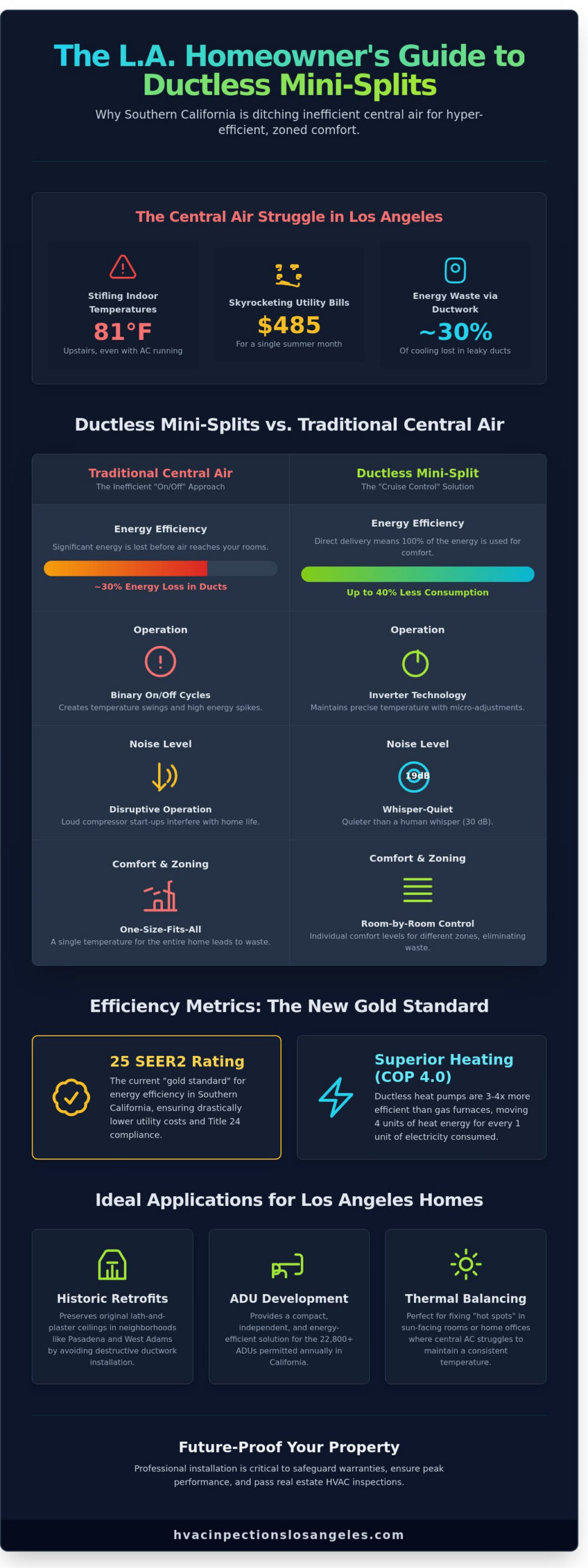
The system consists of a sleek indoor air-handling unit linked to an outdoor compressor by a small conduit. This conduit houses the power cable, refrigerant tubing, and a suction line. Unlike central air, which loses approximately 30% of its cooling energy through duct leaks and thermal transfer in unconditioned attics, ductless units deliver conditioned air directly into the living space. This design ensures that 100% of the energy you pay for actually reaches your room.
Ideal Applications in the South Bay and Beyond
Specific Los Angeles property types benefit most from this technology:
- Historic Retrofits: In neighborhoods like Hermosa Beach or West Adams, installing a ductless mini split preserves original lath-and-plaster ceilings that would otherwise be destroyed by ductwork.
- ADU Development: California processed 22,802 ADU permits in 2023 alone. These compact dwellings require the small footprint and independent billing capabilities that only ductless systems provide.
- Thermal Balancing: Homeowners often use these systems to fix “hot spots” in sun-facing home offices or master suites where the central AC fails to maintain a consistent 72-degree environment.
The transition to this technology isn’t just about comfort; it’s about future-proofing your property value. As local building codes tighten, homes equipped with high-efficiency heat pumps will command higher prices during the inspection and appraisal process. Choosing this path ensures your mechanical systems remain compliant and functional for the next two decades of Los Angeles climate shifts.
How Ductless Technology Works: Efficiency and Performance Standards
Standard central air units operate on a binary cycle; they’re either running at 100% capacity or they’re completely off. This creates the "blast and pause" effect that leads to temperature swings and high energy spikes. A modern ductless mini split utilizes inverter-driven compressors to eliminate this inefficiency. These systems function like a car’s cruise control, slowing down or speeding up in tiny increments to maintain a precise temperature. By avoiding the constant surge of power required to start a motor, these units reduce energy consumption by up to 40% compared to traditional forced-air systems.
Sound management is a critical performance metric for Los Angeles homeowners living in high-density areas like Silver Lake or Santa Monica. Indoor air handlers often operate at 19 to 22 decibels. For context, a human whisper is typically 30 decibels. This near-silent operation ensures that climate control doesn’t interfere with sleep or professional home office environments.
While cooling is the primary focus in Southern California, the heating performance of these systems is mathematically superior to gas furnaces. Modern heat pumps achieve a Coefficient of Performance (COP) of 3.0 to 4.0, meaning they move three to four times more energy than they consume. Traditional furnaces rarely exceed 95% efficiency, making the ductless mini split a more sustainable choice for our cool Pacific nights.
Decoding SEER2 and HSPF2 Ratings
The Department of Energy updated testing standards in 2023 to better reflect real-world external static pressure, leading to the SEER2 and HSPF2 metrics we use in 2026. SEER2 is the ratio of total cooling output to total electric energy input. High-performance models from Mitsubishi and Trane now reach SEER2 ratings as high as 33.1, which significantly lowers the tiered delivery costs on a Southern California Edison bill. Homeowners preparing for a property sale often benefit from a comprehensive system assessment to verify these efficiency claims and ensure the unit meets current California Energy Code requirements.
The Mitsubishi Ductless Elite Dealer Advantage
Working with a Mitsubishi Elite Dealer provides access to a 12-year limited parts and compressor warranty, a significant jump from the standard 5-year or 10-year coverage. These specialized contractors are trained to configure advanced filtration systems, such as the Platinum Deodorizing and PM2.5 filters, which are essential for maintaining indoor air quality during seasonal wildfire events. For residents in higher elevations or canyon pockets where temperatures dip unexpectedly, Hyper-Heating (H2i) technology ensures the system provides 100% heating capacity even when outdoor temperatures drop to 5 degrees Fahrenheit. This technical precision guarantees that the system remains reliable regardless of localized microclimates.
Ductless Mini Splits vs. Traditional HVAC: A Comparative Analysis for SoCal
Choosing between a traditional forced-air system and a ductless mini split requires a clear understanding of long-term operational costs and property value. In the 2026 Los Angeles real estate market, a standard central air installation often requires 3 to 5 days of invasive construction, including wall cutouts and attic transitions. By contrast, a multi-zone ductless system is typically operational within 8 to 10 hours. This speed minimizes disruption for homeowners and maintains the structural integrity of older properties in neighborhoods like Silver Lake or Hancock Park where original plaster walls are common.
The long-term ROI is equally compelling. Data from 2025 local appraisals indicates that homes equipped with high-efficiency zoned cooling see a 3% to 5% increase in valuation. Maintenance for these systems is straightforward but demands consistency. Homeowners can manage basic upkeep by vacuuming air filters every 250 hours of operation. However, professional inspections are necessary every 12 months to verify refrigerant charges and clear condensate drain lines. Modern indoor units have evolved beyond the basic white box. Manufacturers now offer recessed ceiling cassettes and slim-profile floor units that integrate seamlessly into high-end architectural designs, satisfying even the most stringent aesthetic requirements.
Central Air vs. Ductless
Repairing 20-year-old ductwork in a 2,500-square-foot home can cost between $3,500 and $7,000. This investment often fails to yield the same performance as newer heating energy efficient solutions designed for California’s strict Title 24 standards. Central systems frequently struggle in large, multi-story Los Angeles estates because long duct runs lead to static pressure drops and uneven cooling. A ductless mini split eliminates these distribution losses, providing a SEER2 rating that often exceeds 22.0. This precision ensures every room stays at the target temperature without wasting energy on unoccupied spaces.
The Fallacy of Window Units and Portables
Window units are a temporary fix that creates permanent vulnerabilities. They pose a significant security risk by providing an accessible entry point for intruders. They also leak up to 35% of treated air through poorly sealed gaps. In quiet coastal areas like Hermosa Beach, the 65-decibel roar of a portable unit disrupts the neighborhood’s peace and violates local noise sensitivities. A professional mini split operates at a whisper-quiet 19 to 24 decibels. It’s the professional choice for homeowners who prioritize safety, silence, and a 15-year equipment lifespan over the 3-year decline of a retail-grade portable unit.
Selecting and Sizing Your Mini Split: Local Factors for the South Bay
Sizing a ductless mini split based solely on square footage is a common error that leads to short-cycling and premature compressor failure. In the South Bay, environmental variables dictate performance more than floor space. A 400 square foot living room with 12 foot vaulted ceilings requires 25% more cooling capacity than a room with standard 8 foot ceilings. Volume matters because air conditioners cool cubic feet, not just floor area. Insulation levels also play a critical role. Homes built before 1978 often lack modern wall insulation, which increases the required BTU (British Thermal Unit) output to compensate for thermal leakage.
Coastal properties in Manhattan Beach and Redondo Beach face unique hardware challenges. Salt-air corrosion can degrade standard aluminum condenser fins in less than 5 years. For these locations, we recommend units with specialized anti-corrosive coatings, often marketed as Blue Fin or Gold Fin technology. In Torrance, sun exposure is the primary concern. A west-facing bedroom with large windows can experience a heat gain of 3,000 BTUs during the peak afternoon hours. Sizing must account for these thermal spikes to ensure the system doesn’t run at 100% capacity for extended periods.
BTU Sizing Guide for Los Angeles
While every home requires a professional Manual J load calculation, general Los Angeles benchmarks provide a starting point. A 250 square foot office typically requires a 9,000 BTU unit. For 500 square foot primary suites, 12,000 BTUs is the standard, while 1,000 square foot open-concept areas often need 24,000 BTUs. In humid coastal zones, over-sizing a unit is dangerous. If the system is too powerful, it cools the room so quickly that it fails to run long enough to dehumidify the air, resulting in a cold, clammy environment and potential mold growth.
Zoning Configurations
A multi-zone ductless mini split allows you to customize the climate in different rooms independently. This is ideal for Los Angeles floor plans where the kitchen may be 10 degrees warmer than a shaded bedroom. You can mix and match indoor unit styles to fit the aesthetic of your home. Wall-mount units are the most cost-effective, but ceiling cassettes offer a flush look for modern renovations. Floor-mount units work best in attic conversions where wall space is limited. Strategic placement is vital; units should be positioned to allow unobstructed airflow across the longest dimension of the room to prevent hot spots.
Professional Ductless Mini Split Installation and Inspection in Los Angeles
Professional installation is the only reliable way to protect your manufacturer warranty. Most major brands, including Mitsubishi and Daikin, require documentation of a licensed installation to honor their 10-year parts guarantees. If you’re selling a property, a poorly installed system becomes a liability during the escrow period. Our team at HVAC Inspections Los Angeles provides unbiased evaluations that prioritize technical precision over sales commissions. We identify potential failures before they become costly repairs or deal-breakers in a real estate transaction. It’s about safety and verifiable performance.
- Warranty Protection: Certified technicians ensure that refrigerant charges and electrical connections meet factory specifications.
- Escrow Readiness: A professional inspection report provides buyers and sellers with a factual health assessment of the ductless mini split.
- Unbiased Oversight: We don’t sell equipment, so our assessments focus entirely on system integrity and code compliance.
The Inspection and Sales Process
We begin by analyzing your home’s electrical infrastructure. Many older Los Angeles homes operate on 100-amp panels, which often require an upgrade to 200-amp service to safely power a new ductless mini split. Scheduling a hvac inspection before you commit to a purchase prevents surprise expenses during the renovation. Our inspectors verify that every unit complies with the 2026 California Title 24 energy standards, ensuring your system is both legal and efficient. We check for proper mounting, drainage slopes, and line set insulation to prevent moisture damage in your wall cavities.
Investment and Financing
Upfront costs for a high-efficiency system typically range from $4,800 for a single-zone unit to $16,500 for complex multi-zone configurations. These systems offer a 40% reduction in cooling costs compared to traditional central air, which often results in the system paying for itself within seven to nine years. We offer detailed new hvac system financing options for Los Angeles residents to make these upgrades accessible immediately. For homeowners in Hermosa Beach or Redondo Beach, a personalized quote provides a clear, fixed-price roadmap for your South Bay installation. Contact us to schedule your site-specific assessment and secure your project on our 2026 calendar.
Future-Proof Your Los Angeles Home Comfort
Transitioning to a ductless mini split is the most effective way to meet California’s 2026 energy standards while reducing your monthly utility costs by up to 30%. These systems provide precise temperature control across individual zones; they eliminate the energy waste common in the aging ductwork found throughout South Bay homes. As a Mitsubishi Ductless Elite Dealer with over 20 years of local HVAC expertise, we ensure your system is sized correctly for our specific coastal and valley microclimates. Our process relies on meticulous inspection reports to guarantee your investment delivers maximum longevity. You deserve a system that’s built for safety and technical precision. Don’t leave your home’s air quality or efficiency to chance. Get a Professional Quote on Your New Mitsubishi Mini Split Today and enjoy the peace of mind that comes with a verified, high-performance installation. Your path to a more efficient home starts with an unbiased assessment you can trust. We’re here to help you navigate these technical upgrades with confidence and clarity.
Frequently Asked Questions
How much does a ductless mini split cost to install in Los Angeles?
A professional installation in Los Angeles typically ranges from $4,500 for a single-zone unit to $14,000 for a comprehensive multi-zone system. These 2026 price points include labor, equipment, and the necessary electrical upgrades. Your final investment depends on the SEER2 rating of the unit and the length of the refrigerant lines required to connect the components.
Do I need a permit for a mini split installation in LA County?
Yes, you must obtain a mechanical permit from the Los Angeles Department of Building and Safety or your local municipal building department. California Title 24 regulations mandate these permits to verify electrical safety and proper refrigerant management. Skipping this step can lead to fines exceeding $1,000 and complicates the mandatory home inspection process during a property title transfer.
How long do ductless mini split systems last in coastal areas like Manhattan Beach?
A ductless mini split located in coastal zones like Manhattan Beach generally lasts 10 to 12 years due to the corrosive effects of salt air. This is shorter than the 15 to 20 year lifespan seen in inland areas like Pasadena. You can extend the system’s life by 30% if you choose a condenser with specialized anti-corrosion coatings and perform quarterly exterior rinses.
Can a mini split replace my furnace for winter heating in Southern California?
Modern ductless mini split heat pumps can replace a gas furnace entirely because they operate efficiently at temperatures well below the 40 degree Fahrenheit lows typical of Los Angeles winters. These systems eliminate the safety risks of cracked heat exchangers and carbon monoxide leaks associated with old furnaces. Switching to an electric heat pump reduces residential carbon emissions by approximately 45%.
How often should I clean the filters on my ductless unit?
You should clean the reusable mesh filters every 250 to 300 hours of operation, which equates to roughly every 2 to 4 weeks for most Los Angeles households. Clogged filters restrict airflow and can reduce system efficiency by 15%, leading to higher utility bills and premature motor failure. Simply rinse the filters with water and ensure they’re completely dry before you reinstall them.
Will a ductless mini split increase my home’s value in the LA real estate market?
Installing a high-efficiency climate control system can increase your property value by 3% to 5% according to recent Southern California real estate trends. Buyers in the 2026 market prioritize homes with localized temperature control and documented energy savings. Providing a certified inspection report at the time of sale confirms the system’s health and justifies a higher asking price.
Are there rebates available for energy-efficient mini splits in California?
California homeowners can access federal tax credits up to $2,000 under Section 25C and additional state-level incentives through the TECH Clean California program. Many Los Angeles residents also qualify for local utility rebates from LADWP or Southern California Edison that range from $100 to $500 per ton of cooling capacity. You must ensure your chosen model meets the 2026 CEE Tier 2 efficiency standards to qualify.