
 Serving Ventura and LA County
 Years of Experience
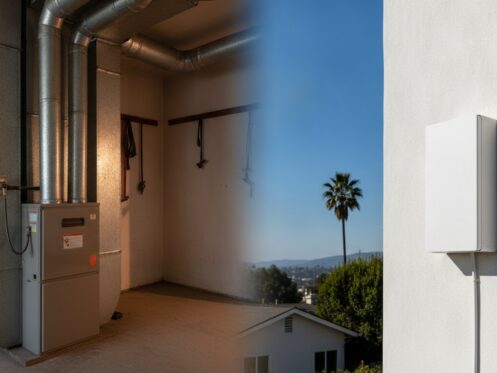
A heat pump can lower heating costs in many Los Angeles homes, but savings are not guaranteed. The California Energy Commission’s 2026 bill modeling found that results depend on climate zone, utility rates, and which upgrades are combined, and that some scenarios raise bills.
In most of the LA basin, mild winters and long cooling seasons favor heat pumps, especially when the existing air conditioner also needs replacing. Whether your home saves money depends on your electric and gas tariffs, duct condition, system sizing, insulation, and solar. Check those before you choose equipment.
Key takeaways
- A heat pump heats and cools with one system by moving heat, while a gas furnace burns fuel and only heats.
- CEC modeling across all 16 California climate zones found savings vary, with the best results where cooling loads are high and electricity rates have low per-kWh charges.
- LADWP lists heat pump HVAC rebates up to $2,500 per ton, tiered by SEER2 and HSPF2, and requires a final approved permit.
- Duct leakage, poor airflow, and oversizing can erase much of the efficiency you pay for.
- A gas furnace can still make sense in some homes, for example when the electrical panel can’t support a heat pump without costly upgrades.
How a heat pump and a gas furnace differ
A heat pump moves heat instead of making it. In winter it pulls heat from outdoor air and moves it inside; in summer it reverses and works as an air conditioner. A gas furnace burns natural gas to heat a heat exchanger and needs a separate air conditioner for cooling.
| Heat pump | Gas furnace | |
|---|---|---|
| How it heats | Moves heat from outdoor air using refrigerant | Burns natural gas |
| Cooling | Built in | Needs a separate air conditioner |
| Fuel bill | Electricity only | Gas for heat, electricity for cooling and the blower |
| Combustion and venting | None | Flue venting and heat exchanger checks for carbon monoxide safety |
| Efficiency rating | SEER2 for cooling, HSPF2 for heating | AFUE for heating |
| What to verify before buying | Panel capacity, duct airflow, sizing, condensate | Gas line, venting, clearances, and the AC it pairs with |
What the California Energy Commission’s 2026 modeling shows
In June 2026 the CEC published a residential energy bill impact analysis that modeled heat pumps, heat pump water heaters, and weatherization in existing homes across all 16 climate zones. It used utility rates through December 2024 for LADWP, Southern California Edison, SoCalGas, and other utilities, and focused on low-income qualified rates.
- Every climate zone had at least some retrofit combinations and rates that lowered bills.
- The largest savings came from cooling efficiency gains in high-cooling-load climate zones.
- Low savings, and in some cases higher bills, showed up in zones with low cooling loads and high heating loads.
- Electricity rates with low per-kWh charges were the most favorable for electrification.
- Switching from a gas furnace or gas water heater to a heat pump was the most effective step for cutting greenhouse gas emissions in every zone.
The takeaway for a Los Angeles homeowner is that the model points in a favorable direction for much of the region, but it is not a promise for your house. Your rates, your ducts, and your existing equipment decide the result.
Los Angeles specifics
Which utility serves you matters
Homes in the City of Los Angeles generally buy electricity from LADWP. Many South Bay and surrounding cities, including Torrance, Hermosa Beach, Redondo Beach, and Manhattan Beach, are served by Southern California Edison. SoCalGas provides natural gas across most of the region. Rates and rebates differ by utility, so a savings estimate built on the wrong tariff is wrong from the start.
LADWP heat pump rebates, checked October 24, 2026
LADWP’s Consumer Rebate Program lists heat pump HVAC rebates of up to $2,500 per ton for equipment purchased and installed on or after November 1, 2025. The minimum is 15.2 SEER2 and 7.7 HSPF2.
| System type | Rebate range per ton | Paperwork LADWP requires |
|---|---|---|
| Central ducted, split, or packaged heat pump | $1,000 to $1,250, by SEER2 and HSPF2 tier | Paid itemized invoice, matching AHRI certificate, final approved building and safety permit |
| Ductless mini-split or multi-split heat pump | $1,500 to $2,500, by SEER2 and HSPF2 tier | Same as above |
LADWP also notes that new construction and ADUs are not eligible, that you apply after purchase and installation within 12 months, and that funding is limited and first come, first served. Rebates change, so confirm on the live page before you sign. Our LADWP heat pump rebate page covers the details.
The 2025 Energy Code is now in effect
The 2025 California Energy Code took effect January 1, 2026. When a replacement requires field verification and diagnostic testing, it now runs through the Energy Code Compliance (ECC) Program, which replaced the HERS compliance function. Projects permitted under older code cycles may still show HERS terminology.
How much does a heat pump cost in Los Angeles?
A whole-home heat pump averages $15,393 installed before incentives nationally, according to EnergySage’s heat pump cost data (updated March 19, 2026). Typical whole-home setups in that data range from roughly $8,000 in New Mexico to $33,000 in New York, and a Los Angeles quote can land anywhere in that span depending on how much work the house needs.
The same EnergySage guide notes that most homes need about 2 to 5 tons of capacity. These are the items that move a Los Angeles quote up or down:
| Cost driver | Why it changes the price | What to check first |
|---|---|---|
| Tonnage (system size) | Larger capacity costs more, and an oversized system costs more to run | A Manual J load calculation, not the old unit’s size |
| Ducted vs. ductless | Multi-zone ductless setups often cost more than a single ducted system | Condition of existing ducts and the number of zones needed |
| Electrical panel upgrade | Some older homes need panel or circuit work before a heat pump can be installed | Panel capacity and breaker space |
| Duct repairs | Sealing or modifying ducts adds labor and materials | A duct leakage test |
| Permits | Permitting costs vary by city, and LADWP pays its rebate only with a final approved permit | That the permit is pulled and closed out |
Rebates and tax credits that change the net cost
For LADWP electric customers, the rebate is figured per ton. A 3-ton ducted system at the entry tier works out to $3,000 (3 tons x $1,000), and a ductless system at the top tier (above 20.5 SEER2 and 9.1 HSPF2) earns $2,500 per ton. A final approved building and safety permit is required. The LADWP rebate does not apply to homes whose electricity comes from Southern California Edison.
The federal Energy Efficient Home Improvement Credit (Section 25C), which allowed up to $2,000 a year for qualifying heat pumps, covered only property placed in service through December 31, 2025, according to the IRS. A heat pump installed in 2026 does not qualify for it.
What can change the answer?
- Your tariff. Electric and gas rates, time-of-use plans, and tiers can swing the result either way.
- Your climate zone. Coastal homes need little heating; inland valley homes need more heating and more cooling.
- Your existing AC. If it also needs replacing, a heat pump replaces two pieces of equipment with one.
- Your ducts. Leaky, crushed, or undersized ducts waste the efficiency a new system is rated for.
- Sizing. An oversized system short-cycles; an undersized one runs constantly. Size should come from a Manual J load calculation, not the old unit’s tonnage.
- Insulation and air sealing. A leaky attic raises the load on any system.
- Solar. Rooftop solar can change the cost of running electric equipment, depending on your solar billing plan.
- Electrical capacity. Some older homes need panel or circuit upgrades before a heat pump can be installed.
When a gas furnace may still make sense
A furnace replacement can be the practical choice when the electrical panel can’t support a heat pump without major upgrades, when the existing air conditioner is newer and in good condition, or when the home’s gas and venting are sound and the budget can’t cover a full system. A dual-fuel setup, which pairs a heat pump with a gas furnace for the coldest hours, is another option in some inland homes. In each case, the furnace’s heat exchanger, venting, and combustion safety should be checked as part of the decision.
How long does a heat pump last?
An air-source heat pump typically lasts about 15 years. Utility efficiency programs assign air-source heat pumps a 15-year effective useful life, a figure from California’s DEER database, and assign gas furnaces 22 years, a DOE figure, in the New York Joint Utilities’ effective useful life table. EnergySage describes 10 to 15 years as the generally accepted range, with some experts expecting 20 to 25 years from a properly installed and maintained system.
| Equipment | Effective useful life | Where the figure comes from |
|---|---|---|
| Air-source heat pump | 15 years | California DEER, as listed by the New York Joint Utilities |
| Gas furnace | 22 years | U.S. Department of Energy, as listed by the New York Joint Utilities |
A heat pump runs for both heating and cooling, so it logs more hours each year than a furnace that only heats. That is part of why its expected life is shorter.
Salt air and South Bay homes
Homes near the coast in Hermosa Beach, Redondo Beach, and Manhattan Beach expose the outdoor unit to salt air, which corrodes coil fins, fasteners, and cabinets faster than inland air does. Ask about corrosion-resistant coil coatings, place the outdoor unit away from direct ocean spray where you can, and rinse the outdoor coil with fresh water as the manufacturer directs.
Maintenance
The U.S. Department of Energy says the energy use of a well-maintained heat pump and a severely neglected one can differ by 10% to 25%, and it recommends professional service at least once a year. Between visits, clean or replace filters, keep the outdoor unit clear of plants and debris, and have refrigerant charge and airflow checked when performance drops.
What to inspect before you replace anything
Most comparison articles stop at the equipment. Here is what we check, because these items decide whether the new system performs the way it was sold.
- Duct leakage, disconnections, and insulation, especially in older attics
- Return air size and static pressure, since heat pumps often need more airflow
- Electrical panel and circuit capacity for the new equipment
- Existing equipment age, condition, and refrigerant type
- Condensate drainage and outdoor unit placement
- Furnace heat exchanger and venting, if you are keeping gas heat
- Permit history for the existing system, which affects rebates and resale
Rated SEER2 and HSPF2 numbers come from lab conditions. Field performance depends on installation, airflow, and refrigerant charge, which is why we look at the whole system, not one rating.
Frequently asked questions
Does a heat pump make sense in Southern California?
Often yes. Mild winters and long cooling seasons suit heat pumps, and the CEC’s modeling found the strongest savings where cooling loads are high. It still depends on your rates, ducts, and existing equipment.
Are heat pumps more efficient than gas heating?
A heat pump moves heat rather than burning fuel, so it can deliver more heat energy than the electricity it uses. Whether that means a lower bill depends on what you pay for electricity compared with gas.
Why is my electric bill higher after installing a heat pump?
Your gas bill should drop while your electric bill rises, because heating moved from gas to electricity. If the total went up, common causes are leaky ducts, poor airflow, oversizing, thermostat settings, or a rate plan that doesn’t fit your usage.
How much is the LADWP heat pump rebate?
As of October 24, 2026, LADWP lists up to $2,500 per ton, with ducted systems at $1,000 to $1,250 per ton and ductless systems at $1,500 to $2,500 per ton depending on efficiency tier. A final approved permit is required.
Can I keep my existing ducts with a heat pump?
Often, but they need to be tested first. Heat pumps typically need adequate airflow, so undersized returns or leaky ducts should be corrected before or during the installation.
Sources
- California Energy Commission: Low-Income Residential Energy Bill Impact Analysis (CEC-300-2026-003, June 2026)
- LADWP Consumer Rebate Program (checked October 24, 2026)
- EnergySage: How much does a heat pump cost in 2026? (updated March 19, 2026; checked October 24, 2026)
- IRS: Energy Efficient Home Improvement Credit (checked October 24, 2026)
- New York Joint Utilities: Appendix P, Effective Useful Life (December 2019)
- EnergySage: How long do heat pumps last?
- U.S. Department of Energy: Operating and Maintaining Your Heat Pump
- California Energy Commission: Energy Code Compliance Program
- California Energy Commission: 2025 Building Energy Efficiency Standards
Check the house before you choose the equipment
An inspection separates equipment problems from duct, airflow, and sizing problems, so you replace the right thing. $595 per system, with photos and a written report.