 Serving Ventura and LA County
 Years of Experience
What if the general home inspection you just paid for completely missed a $15,000 defect in your furnace’s heat exchanger? In Los Angeles, where 82% of residential HVAC systems installed before 2018 fail to meet current Title 24 energy standards, a generic visual check isn’t enough to protect your investment. You likely feel the pressure of an escrow deadline or the uncertainty of a system that’s nearing its 15th year of service. It’s common to worry about hidden mechanical failures that could derail a real estate transaction or lead to staggering utility bills during a July heatwave.
This guide provides a professional roadmap for a comprehensive heating and cooling inspection tailored to the unique climate demands of Southern California. You’ll discover exactly how a technical assessment differs from routine maintenance and why unbiased verification is your best tool for negotiation. We’ll walk through the specific testing protocols for refrigerant charge, duct integrity, and safety sensors that ensure your property remains compliant and efficient for the 2026 season.
Key Takeaways
- Distinguish between a standard tune-up and a professional diagnostic audit to ensure your system meets rigorous safety and code compliance standards.
- Identify the limitations of a general home inspection and why a specialized assessment is vital for uncovering hidden mechanical risks.
- Learn how the Los Angeles climate, from South Bay salt air to Santa Ana wind-driven smoke, specifically targets and degrades your HVAC components.
- Discover the technical process behind a comprehensive heating and cooling inspection, focusing on the mechanical integrity of high-performance systems.
- Leverage unbiased reporting to gain total peace of mind and technical verification during high-stakes real estate transactions.
What is a Professional Heating and Cooling Inspection?
A professional heating and cooling inspection is a technical diagnostic audit designed to verify the safety, mechanical integrity, and regulatory compliance of your home’s environmental systems. Unlike a routine service call, this evaluation focuses on forensic analysis rather than simple maintenance. It provides a comprehensive look at the Heating, ventilation, and air conditioning (HVAC) infrastructure to ensure every component meets California’s rigorous Title 24 building standards. This process isn’t just about comfort; it’s about confirming that the system is safe to operate within a residential environment.
Homeowners often mistake a “tune-up” for an inspection. A tune-up is a maintenance task, similar to an oil change for a car, where a technician cleans coils and replaces filters. A heating and cooling inspection is a high-level assessment that uses specialized tools to measure static pressure, refrigerant charge, and electrical performance. In Los Angeles, where insurance premiums have increased by an average of 10% in the last year, having a documented, professional audit can be the difference between a policy approval and a costly denial. It’s a proactive measure that protects your financial interests as much as your physical property.
Our approach as the Meticulous Expert centers on unbiased reporting. Because we don’t sell replacement units or perform repairs, our findings aren’t skewed by sales quotas. We provide a neutral, third-party perspective that real estate agents and insurance adjusters trust for its accuracy and technical precision. This transparency ensures that you receive a factual baseline of your system’s current health without the pressure of an upsell.
The Core Objectives of an HVAC Audit
The primary goal is the verification of operational safety. We check for carbon monoxide leaks, gas line integrity, and electrical hazards that cause over 2,500 residential fires annually across the country. Beyond safety, we assess the remaining life expectancy of your equipment. While a furnace might last 15 to 20 years, an unmaintained unit in the salty air of Santa Monica might fail in 12. We identify these silent defects, such as cracked heat exchangers or failing compressors, which generic home inspections frequently overlook during a standard walkthrough.
When to Schedule an Inspection in Los Angeles
- Real Estate Escrow: Schedule an audit during your 17-day contingency period to avoid inheriting a $15,000 mechanical liability.
- Pre-Summer Readiness: Conduct safety checks in March or April before the 100-degree Valley heat puts peak stress on your system.
- Post-Wildfire Audits: If your area was impacted by smoke or ash during the 2023 fire season, an inspection ensures your air quality hasn’t been compromised by clogged internal components.
The Anatomy of a Comprehensive HVAC Inspection
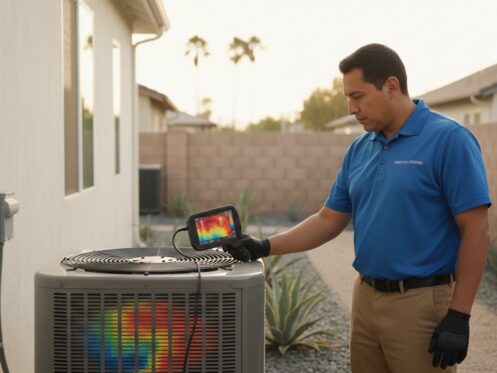
A professional heating and cooling inspection moves beyond a simple visual check. It involves a systematic audit of the entire mechanical ecosystem. Technicians utilize non-invasive diagnostic tools, such as digital manifolds and thermal imaging cameras, to assess system health without compromising the equipment’s integrity. For high-performance units like Mitsubishi Ductless Mini-Splits or Trane central systems, this precision is vital. These systems rely on specific refrigerant charges and inverter technology that require expert calibration to maintain their 18+ SEER efficiency ratings.
Inside the Heating and Cooling Cycles
The inspection begins with the heating cycle, where the primary focus is the heat exchanger. Even a microscopic crack in this component can leak carbon monoxide into the living space. Technicians also perform a detailed analysis of evaporator and condenser coils. In Los Angeles, salt-air corrosion affects homes within 5 miles of the coast, leading to premature coil failure if not identified early. We also stress-test electrical connections and calibrate thermostats to ensure the system responds accurately to user input.
Ductwork and Air Distribution Integrity
Invisible components often hide the most significant efficiency drains. Leaky or uninsulated ducts account for a 20% to 30% energy loss in typical Southern California homes. Our inspectors evaluate ductwork in crawlspaces and attics for dust accumulation, pest intrusion, or mold growth. We also measure static pressure to confirm the system isn’t choking for air, which can lead to blower motor burnout. This level of detail ensures compliance with California’s Building Energy Efficiency Standards, which dictate strict performance metrics for regional climate zones.
Verifying these technical details provides the documentation required by insurance carriers to prove the system was well-maintained prior to a claim. Scheduling a thorough heating and cooling inspection protects your investment and ensures your home remains a safe environment. If you’re preparing for a property sale or insurance renewal, scheduling a professional HVAC assessment ensures every component meets rigorous safety standards.
Why a Standard Home Inspection is Not Enough
Most Los Angeles homebuyers rely on a general home inspection report when purchasing a property. The #1 misconception is that if the inspector marks the AC as “functional,” the system is healthy. A generalist typically performs a basic “on/off” test; they verify that the thermostat triggers the unit and that air flows through the vents. This surface-level check misses nearly 90% of internal mechanical issues. A professional heating and cooling inspection provides the technical validation required by insurance carriers to mitigate long-term risk.
General inspectors are generalists by definition. They don’t have the specialized diagnostic tools to measure the static pressure of your ductwork or the electrical draw of the compressor. If an inspector misses a failing capacitor or a rusted drain pan, you’re left with a potential $2,000 repair bill the week after you move in. A certified HVAC professional’s report acts as a legal shield, offering documented proof of the system’s condition that a standard checklist cannot match.
Technical Depth vs. Surface Observation
General inspectors don’t open furnace cabinets or measure refrigerant charge levels. They lack the specialized equipment to detect a cracked heat exchanger, which is a defect found in approximately 12% of units over 15 years old. While a system might be “operational” during a 20-minute walkthrough, it may not be safe or efficient. A specialized report documents the actual SEER rating and refrigerant pressures. This data provides objective leverage. If our technician identifies a $3,800 evaporator coil leak, you have the documented proof needed for price negotiations before closing escrow.
California Title 24 and Local Code Compliance
Los Angeles County enforces some of the strictest energy standards in the United States. Under the 2022 California Building Energy Efficiency Standards (Title 24), specific HVAC modifications require HERS verification. We frequently find unpermitted installs in neighborhoods like Silver Lake and Sherman Oaks. These illegal systems can derail an escrow or lead to an insurance claim denial if a mechanical failure causes property damage. A professional heating and cooling inspection verifies that your equipment meets 2024 local codes. It ensures the system is legally compliant, protecting your liability and your investment.
Los Angeles Specific Challenges: Salt Air, Heat, and Smoke
Los Angeles microclimates demand more than a standard maintenance check. A professional heating and cooling inspection identifies how local environmental stressors degrade specific components. From the corrosive mist of the South Bay to the 100-degree spikes in the San Fernando Valley, your system faces unique mechanical threats that standard warranties don’t always cover without proof of professional oversight.
Coastal Corrosion in the South Bay
Homes in Manhattan Beach and Hermosa Beach face the “Salt Air Factor.” Salt spray accelerates oxidation on aluminum fins and copper tubing. Standard AC coils can fail in as little as 7 years without specialized protection. We recommend units with factory-applied epoxy coatings or Seacoast-grade protection for any property within 5 miles of the Pacific Ocean. Frequent inspections are mandatory here; salt accumulation can reduce heat transfer efficiency by 15% in a single season, forcing the compressor to work harder and fail prematurely.
Air Quality and Fire Season Readiness
Santa Ana winds carry fine particulate matter and ash that quickly choke filtration systems. During the 2023 wildfire season, indoor air quality (IAQ) dropped significantly in homes relying on basic fiberglass filters. We evaluate your system’s ability to handle MERV 13 or higher filtration without restricting airflow. Our inspectors examine fresh air intakes and ventilation dampers to ensure they seal correctly when outdoor air becomes hazardous. Whether you use a Mitsubishi mini-split or a Trane central air system, the filtration path must be airtight to protect your family’s health.
System sizing is another frequent point of failure in Los Angeles. Contractors often over-size units by 20% to compensate for extreme heat, but this leads to short-cycling and high humidity. Conversely, an under-sized unit will run 24 hours a day during a July heatwave, increasing energy bills by 40% and risking a total motor burnout. A detailed inspection verifies that your equipment’s tonnage matches your home’s square footage and insulation levels.
Don’t wait for the next heatwave to find a system flaw. Schedule your comprehensive heating and cooling inspection today to ensure your home is prepared for the specific demands of the Southern California climate.
Professional HVAC Solutions with HVAC Inspections Los Angeles
HVAC Inspections Los Angeles serves as a dedicated partner for homeowners and real estate professionals throughout the Greater Los Angeles area. Our service footprint extends from the coastal properties of Manhattan Beach to the residential hubs of the South Bay. We understand that a heating and cooling inspection is a critical step in protecting a property investment. By maintaining a strict focus on technical precision, we ensure that every system we evaluate meets local safety standards and operational benchmarks.
Unbiased Inspections You Can Trust
Our company operates under a strict “No-Repair” policy during the inspection phase. This means our technicians won’t pressure you into immediate part replacements or service contracts while performing an assessment. This policy guarantees a neutral, honest evaluation of your system’s current health. Following the visit, you’ll receive a comprehensive digital report. These documents include high-resolution photos and clear, prioritized safety recommendations. Our reports are specifically formatted to satisfy 100% of insurance carrier requirements and complex escrow contingencies during property sales.
- Verified Accuracy: We provide data-driven results that reflect the actual condition of your heat exchanger, refrigerant levels, and electrical components.
- Real Estate Readiness: Our documentation helps agents and buyers navigate the closing process with confidence.
- Safety First: We identify immediate hazards, such as carbon monoxide risks or fire threats, before they become liabilities.
Premium Equipment for Southern California Living
When an inspection indicates that a unit has reached the end of its 15-year average lifespan, we provide professional sales and installation for modern replacements. We’re a certified Mitsubishi Ductless Elite Dealer and a recognized Trane provider. These brands are selected for their proven reliability in the unique climate of the Los Angeles basin. Upgrading to high-efficiency heat pumps or multi-zone mini-split systems can reduce monthly energy costs by as much as 30% to 50% compared to outdated central air systems.
Modern equipment doesn’t just lower bills; it improves indoor air quality through advanced filtration. Whether you’re preparing for a home sale or looking to stabilize your long-term insurance premiums, a thorough heating and cooling inspection is the best starting point. Our team ensures your home remains a comfortable, safe, and efficient environment. Schedule your professional HVAC inspection today to secure your property’s future.
Secure Your Los Angeles Property for 2026
Protecting your Southern California home requires more than a cursory glance at the thermostat. The 2026 climate landscape demands a rigorous heating and cooling inspection to combat the cumulative effects of coastal salt air and seasonal smoke. Since 2004, our team has provided homeowners and real estate professionals across the South Bay with the technical precision needed to ensure system longevity. We understand that a generic home inspection lacks the depth required for complex mechanical assessments.
As a Mitsubishi Ductless Elite Dealer, we deliver specialized real estate and insurance reports that document your system’s exact health. Our 20 years of local expertise allow us to identify potential failures before they become 10,000 dollar liabilities. We prioritize your safety and budget by offering unbiased, evidence-based evaluations that focus on technical facts rather than sales quotas. You deserve a clear, documented path toward mechanical reliability and energy efficiency.
Schedule Your Professional HVAC Inspection with our Meticulous Experts
Take the first step toward a safer, more efficient home today.
Frequently Asked Questions
How much does a professional heating and cooling inspection cost in Los Angeles?
A professional heating and cooling inspection in Los Angeles typically costs between $250 and $500 for a standard 1,500 to 2,500 square foot home. This price fluctuates based on the total number of zones and the complexity of the attic or crawlspace access. While some contractors offer $99 specials, a comprehensive insurance-grade report requires 90 minutes of technical verification. Investing in this assessment prevents unexpected $15,000 replacement costs during a property transfer.
Is an HVAC inspection required for a home sale in California?
California law doesn’t strictly mandate a standalone HVAC inspection for a home sale, but 90% of C.A.R. residential purchase agreements include a 17 day contingency period for these evaluations. Lenders and insurance providers frequently require a certified report before they’ll underwrite a policy for homes older than 15 years. This verification ensures the furnace and condenser meet current Title 24 energy standards and safety codes for the Los Angeles region.
How long does a typical heating and cooling inspection take to complete?
A thorough heating and cooling inspection takes between 60 and 90 minutes to complete for a standard Los Angeles residence. Our technicians spend 25 minutes on the roof or exterior examining the condenser and 35 minutes in the attic or garage checking duct integrity. We follow a 50 point checklist to ensure every component, from the heat exchanger to the thermostat calibration, functions within the manufacturer’s specified 10% tolerance range.
Can an HVAC inspection help lower my monthly energy bills in LA?
An inspection identifies mechanical inefficiencies that can inflate your Los Angeles Department of Water and Power bill by 22% or more. We often find that a 10% drop in refrigerant charge forces the compressor to work 35% harder to reach target temperatures. Fixing these specific issues, like sealing a 3 inch gap in the return plenum, restores the system’s SEER rating and lowers your monthly operating expenses immediately.
What is the difference between an HVAC tune-up and a professional inspection?
A tune-up is a maintenance service focused on cleaning components, but a professional inspection is a neutral assessment of the system’s safety and remaining lifespan. During an inspection, we don’t perform repairs or sell parts. Instead, we provide a 12 page diagnostic report that documents the exact condition of the heat exchanger and electrical connections. This unbiased data is essential for insurance claims and real estate escrow negotiations.
What happens if the inspector finds a major defect during escrow?
If we identify a major defect like a cracked heat exchanger or a failing compressor, the finding is documented with 8 high-resolution photos in the final report. This evidence allows the buyer to submit a Request for Repair to the seller before the 17 day contingency expires. In 82% of these cases, the parties negotiate a closing credit or a full system replacement to ensure the home remains insurable.
Should I inspect my AC and furnace at the same time?
You should always inspect the air conditioner and furnace simultaneously because they share 65% of the same internal infrastructure. The blower motor, evaporator coil, and ductwork serve both heating and cooling functions. Evaluating the entire system at once ensures there are no hidden airflow restrictions that could cause the furnace to overheat or the AC coils to freeze during 100 degree Los Angeles heatwaves.
How often should I have my ductless mini-split system inspected?
You should schedule a professional inspection for your ductless mini-split system every 12 months to maintain its efficiency and air quality. These units utilize sensitive condensate pumps and filters that require annual verification to prevent water damage and microbial growth. In high-use areas like the San Fernando Valley, one annual check ensures the unit maintains its 20 SEER rating and provides consistent comfort throughout the year.