
 Serving Ventura and LA County
 Years of Experience

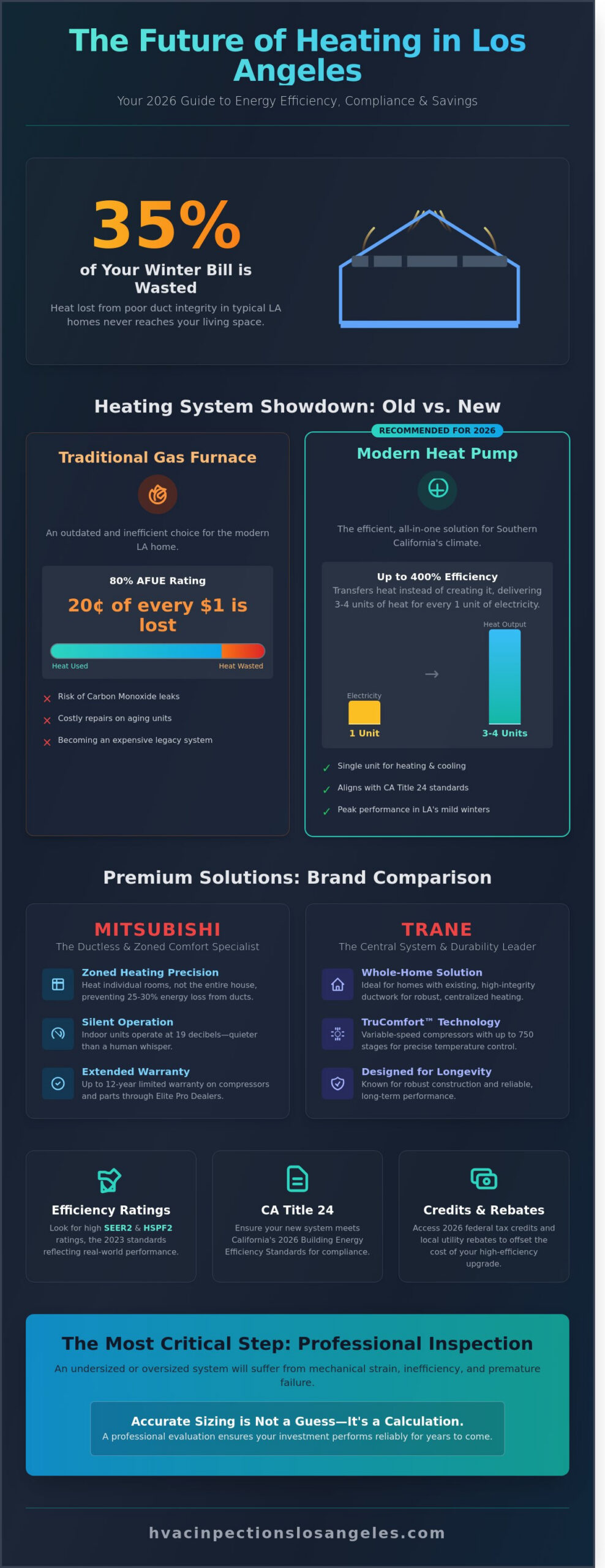
Did you know that 35% of the average Los Angeles homeowner’s winter utility bill is wasted on heat that never reaches the living space due to poor duct integrity? It’s a common frustration for residents in neighborhoods like Pasadena or Silver Lake, where older architectural styles often lead to uneven temperatures between floors. You probably expect your energy costs to rise as soon as the thermometer dips below 55 degrees, but this financial strain isn’t a mandatory part of homeownership. Finding a solution that is truly heating energy efficient requires looking beyond the marketing stickers and into the actual mechanical specs of your system.
Our 2026 comparison guide is designed to help you transition to a system that balances technical performance with local regulatory compliance. Efficiency is about precision. We’ll show you exactly how to achieve lower monthly bills and quiet, reliable operation by aligning your home with California’s Title 24 energy standards. This analysis explores the critical mechanical differences between modern heat pumps and high-efficiency furnaces, providing the unbiased data you need to make an informed investment for your property.
Key Takeaways
- Discover how to select a heating energy efficient system that complies with 2026 California standards while addressing the specific temperature fluctuations of the Los Angeles basin.
- Evaluate the technical differences between Mitsubishi and Trane heat pumps to determine which premium solution provides the highest reliability for South Bay winters.
- Identify how localized issues like duct integrity in older Los Angeles homes can impact system performance and why ductless mini-splits may offer a more efficient alternative.
- Learn why a professional HVAC evaluation is essential for ensuring your new system is accurately sized to prevent mechanical strain and premature failure.
- Gain a clear roadmap for accessing 2026 federal tax credits and local utility rebates to offset the cost of upgrading to a high-efficiency heating solution.
Defining Energy Efficient Heating for the Los Angeles Climate
In Los Angeles, heating energy efficient standards don’t mirror the sub-zero requirements of the Northeast. Our local climate demands systems that handle moderate temperature swings without cycling on and off excessively, which wastes power. By 2026, the shift toward residential electrification has moved from a recommendation to a regulatory framework under California’s Title 24 Building Energy Efficiency Standards. These regulations mandate specific performance thresholds for new installations and major retrofits to reduce the state’s carbon footprint. When you review your monthly LADWP or SoCal Edison bill, the impact of these standards is visible through SEER2 and HSPF2 ratings. These metrics represent the updated 2023 testing protocols that provide a more accurate reflection of how equipment performs under actual field conditions. Higher ratings mean your equipment extracts more comfort from every kilowatt of electricity used, directly lowering your operational costs.
Why Traditional Furnaces are Losing Ground in LA
Standard gas furnaces in coastal neighborhoods like Hermosa Beach are frequently oversized for the actual load of the home. A typical 80% AFUE furnace loses 20 cents of every dollar spent on gas through the flue pipe. Maintaining an aging unit with a compromised heat exchanger often costs 40% of the price of a full system replacement, making repair a poor financial decision. As California pushes toward net-zero emissions, the infrastructure for residential gas is becoming an expensive legacy system. Modern homeowners are finding that the heating energy efficient gains of electric systems far outweigh the familiarity of gas combustion. Safety is also a primary driver, as eliminating gas lines removes the risk of carbon monoxide leaks within the living space.
The Rise of the Heat Pump in Southern California
Heat pumps have become the primary recommendation for Southern California homeowners because they provide comprehensive climate control from a single, compact unit. A heat pump is a system that transfers existing thermal energy from one location to another rather than generating heat through combustion or electrical resistance. Because LA winter temperatures rarely drop below 40 degrees, energy-efficient heat pump technology operates at peak performance throughout the season. These systems can reach efficiency levels of 300% to 400%, meaning they deliver three to four units of heat for every unit of electricity consumed. This makes them the most logical choice for the 2026 market, providing a seamless transition between cooling in the afternoon and heating in the evening with a single set of components.
Comparing Premium Solutions: Mitsubishi vs. Trane
Selecting a heating energy efficient system for a Los Angeles home requires a choice between two distinct engineering philosophies. Mitsubishi specializes in decentralized, ductless technology that offers surgical precision. Trane leads in robust, centralized forced-air systems designed for longevity. While both brands meet 2026 California energy standards, their mechanical execution differs significantly. According to the Department of Energy on Heat Pumps, these systems can reduce electricity use for heating by approximately 50% compared to traditional electric furnaces, making both brands high-performance choices for the South Bay climate.
Mitsubishi Ductless: Precision Efficiency
Mitsubishi Electric is the benchmark for zoned comfort. Their Hyper-Heating INVERTER® technology provides 100% heating capacity down to 5°F, which far exceeds the needs of a typical 45°F January night in Torrance or Santa Monica. This surplus power ensures the system never overworks, extending the mechanical lifespan. Working with an Elite Pro Dealer is vital; it extends the standard 5-year parts warranty to a 12-year limited warranty on the compressor and parts.
- Zoned Heating: You only heat the 400 square feet you’re currently occupying rather than the entire 2,500 square foot floor plan.
- Silent Operation: Indoor units operate at 19 decibels, which is quieter than a human whisper and ideal for dense LA neighborhoods.
- Energy Savings: Eliminating ductwork prevents the 25% to 30% energy loss typically caused by leaks in older attic installations.
Trane Central Systems: Robust Performance
Trane is the preferred choice for homeowners with existing, high-integrity ductwork who want a whole-home solution. The Trane XV20i features TruComfort™ technology, which uses a variable-speed compressor with 750 stages of operation. This prevents the energy-wasting “cycling” common in older single-stage units. Instead of a 100% on or off approach, the system runs at the exact speed needed to maintain a consistent temperature within 0.5 degrees of the thermostat setting.
For older homes in Pasadena or the Hollywood Hills, integrating a high-efficiency Trane furnace with a heat pump creates a dual-fuel system. This provides a heating energy efficient backup for rare cold snaps while relying on the electric heat pump for 95% of the season. Homeowners planning a sale should ensure their HVAC inspection report reflects these modern upgrades to maximize property value. Trane systems are tested for 2,600 hours of continuous operation in extreme conditions, ensuring they survive the salt air of coastal Los Angeles for 15 to 20 years with proper maintenance.
Ductless Mini-Splits vs. Central Heat Pumps: Which is More Efficient?
Deciding between a central heat pump and a ductless mini-split often depends on the existing infrastructure of your Los Angeles property. Central heat pumps utilize a singular air handler to distribute air through a network of ducts. This is usually the most cost-effective path for homes with healthy, existing ductwork. However, ductless mini-splits offer a localized approach that eliminates the thermal loss associated with air transit. For a 2,000 square foot home, the installation of a multi-zone mini-split system can cost 25% to 45% more than a standard central upgrade, yet it provides the highest level of heating energy efficient performance by allowing room-by-room control.
Maintenance is the deciding factor for long-term performance. Central systems require professional duct cleaning every 3 to 5 years to prevent airflow resistance. Mini-splits require homeowners to rinse filters every 30 days to prevent debris from choking the indoor blowers. Both systems need a professional technician to verify the refrigerant charge and electrical connections annually. Neglecting these tasks can drop a system’s efficiency by 15% within a single season.
The True Cost of Ductwork Inefficiency
Data from the Department of Energy shows that leaky or poorly insulated ducts waste up to 30% of heating energy before it reaches your living space. In older Los Angeles neighborhoods where 40-year-old ducts are common, these invisible leaks act as a constant drain on your utility bills. A professional duct integrity test identifies if your system is bleeding heat into the attic or crawlspace. If repair costs for a 1980s-era duct system exceed $3,500, transitioning to a ductless configuration is often the more logical investment for heating energy efficient operation.
Aesthetics and Architecture in LA Homes
Preserving the visual integrity of a 1920s Spanish Colonial or a Mid-Century Modern gem is a technical challenge. In compact beach cities like Manhattan Beach, where floor space is at a premium, ductless systems remove the need for bulky bulkheads or dropped ceilings. Mitsubishi offers versatile hardware like slim-duct units, floor-mounted consoles, or recessed ceiling cassettes that sit flush with the ceiling. These options ensure your HVAC solution remains discreet. You can maintain the historical character of a Craftsman home without sacrificing modern climate control or technical precision.
The Critical Role of Professional HVAC Inspections
Investing in a heating energy efficient system provides no guarantee of lower utility bills if the equipment is incorrectly sized for your home’s specific square footage. An oversized unit causes short-cycling, a process where the system turns on and off rapidly. This inefficiency increases energy consumption by 15% and typically shortens the mechanical lifespan of the blower motor by 3.5 years. A professional evaluation ensures that the BTU output matches your home’s thermal envelope, preventing the wasted wattage that plagues many Los Angeles households.
A general home inspector typically verifies that the furnace ignites and produces heat. In contrast, a specialized HVAC evaluation measures technical metrics like static pressure, gas manifold settings, and ductwork integrity. These details are vital for performance. We often identify cracked heat exchangers, a defect found in roughly 8% of systems over 15 years old in the Los Angeles basin. These microscopic fractures allow carbon monoxide to bypass the exhaust and enter your living space, turning a heating energy efficient goal into a serious health risk.
Pre-Purchase Inspections for LA Real Estate
During the standard 10 to 17-day escrow period, verifying the mechanical health of a home is vital for protecting your investment. Los Angeles properties frequently feature “zombie” systems that appear functional but suffer from 25% air leakage in attic ductwork or 90% blocked evaporator coils. An unbiased inspection report provides the data needed to negotiate a $5,000 to $12,000 credit for a full system upgrade before you close the deal.
Compliance and Insurance Inspections
California’s Title 24 standards require specific efficiency benchmarks that directly impact your ability to secure or maintain homeowners insurance in high-risk zones. A certified mechanical assessment ensures your property meets these 2026 energy codes and safety requirements. Because an unbiased inspector has no financial stake in the repair process, they have zero incentive to recommend unnecessary parts or system replacements.
Ensure your home is safe and compliant before you sign the final papers. Schedule your professional HVAC inspection today to verify your system’s performance.
Next Steps: Maximizing Your Heating Efficiency in Los Angeles
Transitioning to a high-performance HVAC system requires more than just picking a model from a brochure. It demands a technical evaluation of your home’s specific thermal envelope. Our meticulous expert approach ensures your investment in a heating energy efficient system translates into actual utility savings. We focus on technical precision, starting with a comprehensive assessment of your current duct integrity and electrical capacity. This data driven process identifies exactly how a new Mitsubishi or Trane unit will perform under the specific load requirements of your property.
Local Rebates and Financial Incentives
The financial landscape for HVAC upgrades in 2026 remains highly favorable for Los Angeles homeowners. Under current federal tax laws, the Energy Efficient Home Improvement Credit provides a 30% tax credit, capped at $2,000 annually, specifically for qualifying heat pump installations. Local utilities like LADWP and Southern California Edison offer additional tiered rebates. These often provide between $100 and $1,500 back depending on the SEER2 and HSPF2 ratings of your new equipment. We help you document the necessary AHRI certificates to ensure your filing is compliant and your return is maximized. New HVAC system financing options are also available to spread the cost of these upgrades over 5 to 10 years, making a heating energy efficient home accessible for families across the South Bay.
Work with a Mitsubishi Ductless Elite Dealer
System longevity in coastal regions like Torrance and Redondo Beach depends heavily on proper calibration for salt air environments. Standard installations often fail prematurely due to corrosion. As a specialist in Greater LA, we ensure your outdoor condensers are treated and positioned to withstand the unique atmospheric conditions of the Pacific coast. Choosing a certified Mitsubishi Ductless Elite Dealer is the only way to secure the full 12-year parts and compressor warranty. This certification guarantees that the technicians handling your refrigerant charge and electrical connections follow strict manufacturer protocols.
Before you sign a contract for a new installation, get an unbiased inspection from HVAC Inspections Los Angeles. We don’t sell equipment, so our reports remain objective and focused entirely on safety and system health. Whether you are in a historic home in San Pedro or a modern build in Redondo Beach, our team provides the factual data you need to make an informed decision. Contact us today to schedule your evaluation and ensure your home is ready for the 2026 season.
Securing Your Home’s Efficiency and Safety for 2026
Selecting the right system for your Los Angeles property requires balancing advanced technology with local climate demands. Whether you opt for the precision of Mitsubishi’s variable-speed compressors or the robust reliability of a Trane central unit, your goal remains a heating energy efficient home that lowers monthly utility costs. Since 2004, we’ve served the South Bay community by providing the unbiased assessments that homeowners and real estate professionals rely on for peace of mind. Our status as a Mitsubishi Ductless Elite Dealer ensures we understand every technical nuance of these premium systems and how they integrate into Southern California architecture.
Don’t leave your system’s performance to chance during a high-stakes real estate transaction or a mandatory insurance renewal. Our specialized inspections focus on mechanical integrity and safety, ensuring your equipment meets strict California building standards. By verifying your refrigerant charge and duct integrity today, you’ll ensure your system operates at peak performance for years to come. Taking this proactive step protects your investment and guarantees a comfortable environment for your family. We’re here to help you navigate these technical choices with confidence and clarity.
Schedule Your Professional HVAC Inspection in Los Angeles Today
Frequently Asked Questions
Is a heat pump efficient enough for a Los Angeles winter?
Yes, a heat pump is exceptionally effective in the Los Angeles climate where winter temperatures rarely drop below 40 degrees. These systems provide a heating energy efficient alternative to traditional furnaces because they move heat rather than generating it. Modern units maintain 100% heating capacity down to 35 degrees, which covers 98% of typical Southern California winter nights. You’ll experience consistent warmth without the carbon footprint of natural gas.
How much can I save on my energy bill by switching to a high-efficiency furnace?
Homeowners typically realize a 15% to 20% reduction in their monthly heating costs after an upgrade. If you replace an older 80% AFUE unit with a 96% AFUE model, you save approximately $120 to $180 annually in a standard 1,800 square foot home. These savings are calculated based on current Southern California Gas Company rates. Over the 15 year lifespan of the unit, the equipment often pays for itself through reduced consumption.
What is the difference between SEER2 and HSPF2 ratings for heating?
SEER2 measures cooling efficiency during the summer, while HSPF2 specifically rates heating performance for heat pumps. As of January 1, 2023, the Department of Energy requires a minimum HSPF2 of 7.5 for new installations in California. A higher HSPF2 number indicates the system uses less electricity to produce the same amount of heat. Choosing a unit with an HSPF2 of 9.0 or higher ensures your home remains comfortable during chilly coastal evenings.
Do I need to replace my ductwork if I buy a new energy-efficient heater?
You don’t always need a full replacement, but a heating energy efficient system requires airtight delivery to function correctly. Statistics show that 30% of conditioned air is lost through leaks in ductwork older than 15 years. We recommend a duct leakage test to ensure your loss is below the 15% threshold required by Title 24 standards. If your ducts are undersized for the new blower motor, they’ll cause static pressure issues and premature motor failure.
Are there specific HVAC regulations for homes in Hermosa Beach or Manhattan Beach?
Yes, coastal cities enforce strict municipal codes regarding noise levels and salt-air corrosion. Manhattan Beach municipal code requires external condensers to stay under 50 decibels at the property line, which often necessitates sound blankets or specific placement. Additionally, units installed within 3,000 feet of the ocean should have Epoxy-coated coils to prevent salt-induced pitting. These regulations ensure your system lasts its full 12 to 15 year life expectancy despite the harsh marine environment.
How often should I have my energy-efficient heating system inspected?
You should schedule a professional inspection once every 12 months, preferably in October before the first cold snap. Annual maintenance reduces the probability of a mid-winter breakdown by 95% and is a mandatory requirement for maintaining most 10 year manufacturer warranties. During a standard 22 point inspection, a technician verifies the heat exchanger’s integrity and clears the condensate lines. This proactive approach prevents small issues from becoming $2,000 repairs.
Can I get an HVAC inspection if I’m currently in escrow on a home in LA?
Yes, we perform specialized escrow inspections that fit within your 10 to 17 day due diligence period. Unlike a general home inspector, we provide a technical evaluation of the heat exchanger, refrigerant levels, and overall system health. Our unbiased reports give buyers a factual basis for negotiating repair credits or replacements before the contingency removal date. This transparency protects your investment and ensures there are no $10,000 surprises after you move in.
What is the average lifespan of a Mitsubishi ductless mini-split in Southern California?
A Mitsubishi ductless system typically lasts between 18 and 22 years when maintained properly. In inland areas like Burbank, these units often reach the 20 year mark due to lower humidity and less salt exposure. However, units located within one mile of the Pacific Ocean may see a 25% reduction in lifespan if they aren’t rinsed regularly. Following a semi-annual filter cleaning schedule is the most effective way to ensure your system reaches its maximum operational age.