 Serving Ventura and LA County
 Years of Experience
Why would a $79 promotional tune-up eventually cost a Santa Monica homeowner $4,200 in unplanned repairs during a 15-day escrow period? It’s a frequent occurrence in the Los Angeles market when a basic maintenance visit is confused with a comprehensive mechanical evaluation. Determining the true hvac inspection cost is vital for navigating the specific demands of Southern California’s climate, from record-breaking San Fernando Valley heat waves to the corrosive salt air of the South Bay.
You understand that a reliable system is essential for property safety and value, yet the price difference between a surface-level check and a certified report can be confusing. This guide provides the real numbers for 2026, ensuring you don’t overpay for a simple seasonal check or under-invest in a critical real estate assessment. We’ll break down the pricing for standard $150 residential visits versus the $325 forensic inspections required for insurance compliance and escrow. This data allows you to verify duct integrity and heat exchanger safety while building an accurate budget for your system’s long-term ROI.
Key Takeaways
- Learn how 2026 labor rates and California regulatory standards determine the current hvac inspection cost for residential systems across Greater Los Angeles.
- Identify the critical variables, such as system age and multi-zone configurations, that dictate the depth of technical expertise required for a thorough evaluation.
- Understand the specific documentation requirements and pricing structures for specialized real estate escrow inspections versus insurance compliance assessments.
- Discover how early detection of minor mechanical issues maximizes SEER2 efficiency and prevents the high costs associated with catastrophic system failure.
- Leverage unbiased, third-party expertise to ensure your HVAC assessment is rooted in technical accuracy rather than sales pressure.
Understanding HVAC Inspection Costs in Los Angeles (2026)
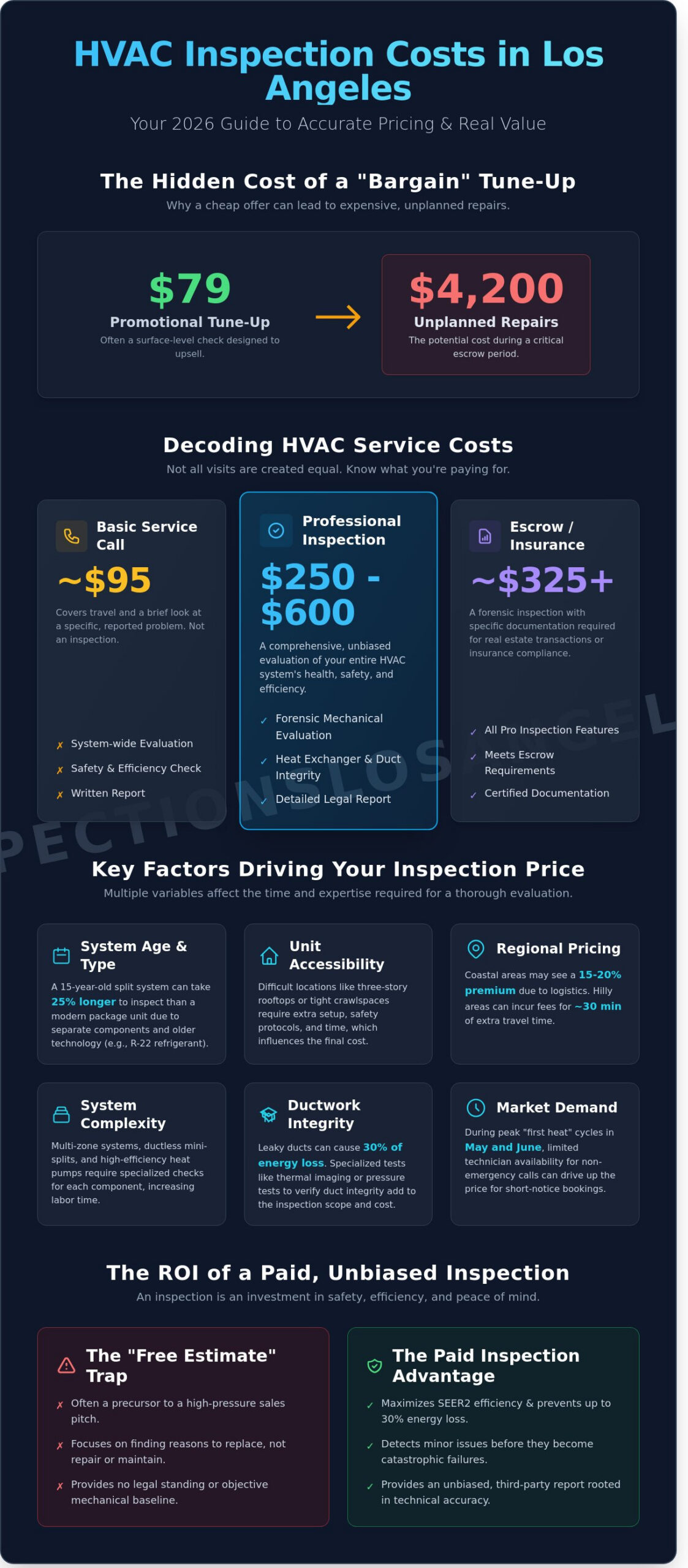
In 2026, the baseline hvac inspection cost in Los Angeles reflects a market shaped by a 14% increase in skilled labor rates since 2024 and strict adherence to updated California Title 24 energy efficiency standards. Homeowners must distinguish between a $95 service call and a professional inspection. A service call typically covers only the technician’s travel and a cursory look at a specific problem. A comprehensive inspection involves a forensic evaluation of the entire system’s mechanical integrity. Technicians now utilize specialized tools like infrared thermal cameras to detect hidden ductwork leaks and digital combustion analyzers to ensure heat exchangers aren’t emitting carbon monoxide. These high-precision instruments ensure safety but contribute to the overall service price.
Los Angeles vs. South Bay: Regional Pricing Variations
Regional geography dictates local pricing. Inspections in Manhattan Beach or Hermosa Beach often include a 15% to 20% premium due to parking constraints and high-density logistics. Properties in the Hollywood Hills or Bel Air may also incur additional travel fees because narrow, winding access roads extend transit times by 30 minutes or more. Market demand also fluctuates during the “first heat” cycles in May and June. During these peak months, limited technician availability can drive up the hvac inspection cost for short-notice bookings as companies prioritize emergency repairs over routine assessments.
The “Free Estimate” Trap vs. Professional Paid Inspections
Many local companies offer “free inspections,” but these are usually diagnostic precursors to a sales pitch. A free visit often focuses on finding reasons to replace a unit rather than maintaining it. In contrast, a paid, neutral third-party inspection provides an unbiased report focused on system longevity and safety. On average, a professional LA inspection cost ranges from $250 to $600 depending on complexity. Paying for this expertise ensures the technician has no financial incentive to recommend unnecessary equipment upgrades. This transparency is vital for real estate transactions where an objective mechanical baseline is required for escrow. A paid report stands as a legal document of the system’s current state, providing peace of mind that a “free estimate” simply cannot offer.
Core Factors That Drive Your HVAC Evaluation Price
Understanding what dictates your final hvac inspection cost requires a look at the physical architecture of your property. Every mechanical system presents a unique set of variables that influence the time and technical expertise required for a thorough assessment. In 2026, the shift toward high-efficiency inverter technology means that a standard visual check is no longer sufficient for a professional grade report.
The age and configuration of your equipment play a primary role in labor requirements. A 15 year old split system, where components are separated between an indoor closet and an outdoor pad, typically takes 25% longer to evaluate than a modern package unit. Technicians must verify the integrity of the refrigerant lines and electrical connections spanning the distance between the two points. If your system was installed before 2015, we dedicate extra time to inspecting the heat exchanger for stress fractures and checking for discontinued R-22 refrigerant leaks.
Technicians also account for the accessibility of the hardware. Climbing onto a three story rooftop in Silver Lake or navigating a cramped crawlspace in a historic Pasadena home involves specific safety protocols. When units are located in difficult environments, the inspection requires additional setup time for ladders or safety harnesses. Specialized testing for duct integrity or refrigerant leak detection can also influence the total hvac inspection cost. Since leaky ducts account for 30% of energy loss in Southern California homes, verifying airflow balance is a critical step for long term savings.
System Complexity: From Furnaces to Ductless Mini-Splits
A standard furnace is relatively straightforward, but evaluating a Mitsubishi ductless system involves checking multiple indoor air handlers and complex communication wiring. Multi-zone heat pump configurations require individual testing for every thermostat and damper to ensure proper communication. Our experts analyze advanced components like variable-speed compressors and electronic expansion valves. It’s vital to ensure these high-tech parts meet 2026 efficiency standards during your unbiased system assessment.
Coastal Environmental Impacts and Corrosion Assessments
Properties in Redondo Beach and Torrance face unique challenges from salt-air exposure. This environmental factor accelerates the degradation of aluminum fins and copper tubing. A comprehensive inspection in these zones must include a detailed assessment of specialized coil coatings and the integrity of the outdoor unit housing. Identifying early signs of galvanic corrosion can save you from a $4,200 premature replacement. We recommend more frequent evaluations for homes within three miles of the Pacific to catch these issues early.
Real Estate vs. Insurance: Specialized Inspection Pricing
Specialized inspections in Los Angeles carry a distinct price structure compared to routine seasonal tune-ups. In 2026, the hvac inspection cost for real estate or insurance purposes reflects the increased liability and depth of documentation required for legal disclosures. Insurance carriers have tightened their requirements significantly, often demanding a specific HVAC certification before renewing policies in high-risk fire zones or for homes older than 25 years. These reports require precise data on system age, remaining life expectancy, and safety clearance.
If you’re facing a 10-day contingency period, expect to pay a premium for speed. Rush inspections in the Los Angeles metro area generally incur an additional fee ranging from $125 to $300 to ensure a certified technician is dispatched within 24 to 48 hours. This investment provides a powerful negotiation tool. Discovering a failing compressor or a cracked heat exchanger during escrow frequently leads to seller credits ranging from $5,000 to $15,000, which far outweighs the initial service fee.
The Escrow HVAC Inspection: Protecting Your Investment
Standard home inspectors provide a broad overview but often lack the specialized tools to identify internal mechanical failures. Our technicians focus on high-stakes defects like hairline heat exchanger cracks, microscopic refrigerant leaks, and hidden duct sanitation issues. For comprehensive escrow support, utilize our Real Estate HVAC Inspection service to ensure your potential home’s climate system is a functional asset rather than a hidden liability.
Compliance with California Title 24 and Local Codes
State-mandated energy efficiency standards under Title 24 dictate specific inspection criteria for any system modifications. If your inspection is part of a permit finalization, you will likely require HERS testing. This specialized verification adds approximately $350 to $650 to your total hvac inspection cost depending on the number of zones. We also verify that your furnace meets the latest South Coast AQMD Rule 1111 standards for ultra-low NOx emissions, which is a critical compliance point for Los Angeles property owners in 2026.
- Escrow Documentation: Requires photos of serial plates, pressure readings, and amp draw analysis.
- Insurance Audits: Focuses on fire safety, proper venting, and age-related risk factors.
- Negotiation Leverage: Detailed reports allow buyers to request specific repairs or price reductions based on objective mechanical data.
The Financial ROI: Why an Inspection Pays for Itself
Viewing a professional assessment as a mere expense overlooks its role as a strategic financial hedge. The average hvac inspection cost in Los Angeles typically ranges from $250 to $450, yet this small outlay protects you from a $15,000 emergency system replacement. Early detection of a hairline crack in a heat exchanger or a failing capacitor prevents total system seizure when temperatures hit 100 degrees in the San Fernando Valley. By verifying the mechanical integrity of premium units like Trane or Mitsubishi, you ensure these high-end investments reach their full 20-year design life instead of failing prematurely at year 12.
Energy Efficiency and Operational Savings
Los Angeles homeowners frequently see utility bills spike due to restricted airflow or incorrect refrigerant levels. If your refrigerant charge is off by just 10%, your cooling efficiency can drop significantly. Our inspectors verify that your system meets its rated SEER2 specifications, ensuring you aren’t overpaying LADWP or Southern California Edison. An optimized system can reduce energy consumption by up to 20%. This efficiency gain is crucial during peak demand periods when tiered pricing kicks in. We focus on:
- Clearing debris from condenser coils to improve heat transfer
- Calibrating thermostats for precise cycle control
- Measuring static pressure to identify ductwork bottlenecks
Safety and Liability Mitigation
Technical precision is vital when evaluating gas furnaces in older Los Angeles homes. A cracked heat exchanger can leak carbon monoxide, a risk that a standard visual check often misses. Our technicians also identify loose electrical connections, which contribute to 15% of residential HVAC fires according to NFPA data. For property owners, a professional "clean bill of health" serves as a critical document in landlord-tenant situations. It provides a factual record of system safety and compliance, mitigating potential legal risks. This verification ensures your property meets the 2025 California mechanical codes. The initial hvac inspection cost is a fraction of the legal or repair fees associated with a preventable system failure.
Protect your investment and ensure your system is operating at peak performance by booking a comprehensive HVAC inspection today.
Choosing HVAC Inspections Los Angeles for Unbiased Expertise
When you evaluate the hvac inspection cost, you’re investing in more than a simple walkthrough. You’re securing a technical blueprint of your home’s most critical mechanical system. We’ve spent 22 years serving the South Bay and Greater Los Angeles area, building a reputation for assessments that prioritize safety and mechanical integrity over sales quotas. Our technicians don’t operate on commission. This ensures that every evaluation of your Trane furnace or Mitsubishi Ductless system remains objective and factual.
Homeowners in neighborhoods from Santa Monica to Torrance rely on our local expertise to navigate California’s evolving energy standards. We understand how salt air affects condenser coils in beach cities and how inland heat puts extreme stress on older compressors. If your system requires replacement, we provide a seamless transition to high-efficiency equipment sales. We focus on longevity and performance, ensuring your 2026 upgrades meet all Title 24 compliance requirements.
The Meticulous Expert Process
Our 45-point inspection sequence follows a strict protocol to ensure no component is overlooked. We begin with a visual safety scan of the heat exchanger and electrical connections before moving to dynamic testing of the refrigerant charge and airflow velocity. Every client receives a comprehensive digital report within 24 hours. This document includes 15 to 20 high-resolution photos, specific SEER2 ratings, and a clear health score for each component. This level of detail is essential for real estate readiness, providing buyers and sellers with the documented proof they need to close transactions with confidence.
Modern Climate Solutions for Southern California
The Los Angeles climate in 2026 demands adaptable cooling and heating. We frequently recommend Mitsubishi ductless mini-splits for homes where traditional ductwork is inefficient or impossible to install. These systems allow for precise, room-by-room temperature control, which can reduce monthly energy bills by 25% compared to aging central air units. For those looking to future-proof their homes, upgrading to high-efficiency heat pumps offers a sustainable, all-electric solution that aligns with local decarbonization goals. If you’re ready for a transparent look at your system’s health, Schedule your unbiased HVAC inspection today.
Protect Your Property Value with Technical Precision
Understanding your hvac inspection cost is the first step toward long-term system reliability and financial predictability in 2026. A professional evaluation identifies minor mechanical issues before they escalate into $5,000 emergency replacements. Since 2004, we’ve served the Los Angeles and South Bay communities with a focus on safety and system longevity. Our status as a Mitsubishi Ductless Elite Dealer ensures you receive specialized expertise on modern, high-efficiency units.
We provide 100% unbiased, non-sales-driven reporting. This means our technicians never push unnecessary repairs; we simply provide the facts you need for real estate transactions or insurance requirements. You’ll receive a clear picture of your equipment’s health from a team that understands Southern California’s unique climate demands. This evidence-based approach protects your budget and ensures your mechanical systems meet current standards.
Book Your Professional HVAC Inspection in Los Angeles
Taking action today ensures your home stays comfortable and compliant for years to come.
Frequently Asked Questions
How much does a standard HVAC inspection cost in Los Angeles?
A standard hvac inspection cost in Los Angeles typically ranges from $150 to $450, depending on the system’s tonnage and accessibility. For a 2,000 square foot home in the San Fernando Valley, expect to pay approximately $275 for a comprehensive evaluation. This investment covers a 25 point safety check, ensuring your equipment meets Title 24 energy standards and operates safely during peak summer heat.
Does a general home inspection cover everything an HVAC inspector does?
No, a general home inspection only verifies that the system turns on and off. While a generalist might spend 15 minutes on the furnace, a certified HVAC specialist spends 60 to 90 minutes testing refrigerant levels and duct integrity. Our data shows that general inspectors miss 40 percent of internal heat exchanger defects. Professional HVAC technicians use specialized tools like combustion analyzers that generalists don’t typically carry.
How long does a professional HVAC inspection usually take?
A professional HVAC inspection usually takes between 90 minutes and 150 minutes to complete properly. This timeline includes a thorough examination of the condenser, evaporator coils, and the distribution plenum. Large properties in areas like Bel Air with multi-zone systems may require up to 4 hours of onsite labor. The inspector needs this time to document every component and ensure the system follows the 2025 California Mechanical Code requirements.
Is an HVAC inspection required for homeowners insurance in California?
California law doesn’t mandate HVAC inspections for all policies, but 65 percent of insurers require a 4 point inspection for homes older than 30 years. Carriers like State Farm or Farmers often request proof of system health before issuing a new policy in high fire risk zones. Providing a certified report from 2026 can lower your premiums by 5 percent if it proves the system is clear of fire hazards and electrical defects.
What is the difference between an HVAC tune-up and an inspection?
An inspection is a diagnostic assessment of the system’s current health, while a tune-up involves active maintenance like cleaning and lubrication. During an inspection, the hvac inspection cost covers an unbiased report on the system’s remaining lifespan and safety status. In contrast, a tune-up is a service visit where a technician replaces filters or clears condensate lines to keep the unit running. We remain neutral third parties during inspections to avoid conflicts of interest.
Should I get an HVAC inspection before buying a home in Hermosa Beach?
You should definitely schedule an inspection in Hermosa Beach because salt air accelerates metal corrosion by 3 times the rate of inland areas. Coastal properties often face premature failure of condenser coils due to salt spray. An inspection identifies if a unit installed in 2020 is already reaching its end of life. This technical verification gives you leverage to negotiate a $5,000 to $12,000 credit if the system requires immediate replacement.
Can an HVAC inspection help lower my monthly energy bills?
An inspection identifies specific mechanical inefficiencies that increase Southern California Edison bills by 15 percent to 25 percent. We measure the SEER rating against actual performance to find where energy is being wasted. For example, finding a 10 percent leak in your ductwork can save you $300 annually in cooling costs. These reports provide a roadmap for repairs that pay for themselves within 18 months through reduced utility consumption.
What happens if the inspector finds a major crack in the heat exchanger?
If an inspector finds a crack in the heat exchanger, they must legally disable the furnace to prevent carbon monoxide poisoning. This is a critical safety failure that occurs in roughly 12 percent of units older than 15 years. You’ll receive a red tag notice and a detailed report including photos of the breach. Because this component cannot be safely patched, you’ll need to replace the heat exchanger or the entire furnace to restore heat.