 Serving Ventura and LA County
 Years of Experience
A standard maintenance tune-up is not a professional hvac inspection service, and mistaking the two could cost you $12,500 in hidden replacement fees during a Los Angeles home sale. You’ve likely felt the mounting pressure of a closing escrow or the nagging suspicion that a contractor is using a basic check-up as a thinly veiled sales pitch for a new unit. It’s stressful to manage a high-stakes property transaction when you don’t have a clear, technical picture of the mechanical systems involved. We’re here to provide the clarity you need.
This guide outlines the exact technical criteria an unbiased inspection must cover to protect your real estate investment and ensure compliance with California’s 2026 efficiency mandates. You’ll discover how to identify critical safety defects and verify SEER2 ratings, giving you a factual report that stands up to the scrutiny of any buyer or agent. We’ll walk you through the essential components of a master checklist designed specifically for the unique climate demands of Southern California, ensuring your system is safe, efficient, and ready for the long term.
Key Takeaways
- Understand why specialized technical evaluations identify critical safety risks, such as cracked heat exchangers, that general home inspections typically overlook.
- Learn the methodical steps experts take to verify duct integrity and performance, ensuring your system meets modern efficiency standards.
- Discover the essential value of a truly unbiased hvac inspection service compared to the inherent conflicts of interest found in “free” repair estimates.
- Identify how the specific climate challenges of Los Angeles and coastal South Bay neighborhoods impact your equipment’s lifespan and safety.
- Gain the clarity needed to interpret a professional inspection report to effectively prioritize immediate repairs versus long-term capital planning for your property.
The HVAC Inspection Service Checklist: Why General Home Inspections Fall Short in Los Angeles
A professional hvac inspection service is a technical evaluation of a system’s safety, mechanical performance, and regulatory compliance. It goes beyond a simple visual check; it’s a forensic audit designed to identify hidden defects before they become catastrophic failures. In the 2026 Los Angeles real estate market, where median home prices remain significantly above national averages, the margin for error is nonexistent. A specialized inspection ensures that the heating and cooling systems meet current California Title 24 energy standards and local safety codes. This process provides a level of detail that a standard home inspector simply isn’t equipped to deliver.
The gap between a generalist and a specialist is often measured in thousands of dollars. While a home inspector looks at the “big picture” of a property, our technicians focus on the intricate mechanical health of the air handler, condenser, and distribution network. We provide an unbiased report that serves as a factual foundation for homeowners and real estate professionals alike. This document is essential for establishing the true value of a property’s mechanical infrastructure.
The Limitations of a Standard Home Inspection
General home inspectors are generalists by definition. They check the roof, the plumbing, and the electrical panel, but they rarely have the specialized training to diagnose complex mechanical issues. Most general reports only confirm if the system cycles on and off during the walk-through. They don’t use combustion analyzers to detect hairline cracks in heat exchangers or manometers to measure static pressure within the ductwork. A system that seems to function for 15 minutes can still harbor a cracked heat exchanger that costs $4,500 to replace. These defects create massive financial liabilities for buyers immediately after the sale closes. Specialist tools allow us to see what the naked eye misses:
- Combustion Analysis: Measuring flue gases to ensure the furnace isn’t leaking carbon monoxide.
- Duct Leakage Testing: Quantifying exactly how much conditioned air is escaping into the attic or crawlspace.
- Refrigerant Charge Verification: Checking for leaks or improper levels that force the compressor to work 30% harder.
- Static Pressure Testing: Identifying if the ductwork is sized correctly for the blower motor’s capacity.
When to Schedule a Specialized HVAC Inspection Service
Timing is critical during high-stakes property transactions. You should schedule a dedicated hvac inspection service within the first five days of an escrow period. This provides the necessary window to use the findings for repair credits or price adjustments before contingencies are removed. Beyond real estate deals, insurance carriers in 2026 are increasingly requiring specialized HVAC audits for homes in high-fire-risk zones like the Hollywood Hills or Topanga. These reports prove the system isn’t a fire hazard and that the filtration is adequate for post-wildfire air quality. Additionally, homeowners in neighborhoods like Santa Monica or Venice should schedule audits every 24 months to monitor the corrosive effects of salt air on outdoor condenser coils. An unbiased, third-party report provides the documentation needed to satisfy underwriters and ensure long-term peace of mind.
A Deep Dive Into the Professional HVAC Inspection Process: What Our Experts Examine
A professional hvac inspection service shouldn’t rely on a quick glance or a simple flashlight. Our approach mirrors that of a forensic investigator. We prioritize empirical evidence over visual assumptions. By using calibrated instruments, we gather diagnostic data that reveals the internal health of your equipment. This methodical process ensures your system operates at peak efficiency while protecting your home’s structural integrity and your family’s health.
Heating and Cooling Core Component Audit
We begin by scrutinizing the mechanical heart of your system. This isn’t just about functionality; it’s about longevity. Our experts focus on three critical areas:
- Heat Exchanger: We look for microscopic cracks as small as 0.005 inches. These defects are often invisible to the naked eye but can allow carbon monoxide to seep into your living space.
- Refrigerant Charge: Precision matters here. A 10% undercharge can increase energy costs by 20% and lead to premature compressor failure. We measure subcooling and superheat to ensure your heat pump or AC performs to factory specifications.
- Electrical Connections: For homes in coastal areas like Manhattan Beach or Redondo Beach, salt air accelerates terminal corrosion. We inspect and tighten every high-voltage connection to prevent arc flashes and board failures.
System Performance and Airflow Analysis
Airflow is the lifeblood of home comfort. If your system can’t breathe, it can’t cool. We use static pressure testing to determine if your duct system is “choking” the equipment. High resistance often indicates undersized returns or clogged coils. A professional ductwork inspection is a vital part of this phase. Leaky ducts can waste up to 30% of conditioned air before it ever reaches your vents.
We also verify thermostat calibration within a 0.5-degree margin to ensure the system’s “brain” communicates accurately. Finally, we examine condensate drainage. Blocked or poorly pitched drain lines cause 40% of emergency HVAC shut-offs in Los Angeles homes due to moisture buildup and subsequent mold growth.
Safety and Compliance Verification
Safety is our non-negotiable priority. We test gas-fired furnaces for proper venting and draft to prevent backdrafting of toxic fumes. Combustion analysis is the gold standard for verifying furnace safety in residential properties by measuring flue gas composition and oxygen levels.
Our hvac inspection service also ensures your system meets the 2026 California Title 24 energy code requirements. These standards mandate specific efficiency ratings and airtightness levels for all residential mechanical systems. Staying compliant isn’t just a legal necessity; it’s a financial safeguard. Homeowners planning a property transfer should consider a certified system assessment to ensure every component meets these rigorous California standards before entering escrow.
Comparing HVAC Inspection Services: Unbiased Evaluations vs. “Free Sales Estimates”
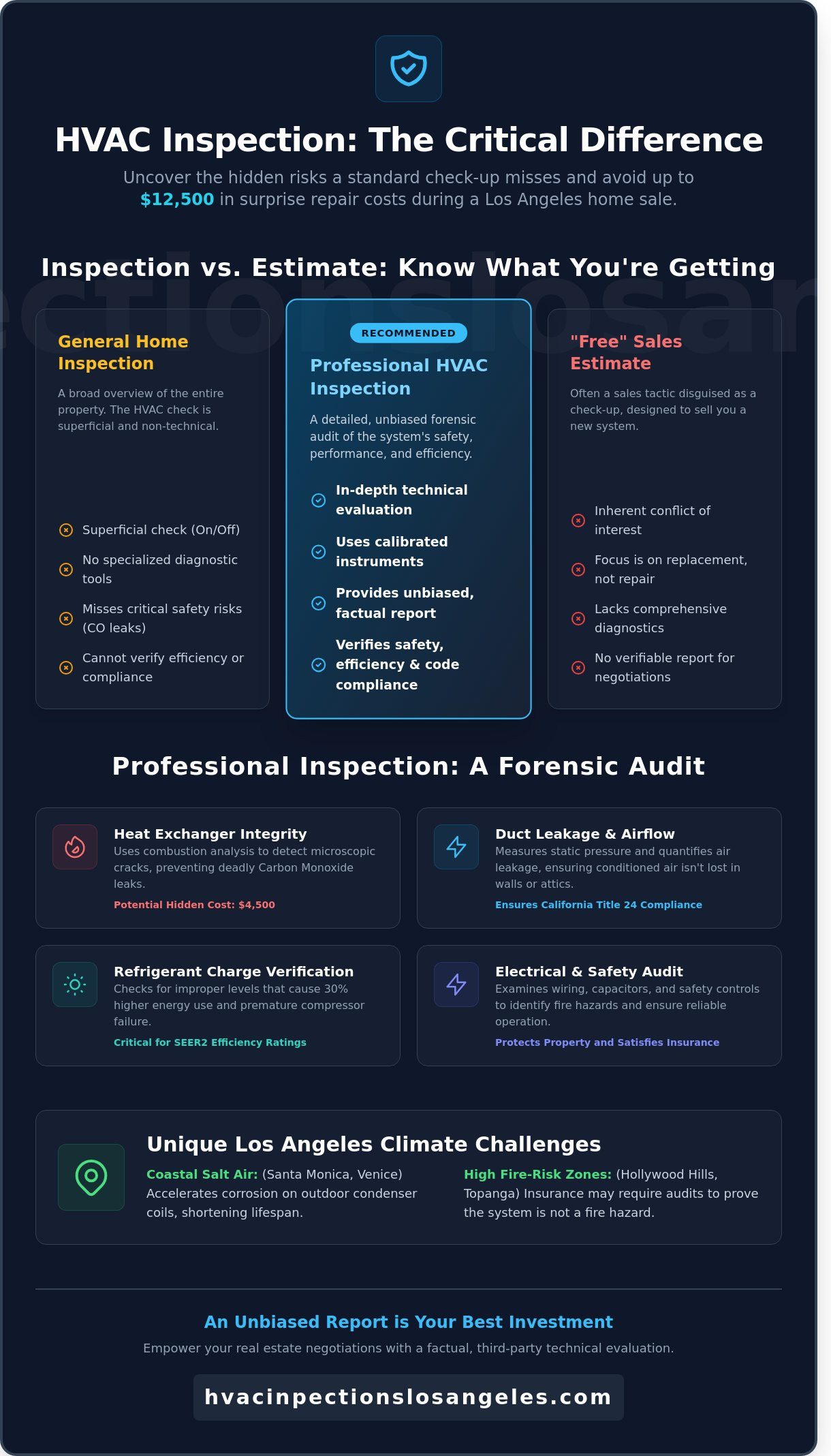
Los Angeles homeowners often ask why they should pay for a professional hvac inspection service when many local contractors offer “free estimates.” The distinction is critical to your property’s safety and your financial bottom line. A free estimate is a sales tool designed to convert a lead into a customer. An inspection is a diagnostic technical service designed to provide the truth. When a company offers a service for free, they must recoup those labor costs elsewhere, often through the sale of high-margin equipment or unnecessary repairs.
The “Free Estimate” Trap
Most “free” visits are performed by sales technicians whose compensation is tied to commissions. In 2026, data suggests that 82% of repair-focused companies in Southern California use these consultations as lead generation for full system replacements. These technicians are trained to find reasons for a new installation rather than identifying ways to extend the life of your current unit. They might overlook a simple $300 blower motor repair if they can justify a $16,000 system upgrade. Furthermore, these visits rarely result in a formal, written technical report. You’re left with a quote for new equipment rather than a comprehensive map of your system’s mechanical health and safety status.
The Value of an Unbiased Technical Report
A specialized hvac inspector operates with total neutrality. We don’t sell Mitsubishi condensers or Trane furnaces, so we have no financial incentive to recommend a replacement unless it’s strictly necessary for safety or efficiency. This objectivity creates a report that functions as a powerful legal and financial document. In the high-stakes Los Angeles real estate market, an unbiased report provides the leverage needed to negotiate price credits or repair demands with confidence. If our findings show that duct integrity is compromised or the heat exchanger is failing, you have the evidence required to protect your investment.
- Accurate Capital Planning: Use our findings to forecast your HVAC expenses over the next 48 months rather than facing an emergency failure.
- Safety Verification: We prioritize technical precision, identifying carbon monoxide risks and electrical faults that sales-driven technicians often ignore.
- Title 24 Alignment: Our reports ensure your system meets 2026 California energy standards, preventing future compliance issues.
Investing in a professional hvac inspection service eliminates the guesswork and the pressure of a sales pitch. It’s about data, not quotas. To understand how these professional evaluations fit into your budget, you can review our hvac inspection cost guide for transparent pricing and ROI analysis.
Local Considerations for Los Angeles and South Bay HVAC Inspections
Living in Los Angeles requires an awareness of how microclimates dictate the lifespan of mechanical equipment. A standard hvac inspection service must account for the specific environmental stressors found between the Santa Monica Mountains and the South Bay. While inland units battle extreme heat and dust, coastal systems face a silent, chemical threat that can cut a system’s life expectancy by 40 percent. By 2026, the shift toward higher-efficiency heat pumps has made these local factors even more critical to monitor during a routine check.
Coastal Corrosion in the South Bay
Properties within three miles of the Manhattan Beach Pier or the Redondo Beach King Harbor face accelerated salt air corrosion. Salt particles settle on aluminum condenser fins, leading to galvanic corrosion that restricts heat transfer. In Torrance and Hermosa Beach, we often see coils disintegrate in as little as seven years. Our inspectors look for white, powdery oxidation that general contractors might overlook. For these environments, we recommend specialized epoxy coatings or high-durability Mitsubishi ductless systems that feature enhanced corrosion resistance for outdoor components. This technical oversight prevents the premature $6,000 replacement costs that salt spray often triggers.
Wildfire Season and Indoor Air Quality (IAQ)
The 2024 and 2025 wildfire seasons left a lasting impact on local HVAC health. Fine particulate matter and ash don’t just clog filters; they infiltrate blower motor housings and coat evaporator coils. This debris forces the system to work 20 percent harder to maintain temperatures. Scheduling a post-fire season heating and cooling inspection is a critical health measure for your household. During this process, we verify the following:
- Filter Compatibility: Ensuring the system can handle MERV 13 or higher filtration without damaging the blower motor.
- Air Sealing Integrity: Checking ductwork for leaks that allow outdoor pollutants to bypass the filtration system.
- Blower Cleanliness: Removing microscopic ash buildup that causes friction and premature motor failure.
- Sensor Accuracy: Calibrating thermostats and IAQ sensors that may have been skewed by heavy smoke exposure.
This level of technical verification is the only way to ensure your indoor air remains safe during the next Air Quality Management District (AQMD) alert. A comprehensive hvac inspection service identifies these hidden contaminants before they lead to mechanical failure or respiratory issues. We provide the data you need to breathe clearly, regardless of the outdoor conditions in the Los Angeles basin.
Ensure your system is prepared for the unique challenges of the South Bay by booking your unbiased HVAC assessment today.
Securing Your Investment: Next Steps After Your HVAC Inspection
Once the physical assessment concludes, the raw data must be translated into a clear action plan for your property. A professional hvac inspection service provides more than just a pass or fail grade; it delivers a technical roadmap for your home’s climate control health. We provide an unbiased report that separates immediate safety hazards from long-term maintenance suggestions. This ensures you don’t overspend on unnecessary repairs while protecting your household from risks like carbon monoxide leaks or critical electrical failures that often go unnoticed during a general home inspection.
Interpreting Your Unbiased Report
Your final report categorizes findings into a structured “Priority List” to simplify your decision-making process. Category 1 items involve immediate safety concerns, such as a cracked heat exchanger or a compromised vent pipe; these require instant attention to remain compliant with California safety standards. Category 2 items focus on operational efficiency and suggested upgrades, such as cleaning evaporator coils or replacing aging capacitors. For homeowners currently in escrow, this document serves as a vital negotiation tool. You can use our documented findings to request specific repairs or financial credits during the standard 17-day contingency period common in Los Angeles real estate. We also calculate the Remaining Useful Life (RUL) of your components. If a furnace is 14 years old, it’s nearing the end of its 15 to 20-year lifecycle. This allows you to budget for a planned replacement in 2027 rather than facing an emergency breakdown during a heatwave.
Modern Solutions: When Replacement Makes Sense
Los Angeles building codes are shifting rapidly toward electrification and higher efficiency standards. If your inspection reveals that an old gas furnace is inefficient or unsafe, transitioning to a high-efficiency heat pump is often the most logical financial move. As a Mitsubishi Ductless Elite Dealer, we bridge the gap between expert diagnosis and premium equipment sales. We specialize in Title 24 compliant systems that handle the unique coastal and valley temperature swings of Southern California. Our team doesn’t just identify the problem; we provide the engineering solutions to fix it. We offer direct access to variable-speed technology that can reduce cooling costs by 30 percent compared to older 13 SEER units. This expertise ensures your new system is sized correctly for your square footage, preventing the short-cycling issues that plague uncertified installs.
Don’t leave your comfort or your budget to chance in 2026. Whether you’re finalizing a home purchase in Pasadena or upgrading a rental property in Santa Monica, a professional hvac inspection service is your best defense against hidden mechanical costs. Contact HVAC Inspections Los Angeles today to schedule your comprehensive system evaluation and secure the technical clarity you deserve.
Secure Your Property Investment with Technical Precision
Protecting your Southern California property requires more than a cursory glance at a thermostat. A professional hvac inspection service provides the technical precision necessary to identify hidden risks like compromised heat exchangers or duct integrity issues that general home inspectors often overlook. Since 2004, we’ve delivered over 20 years of local expertise to the Los Angeles and South Bay communities. As a Mitsubishi Ductless Elite Dealer and Trane Provider, our team focuses on factual, unbiased reporting rather than high-pressure sales quotas. This data-driven approach is essential for meeting 2026 real estate and insurance compliance standards. You’ll receive a comprehensive report that documents your system’s actual health, giving you the leverage needed during high-stakes property negotiations. Don’t leave your mechanical safety to chance when you can rely on a specialist who understands the specific climate demands of our region. We’re here to ensure your system remains efficient and compliant for years to come.
Schedule Your Unbiased HVAC Inspection in Los Angeles Today
Your home deserves the clarity that only a meticulous expert can provide.
Frequently Asked Questions
Is a specialized HVAC inspection service required for escrow in Los Angeles?
A specialized HVAC inspection service isn’t legally mandated by California state law for escrow, but it’s a standard requirement for most 17-day inspection contingency periods in Los Angeles real estate contracts. General home inspectors typically only perform a visual check of the thermostat and registers. A dedicated professional evaluates the heat exchanger and refrigerant levels, providing the technical documentation needed to negotiate repair credits before the closing date.
How long does a professional HVAC inspection take to complete?
A professional inspection for a standard 2,000 square foot home takes between 60 and 90 minutes to complete. This timeframe allows the technician to access the attic or crawlspace, test the compressor’s amperage draw, and measure airflow at each vent. If your property features multiple zones or dual-package units, expect the process to extend by 45 minutes per additional system to ensure a comprehensive evaluation.
What is the difference between an HVAC tune-up and an inspection?
An inspection is a diagnostic assessment of the system’s health, while a tune-up is a maintenance service that includes cleaning and minor adjustments. During an HVAC inspection service, our goal is to provide an unbiased report on the system’s remaining lifespan and safety. We don’t perform repairs or part replacements during this visit. A tune-up focuses on optimizing current performance by cleaning coils or lubricating motors to prevent immediate breakdowns.
Will an HVAC inspection help lower my monthly energy bills in LA?
An inspection identifies specific mechanical inefficiencies that can increase your LADWP or Southern California Edison bills by 15% to 20%. Our technicians check for duct leaks and improper refrigerant charges that force the system to run longer cycles. By identifying these issues, you can restore the unit to its rated SEER2 efficiency, which is critical given the 100-degree summer peaks common in the San Fernando Valley.
Can a cracked heat exchanger be repaired, or does it require a full furnace replacement?
A cracked heat exchanger cannot be repaired and requires an immediate replacement of the component or the entire furnace to prevent carbon monoxide leaks. This is a critical safety failure according to American National Standards Institute (ANSI) guidelines. Because the heat exchanger is the primary barrier between combustion gases and your home’s air, any breach in its integrity makes the unit unsafe to operate under California mechanical codes.
Does an HVAC inspection report satisfy California Title 24 requirements?
A standard inspection report doesn’t satisfy Title 24 requirements, as those mandates specifically apply to new installations or alterations involving more than 40 feet of ductwork. To meet the 2022 Building Energy Efficiency Standards, you must hire a certified HERS rater to perform duct leakage testing and verify refrigerant charge. While our inspection identifies if your system is compliant, the Title 24 certificate is a separate regulatory filing required for permit finalization.
How much should I expect to pay for a professional HVAC inspection service in the South Bay?
Homeowners in the South Bay should expect to pay between $250 and $450 for a comprehensive HVAC inspection service. Prices vary based on the number of systems and the accessibility of the unit, such as those located in tight crawlspaces in older Redondo Beach homes. This investment provides a detailed digital report and a 12-month outlook on the system’s viability, which often saves buyers thousands in post-closing repair costs.
What happens if the HVAC inspector finds a major safety defect?
If an inspector identifies a life-safety defect like a gas leak or high carbon monoxide levels, they’ll “red-tag” the unit and disable it for your protection. We’ll provide a written notice explaining the specific violation of the California Mechanical Code and the necessary steps for remediation. This documentation is vital for real estate transactions; it alerts all parties that the system is currently non-functional and requires professional repair before use.