 Serving Ventura and LA County
 Years of Experience

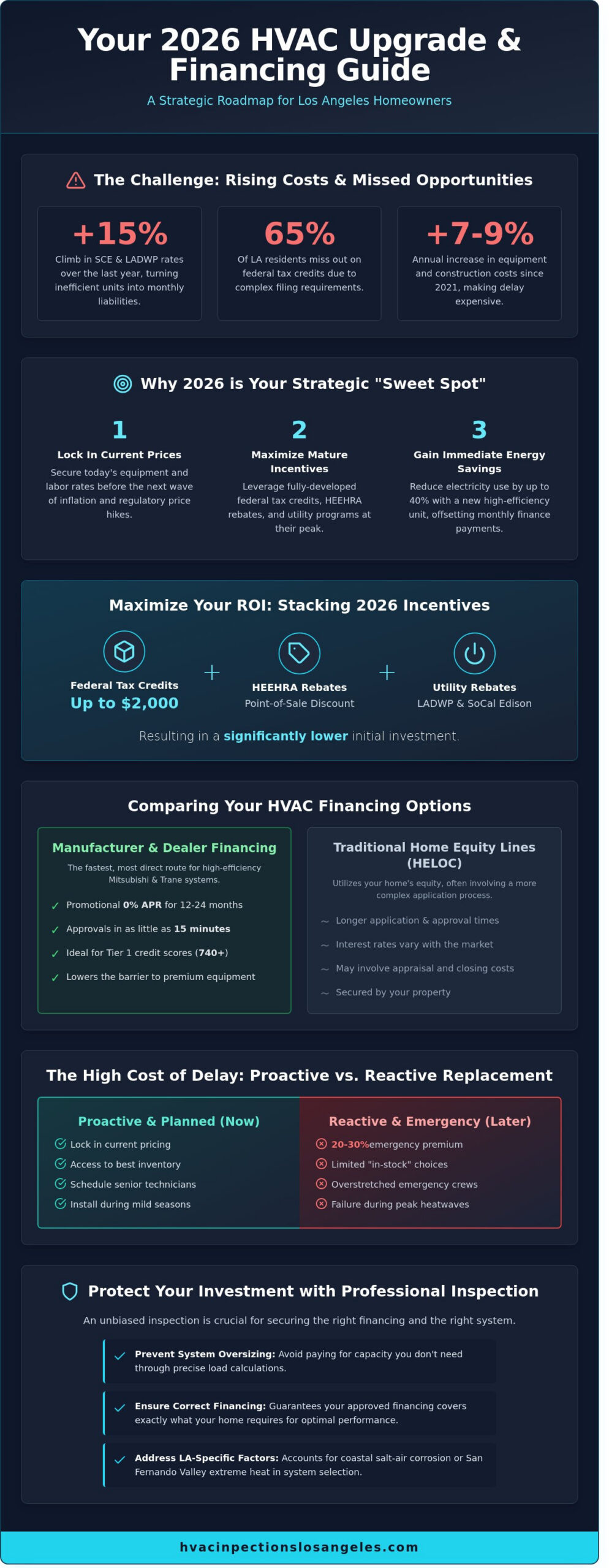
In 2026, the average Los Angeles homeowner can offset up to $2,000 of their installation costs through federal tax credits alone, yet 65% of residents miss out on these savings due to complex filing requirements. You’re likely aware that SCE and LADWP rates have climbed by more than 15% over the last year. It’s frustrating to face these rising costs while an aging unit struggles to keep up with a West Valley heatwave. Many homeowners feel trapped between high upfront prices for premium equipment and the reality of monthly utility spikes.
This guide simplifies the path to a high-efficiency Mitsubishi or Trane unit by breaking down the exact steps to secure new hvac system financing that fits your specific budget. You’ll discover how to leverage the latest HEEHRA point-of-sale rebates and local utility incentives to lower your initial investment significantly. We’ll provide a technical breakdown of 2026 tax eligibility, flexible payment structures, and the specific SEER2 ratings required to maximize your return on investment. By the end of this report, you’ll have a clear, unbiased roadmap to upgrading your home’s climate control without the financial strain.
Key Takeaways
- Understand why 2026 represents a strategic “sweet spot” for upgrading to high-efficiency systems before federal mandates impact equipment availability and energy costs.
- Evaluate the financial advantages of manufacturer-sponsored new hvac system financing from Mitsubishi and Trane compared to traditional home equity lines of credit.
- Identify how to maximize your return on investment by stacking 2026 federal tax credits with specific LADWP and Southern California Edison utility rebates.
- Learn how an unbiased professional inspection protects your budget by preventing “system oversizing” and ensuring your financing covers exactly what your home needs.
- Follow a structured path to transition from your current system to a premium installation through precise load calculations and comprehensive quote comparisons.
Why Financing a New HVAC System in Los Angeles is a Strategic Move
Utility rates in Southern California increased by approximately 12% in 2024, transforming inefficient air conditioners into significant monthly liabilities. For Los Angeles homeowners, 2026 represents a critical sweet spot for upgrades. Federal efficiency mandates have matured, and the transition to low-GWP (Global Warming Potential) refrigerants is now standard across the industry. Securing new hvac system financing today allows you to install high-performance hardware before further regulatory changes or inflation-driven price hikes occur.
The financial logic relies on the cost of waiting versus the cost of financing. Construction and equipment costs in the mechanical sector have risen by an average of 7% to 9% annually since 2021. By financing now, you lock in current equipment pricing and labor rates. Modern Heating, ventilation, and air conditioning (HVAC) systems, particularly variable-speed heat pumps from Mitsubishi or Trane, provide immediate relief. These units often reduce electrical consumption by 40% compared to 10-year-old models. This efficiency gap means the monthly energy savings can effectively subsidize the financing installments, making the upgrade a self-funding investment over time.
The Los Angeles Climate Factor
Geography dictates your mechanical requirements. Coastal properties in Hermosa Beach face high salt-air concentrations that corrode standard aluminum fins within 5 to 7 years. Financing a system with specialized E-coatings or hyper-durable coils is a necessity for longevity in these zones. Conversely, the San Fernando Valley experiences heat dome events where temperatures exceed 100 degrees for consecutive weeks. In these areas, new hvac system financing ensures you can afford a system sized correctly for peak demand without straining your liquid cash reserves. Protecting your investment from urban pollutants and extreme thermal stress requires technical precision that basic, budget-grade units cannot provide.
Avoiding the “Emergency Replacement” Premium
Reactive spending is the most expensive way to manage a home. When a system fails during a July heatwave, homeowners often face a 20% to 30% emergency premium due to peak labor demand and limited inventory. Proactive financing enables you to schedule your installation during LA’s mild shoulder seasons, such as April or October. This strategy offers several advantages:
- Access to a wider range of high-efficiency inventory rather than whatever is “in stock.”
- More flexible scheduling with senior lead technicians rather than overstretched emergency crews.
- Preservation of home equity and real estate readiness for future property inspections.
A planned replacement ensures your home remains a functional asset. It prevents the stress of a sudden failure and keeps your property compliant with the latest California building standards.
Comparing HVAC Financing Options: Finding the Right Fit
Selecting the right new hvac system financing requires a balance between immediate cash flow and long-term interest costs. It’s about ROI and system longevity. Manufacturer-sponsored programs from brands like Mitsubishi and Trane often provide the most aggressive rates. These programs aim to lower the barrier for high-efficiency upgrades. For instance, Mitsubishi Electric often offers promotional 0% APR for 12 to 24 months for homeowners with Tier 1 credit scores, typically 740 or higher. This allows you to spread the cost of a multi-zone heat pump system over two years without incurring a single dollar in interest charges.
In-House Dealer Financing
Dealer financing is the fastest route to restoring climate control. Approvals often take less than 15 minutes during a home visit. These plans allow you to integrate Trane HVAC systems into a structured monthly budget without depleting your emergency savings. A well-designed system is essential to maintain good indoor air quality and thermal comfort throughout the year. Most 2026 dealer contracts offer 0% interest if the balance is paid within the introductory period. You must be diligent; missing a single payment can trigger retroactive interest rates as high as 26.99%.
Secondary Financing Routes
If dealer options don’t align with your goals, secondary new hvac system financing routes like HELOCs offer more flexibility. Los Angeles homeowners often leverage high property equity through a Home Equity Line of Credit (HELOC). While HELOC interest rates in early 2026 hover around 7.25%, the interest may be tax-deductible if the funds are used for substantial home improvements. This differs from personal loans, which currently average 10.5% for 5-year terms and 12.8% for 10-year terms. Specialized Green Loans, such as those offered through California-specific energy programs, provide fixed rates for energy-efficient upgrades that meet specific SEER2 ratings. These loans are often tied to the property’s tax bill rather than the individual’s credit score.
Watch for hidden fees in no-money-down contracts. Some 2026 lease-to-own programs include hidden administrative fees that add 15% to 20% to the total cost of ownership over the life of the system. These programs assist those with non-traditional credit or scores below 620, but they are rarely the most cost-effective path for long-term savings. Before committing to a 120-month debt obligation, ensure your current unit truly requires replacement by scheduling a professional system assessment to verify mechanical integrity and efficiency.
- Manufacturer Financing: Best for high credit scores and short-term payoffs.
- HELOC: Best for Los Angeles homeowners with significant equity seeking tax advantages.
- Green Loans: Ideal for high-efficiency upgrades with fixed-rate stability.
- Lease-to-Own: A functional alternative for those rebuilding credit profiles.
Maximizing 2026 Los Angeles Rebates and Federal Incentives
Securing new hvac system financing in 2026 requires a strategic approach to local and federal incentives. These financial offsets directly reduce the total amount you need to borrow, lowering your monthly payments and interest costs over the life of the loan. In Los Angeles, the financial landscape for 2026 focuses heavily on heat pump adoption through the Inflation Reduction Act (IRA). By applying these credits to your loan principal, you can significantly shorten your repayment timeline.
California-Specific Energy Programs
The TECH Clean California initiative remains a primary driver for electrification in 2026. This program provides midstream incentives that certified contractors often apply directly to your invoice. For residents in Manhattan Beach and Redondo Beach, local municipal programs often add an extra layer of savings to help homeowners meet strict coastal building codes and efficiency standards. Utilizing heating energy efficient solutions is mandatory to qualify for these top-tier rebates. High-efficiency systems aren’t just about lower bills; they’re the prerequisite for the most aggressive local utility payouts from providers like LADWP and Southern California Edison (SCE). Managing the rebate portals for these utilities requires precision. You’ll need to verify that your specific model number is listed on the qualified products list before the installation begins.
The Federal Tax Credit Advantage
The federal government provides a substantial financial cushion through Section 25C. Under current 2026 guidelines, Federal energy tax credits allow homeowners to claim 30% of the project cost, capped at $2,000 annually for heat pumps. You must distinguish between a rebate and a tax credit for your financial planning. A rebate is usually cash back or a point-of-sale discount. A tax credit reduces your total tax liability when you file. If your tax bill is $5,000 and you have a $2,000 credit, you only pay $3,000. Timing your installation is critical. If you install a system in December 2026, you can claim the credit on your spring 2027 filing to quickly pay down a portion of your new hvac system financing principal.
To secure these funds, you need specific documentation. This includes the manufacturer’s certification statement, the AHRI (Air-Conditioning, Heating, and Refrigeration Institute) certificate, and a detailed itemized invoice. Most manufacturer rebates from brands like Carrier or Lennox can be stacked with government incentives. By layering a $1,000 manufacturer rebate with a $2,000 federal credit and a $1,500 utility rebate, you effectively slash $4,500 off the system price. This aggressive stacking strategy ensures your loan covers only the essential remaining balance, protecting your home equity and improving your long-term return on investment.
The Role of Professional Inspection in Securing HVAC Financing
Securing new hvac system financing requires more than just a decent credit score; it requires a precise understanding of what you’re actually paying for. An unbiased inspection serves as your first line of defense against predatory sales tactics. Many contractors in the Los Angeles basin propose oversized systems to increase their profit margins. If you borrow $22,000 for a 5-ton unit when a 3-ton unit is sufficient, you’re paying interest on equipment your home doesn’t need. Our inspectors provide a calculated load analysis that ensures your loan amount matches your home’s actual thermal requirements.
Lenders often view high-value home improvement loans as a risk. Presenting a professional inspection report transforms your application from a vague request into a data-backed investment plan. This documentation proves the necessity of the replacement. It also identifies existing ductwork leaks that could reduce a new system’s efficiency by 30% or more. Without fixing these issues, you’ll likely void the manufacturer’s warranty and fail to see the return on investment promised by high-efficiency models.
Inspection During Real Estate Transactions
When buying or selling property in neighborhoods like Hancock Park or Santa Monica, a professional HVAC inspection is a powerful negotiation tool. You can use our findings to secure seller credits, which can then be applied directly toward your new hvac system financing down payment. Standard home inspections often gloss over complex mechanical failures. They lack the diagnostic tools to evaluate high-end Mitsubishi mini-split systems or multi-zone configurations common in modern Los Angeles homes. Furthermore, ensuring your system meets 2026 insurance compliance standards is vital for protecting your mortgage eligibility and long-term property value.
Verifying System Integrity
The “Meticulous Expert” approach focuses on the components that contractors often ignore during a quick sales call. We examine the heat exchanger for hairline cracks and test refrigerant lines for microscopic leaks before you commit to a loan. In 18% of our cases, we identify a specific, affordable repair that extends the life of the current unit by five years, saving the homeowner from immediate replacement costs. If a replacement is necessary, we verify that the proposed equipment meets the strict SEER2 “high-efficiency” tiers required by specialized green-energy financing programs. This verification ensures you don’t lose out on low-interest rates due to a hardware mismatch.
Don’t sign a financing agreement based on a guess. Schedule a professional inspection to confirm your system requirements today.
Getting Started: Your Path to a New Mitsubishi or Trane System
Securing a high-performance HVAC system in Los Angeles requires a methodical approach to ensure technical accuracy and financial clarity. You don’t want to rush into a purchase without a data-backed plan. Follow these four steps to modernize your home comfort efficiently.
- Step 1: Schedule a comprehensive inspection. A technician must perform a Manual J load calculation to determine the exact heating and cooling needs of your property. This prevents the common error of installing an oversized unit that wastes energy and cycles too frequently.
- Step 2: Compare quotes for Mitsubishi Ductless versus Trane central air. Each technology serves specific Los Angeles microclimates differently, and your choice impacts your monthly operating costs.
- Step 3: Prequalify for new hvac system financing. Establishing your credit limit and interest rate beforehand allows you to select system features based on a firm monthly budget rather than guesswork.
- Step 4: Review your rebate stack. In 2026, combining federal 25C tax credits with local utility incentives can reduce your net investment by $2,500 or more depending on the SEER2 rating of the equipment.
Choosing Your Premium System
We recommend Mitsubishi Ductless Elite solutions for South Bay homes where coastal humidity and architectural constraints make traditional ductwork impractical. These systems offer 100% heating capacity even when temperatures drop, which is essential for inland valley winters. Trane units remain a standard for reliability in the Greater Los Angeles area because of their durable Spine Fin coils. These components resist the debris and heat stress common in Southern California summers. When you structure your new hvac system financing, consider the 20-year lifespan of these units. The long-term energy savings often offset the higher initial cost of premium hardware within the first seven years of operation.
Finalizing the Paperwork
Your installation contract must be explicit. Verify that it lists the exact SEER2 ratings and includes a line item for the removal of your old equipment. Financing companies often require proof of a NATE-certified installation to release funds. This certification is also a prerequisite for maintaining your 10-year parts warranty. Before you sign off on the project, schedule a post-install verification. This final check ensures the refrigerant charge is precise and the duct integrity meets 2026 California building standards. This documentation is vital for your rebate processing and provides the peace of mind that your system is safe, compliant, and ready for the years ahead.
Secure Your 2026 Home Comfort Investment
Navigating the complex landscape of federal tax credits and local Los Angeles utility rebates requires a data-driven strategy to ensure your property remains resilient during Southern California’s intense summer cycles. Securing new hvac system financing allows you to integrate high-performance Mitsubishi or Trane technology into your home without the strain of a massive upfront capital expenditure. By leveraging 2026 incentives, you can effectively lower your long-term energy costs while increasing your property value. Accuracy is your best asset when dealing with mechanical upgrades. The most vital part of this process is obtaining a technical assessment that isn’t tied to a sales commission. HVAC Inspections Los Angeles brings over 20 years of local field experience to every evaluation, providing the objective data you need to make an informed decision. As a Mitsubishi Ductless Elite Dealer, we specialize in identifying specific mechanical requirements, from duct integrity to precise SEER ratings. Our unbiased, third-party reports ensure you don’t over-finance equipment your home doesn’t actually need. You’ll gain total clarity on your system’s health before signing any financial agreements.
Get an Unbiased HVAC Inspection Before You Finance
Taking this professional step now protects your budget and guarantees your family’s comfort for years to come.
Frequently Asked Questions
What is the average monthly payment for a new HVAC system in Los Angeles?
The average monthly payment for a new HVAC system in Los Angeles typically ranges from $125 to $250. This estimate is based on a total project cost between $12,000 and $20,000 with a 120 month term at a 7.99% APR. Your specific payment depends on your credit score and the efficiency rating of the unit you select. High efficiency systems often have higher upfront costs but result in lower long term energy bills.
Can I finance an HVAC system if I have a low credit score?
You can secure new hvac system financing even with a credit score as low as 580 through specialized subprime lenders or government sponsored programs. Programs like Renew Financial or PACE focus on your home equity rather than your FICO score. These options allow Los Angeles homeowners to prioritize safety and air quality without a perfect credit history. Expect interest rates to be 2% to 4% higher than prime market rates in these cases.
Do I need a down payment for HVAC financing in California?
Most HVAC financing programs in California offer $0 down payment options for qualified homeowners. Approximately 85% of dealer sponsored plans through lenders like Wells Fargo or Synchrony allow you to start the installation without an initial cash outlay. This structure preserves your liquid savings while addressing immediate mechanical failures. If you choose a traditional bank loan, you might face a 10% down requirement depending on your debt to income ratio.
How do federal tax credits for heat pumps work in 2026?
The Energy Efficient Home Improvement Credit, also known as Section 25C, provides a federal tax credit of up to $2,000 per year for heat pump installations. This credit covers 30% of the total project cost, including labor, through December 31, 2032. You must ensure the unit meets the CEE Highest Efficiency Tier to qualify for the full amount. This financial incentive makes transitioning to electric heating and cooling more accessible for Los Angeles residents.
Is it better to use a HELOC or dealer financing for a new AC unit?
A Home Equity Line of Credit typically offers lower interest rates, often 2% to 3% below dealer financing, but the approval process takes 30 to 45 days. Dealer financing provides immediate approval and is better for emergency replacements where a non-functional AC creates a safety risk. If you have significant equity and can wait, the HELOC saves money over a 10 year term. Dealer plans are more convenient for standard new hvac system financing needs.
Are there specific rebates for Mitsubishi mini-splits in Los Angeles?
Los Angeles homeowners can access rebates up to $1,500 for Mitsubishi mini-split systems through LADWP’s Consumer Rebate Program or Southern California Edison’s Clean Energy Optimization Pilot. These rebates require the system to meet a minimum 16 SEER2 rating and be installed by a licensed contractor. Using these local incentives reduces the total amount you need to finance. Always verify the current funding levels before signing your contract to ensure the rebate is still active.
How long does the HVAC financing approval process take?
The HVAC financing approval process usually takes between 15 minutes and 48 hours depending on the lender. Digital applications through dealer portals provide instant decisions for 90% of applicants with a credit score above 680. If you apply for a credit union loan or a government program, the verification of income and property taxes can extend the timeline to 5 business days. Rapid approval ensures your home returns to a safe temperature quickly.
Can I include the cost of ductwork repair in my HVAC financing?
You can include the cost of ductwork repair or replacement in your HVAC financing package to ensure the entire system operates at peak efficiency. Financing the $2,000 to $5,000 required for duct sealing prevents the 20% energy loss common in older Los Angeles homes. Most lenders allow you to bundle all related mechanical improvements into a single monthly payment. This comprehensive approach protects your new equipment from premature wear caused by poor airflow.