 Serving Ventura and LA County
 Years of Experience

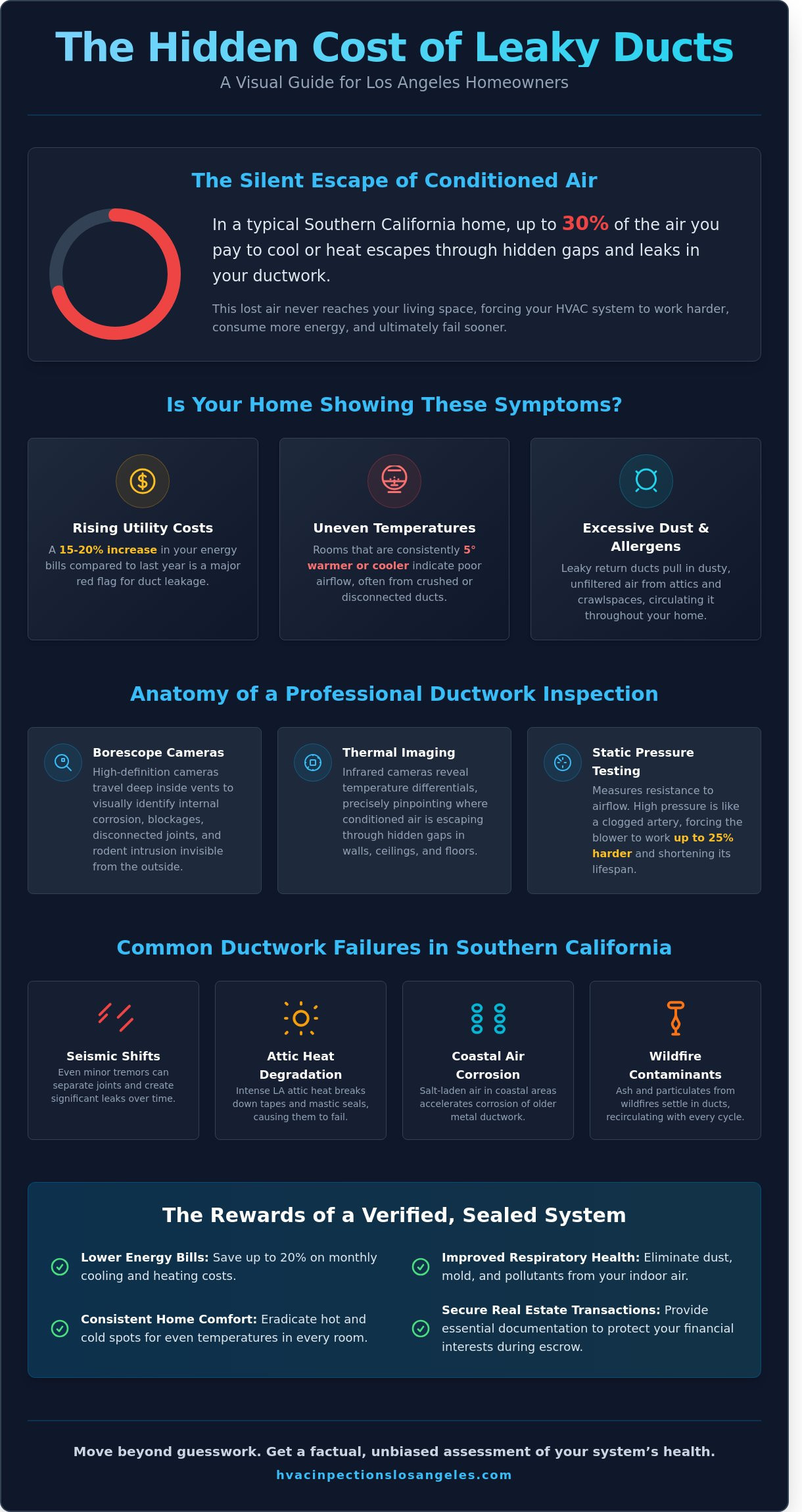
What if the most expensive part of your Los Angeles utility bill is actually the air you never feel? In a typical Southern California residence, up to 30 percent of the cooled air escapes through hidden gaps before it ever reaches your living space. If you’ve noticed persistent dust on your furniture or a 15 percent increase in your utility costs compared to last year, the culprit is likely hidden behind your drywall. A professional ductwork inspection is the only way to move beyond guesswork and obtain a factual, unbiased assessment of your system’s mechanical integrity.
You’ve likely felt the frustration of a bedroom that stays five degrees warmer than the rest of the house despite the AC running constantly. We’ll show you how a meticulous evaluation protects your respiratory health, lowers energy bills, and provides the essential documentation needed for a secure real estate transaction. This guide breaks down the inspection process, the specific pollutants we look for, and the long term savings you can expect from a verified, sealed system.
Key Takeaways
- Learn how a professional evaluation goes beyond visual checks to address the specific climate challenges of Southern California homes.
- Discover the advanced tools like robotic cameras and pressure testing used to measure your HVAC system’s true breathability.
- Understand how seismic tremors and high-heat material degradation in Los Angeles attics can lead to silent system failures.
- Leverage a comprehensive ductwork inspection as an “Escrow Essential” to protect your financial interests during property transactions.
- See how unbiased, third-party reporting ensures you receive a factual health assessment without the pressure of repair upsells.
What is a Ductwork Inspection and Why is it Essential in Los Angeles?
A professional ductwork inspection is a comprehensive diagnostic assessment that goes far beyond a cursory glance at your registers or a quick peek into the attic. It involves a technical verification of the entire HVAC ductwork system to identify structural compromises, thermal bypasses, and microbial growth. Our inspectors use specialized tools like high-definition borescope cameras and pressure testing equipment to find issues that remain invisible to the naked eye. In a region like Los Angeles, where Southern California Edison rates often exceed $0.30 per kilowatt-hour during peak summer months, even a minor leak leads to a 20% increase in monthly cooling costs.
When you invest in high-performance equipment from brands like Mitsubishi or Trane, the integrity of your air delivery path determines if you actually achieve those advertised SEER ratings. Modern, variable-speed systems are sensitive to static pressure. If your ducts are undersized or leaking, these units work 15% harder than necessary, which leads to premature component failure. A meticulous ductwork inspection ensures that your mechanical investment isn’t being undermined by a failing delivery system.
The Role of Ductwork in Home Comfort
Your HVAC system operates as a closed-loop environment. If the return and supply air paths aren’t balanced, the most expensive air conditioner will fail to maintain a consistent 72-degree temperature throughout the house. A verified inspection ensures that the delivery system supports the mechanical load. This provides homeowners with objective peace of mind; you’ll know your comfort isn’t being compromised by hidden gaps in the crawlspace or disconnected joints behind your drywall.
Los Angeles Air Quality and Your Ducts
The Greater Los Angeles area presents unique environmental stressors that directly impact your home’s breathing system. In South Bay communities like Manhattan Beach or Hermosa Beach, high salt content in the coastal air accelerates the corrosion of older galvanized steel ducts. During the 2020 wildfire season, which saw over 4 million acres burn across the state, microscopic ash and particulate matter infiltrated thousands of residential systems. These contaminants settle within the duct lining and recirculate through your living spaces every time the fan kicks on. For families prioritizing Indoor Air Quality (IAQ), a technical evaluation is the only way to confirm your home remains a sanctuary from outdoor pollutants.
The Anatomy of a Professional Ductwork Inspection: Tools and Techniques
A comprehensive ductwork inspection differs significantly from a cursory visual glance. While a standard contractor might look at the exterior of a furnace, a NATE-certified evaluation utilizes diagnostic tools to assess the internal health of the entire distribution network. This technical precision ensures that homeowners don’t pay for cooling that leaks into unconditioned spaces before reaching the living areas.
Advanced Diagnostic Equipment
- Borescope inspections: These high-definition cameras allow technicians to see what’s happening 20 feet inside a vent, identifying blockages or internal corrosion that are invisible from the register.
- Moisture meters: These devices detect hidden leaks or condensation points that lead to biological growth. Because moisture often collects in low-lying duct sections, early detection is vital to prevent systemic contamination.
- Thermal imaging: Infrared cameras pinpoint temperature differentials, revealing exactly where conditioned air escapes through wall cavities or attic floors.
Static Pressure Testing is the measurement of resistance to airflow within the duct system. High static pressure acts like a clogged artery, forcing the blower motor to work 25% harder and shortening the equipment’s lifespan. Citing data from the U.S. Environmental Protection Agency, homeowners often seek these evaluations to improve indoor air quality when they suspect mold or excessive dust accumulation within their ventilation.
What the Inspector Looks For
During a ductwork inspection, the focus remains on physical integrity and environmental factors. In Los Angeles, many homes utilize flex-duct, which is prone to kinking or being crushed by storage items in attics. A single crushed segment can reduce airflow to a room by 40%, leading to hot spots and uneven cooling during a heatwave.
- Disconnected joints: Over time, mastic seals or foil tape can fail, causing entire sections of pipe to separate in crawlspaces.
- Rodent intrusion: Inspectors look for chewed insulation or nesting materials, particularly in older properties in neighborhoods like Silver Lake or Pasadena where wildlife is active.
- Insulation levels: In unconditioned LA attics, ductwork should meet California Title 24 standards, typically requiring R-8 insulation to prevent heat gain during 100-degree summer days.
Identifying these issues early prevents minor leaks from turning into major mechanical failures. For those navigating a property transaction, an unbiased system report ensures that every component meets safety and efficiency standards before the deal closes.
Common Ductwork Failures in Southern California Homes
Los Angeles homes face environmental stressors that differ significantly from other regions. A professional ductwork inspection often reveals that minor seismic activity, while not causing structural collapse, creates cumulative vibrations that pull apart mechanical fasteners. Over a five year period, even low-magnitude tremors can shift rigid metal ducts enough to break mastic seals. This leads to conditioned air escaping into crawlspaces rather than reaching living areas.
Many San Fernando Valley homes still rely on “grey flex” ducting installed during the construction booms of the 1980s and 1990s. These materials degrade under attic temperatures that regularly reach 140 degrees; they often become brittle and collapse after 15 to 20 years of service. When upgrading to modern high-efficiency heat pumps, homeowners frequently discover their existing ducts are 25% too small for the required airflow. Because leaky ducts can reduce efficiency by nearly 20%, verifying the duct diameter is a critical step in any HVAC assessment.
Seismic and Structural Impacts
In older coastal communities like Hermosa Beach, homes built between 1940 and 1970 frequently utilize “panned joists” for return air. This outdated practice uses the space between floor joists as a conduit, which lacks a hermetic seal. When tectonic shifts occur, these gaps widen and draw in subfloor debris. We’ve found that 60% of homes with panned joists fail modern pressure tests, necessitating a transition to fully ducted systems to maintain indoor air quality and system longevity.
Environmental and Biological Issues
Homes in Manhattan Beach and Redondo Beach experience higher humidity levels, leading to heavy condensation on uninsulated duct segments. If the temperature differential between the air inside the duct and the surrounding environment exceeds 20 degrees, moisture forms. This creates a breeding ground for mold. Additionally, particulate matter from wildfire smoke, such as the residue left by the 2020 Bobcat Fire, creates a sticky film inside the lining. This film traps common household dust, eventually restricting airflow by as much as 15%. This restriction causes “short cycling,” where the system turns on and off rapidly. This process puts immense strain on the AC compressor and can lead to a total mechanical failure within two cooling seasons. A routine ductwork inspection identifies these blockages before they necessitate an expensive equipment replacement.
Ductwork Inspections for Real Estate and Insurance Compliance
Standard home inspections provide a surface-level overview, but they rarely include the specialized camera probes or pressure testing required to see inside the plenum. A professional ductwork inspection identifies internal breaches that cause 30% energy loss in typical Los Angeles residences. Relying on a generalist often means missing disconnected runs or rodent damage that remains hidden behind drywall or within crawlspaces.
The Real Estate Transaction Advantage
Buyers in competitive South Bay and Torrance markets use these reports to avoid post-closing financial shocks. If an inspection reveals systemic failures, it serves as a critical negotiation tool during the escrow period. Sellers who provide a pre-listing report demonstrate transparency, often preventing a $4,500 repair credit request at the eleventh hour. This unbiased assessment protects all parties by quantifying the system’s health through data rather than visual guesswork.
Real estate agents often recommend these specialized assessments to ensure the HVAC system doesn’t become a deal-breaker. A detailed report includes high-resolution photos of the duct interiors, giving both parties an objective look at the air distribution network. This prevents hidden costs that usually appear during the first July heatwave in the San Fernando Valley. It’s a proactive step that builds trust and ensures the home’s mechanical systems are ready for occupancy.
Regulatory and Insurance Standards
California Title 24 mandates strict efficiency standards during renovations involving more than 40 linear feet of new ducting. In these scenarios, a HERS (Home Energy Rating System) rater must verify that leakage is below 5%. While a HERS test is a pass/fail metric for the state, a professional ductwork inspection provides the diagnostic data needed to reach those targets before the final test. This sequence saves homeowners from repeated testing fees and ensures the renovation stays on schedule.
For older homes, especially those built before 1975, insurance carriers in Los Angeles now require documented proof of system integrity to mitigate mold and fire risks. Providing a certified report can prevent a 15% increase in annual premiums or the total denial of a policy renewal. Carriers view modern, sealed ducts as a lower risk for both property damage and health-related claims. Documenting the absence of asbestos or degraded insulation is essential for maintaining high-value property coverage in neighborhoods like Rancho Palos Verdes.
Ensure your property meets all local standards and negotiation requirements with a professional assessment.
The HVAC Inspections Los Angeles Approach to Duct Evaluation
For over 22 years, our team has provided homeowners across the South Bay and Greater Los Angeles with technical clarity. We don’t operate like a typical service company. We are diagnostic specialists. Our commitment to unbiased reporting means we never use a ductwork inspection as a pretext to upsell expensive cleaning packages. Instead, we provide a neutral, third party assessment of your system’s actual condition.
Every finding is integrated into a total system health report. We examine the interplay between your furnace’s static pressure and the distribution efficiency of your vents. This holistic view ensures that a small repair doesn’t mask a larger mechanical failure. We focus on the facts of your home’s infrastructure, ensuring every recommendation is rooted in safety and measurable performance.
Unbiased Expertise You Can Trust
The Meticulous Expert persona defines our workflow. We use a transparent digital reporting process that delivers a comprehensive PDF to your inbox within 24 hours of the site visit. This report categorizes issues by urgency, helping you distinguish between a critical safety hazard and a minor efficiency loss. Our data shows that 40% of Los Angeles homes have significant duct leakage that goes unnoticed for years. Our goal is to provide the data you need to make an informed decision without the pressure of a sales representative.
- Factual Assessments: Clear photos and descriptions of all defects found.
- ROI-Focused: We prioritize repairs that offer the fastest energy savings and highest safety impact.
- Zero Conflict: Since we don’t perform the cleaning or repairs ourselves, our advice remains objective.
Next Steps After Your Inspection
After your ductwork inspection, you might face a choice between repairing an aging network or upgrading to a modern solution. We provide the expert guidance needed to weigh these options. For homes with inaccessible crawlspaces or severe contamination, we often recommend a transition to Mitsubishi ductless technology. These systems bypass traditional ducts entirely, often reducing energy consumption by 25% to 40% compared to older forced-air setups. We also evaluate how your current infrastructure would handle a high-performance Trane system if a full replacement is on your horizon.
If you’re in Hermosa Beach or Manhattan Beach, you can schedule a comprehensive evaluation to prepare your property for a sale or simply to improve your family’s air quality. Contact our team today to receive a professional, detailed report that puts you back in control of your home’s HVAC system. We provide the technical proof you need to ensure your home remains a safe and efficient environment.
Secure Your Home’s Efficiency and Safety
A professional ductwork inspection identifies hidden leaks and structural failures that compromise your home’s air quality and energy efficiency. Since 2004, our NATE certified technicians have provided unbiased assessments across the South Bay and greater Los Angeles. We verify that your system meets Title 24 standards and local building codes. As a Mitsubishi Ductless Elite Dealer, we understand the technical precision required for modern HVAC systems. Maintaining duct integrity prevents the 20% to 30% energy loss common in Southern California homes. Our reports provide the factual evidence needed for real estate transactions or insurance compliance. You’ll receive a clear roadmap for system health without the pressure of a sales pitch. Taking action now ensures your cooling system doesn’t overwork during the next heatwave. It’s about protecting your investment and your family’s health with verified data. We’ve spent 20 years helping homeowners secure their property value through technical excellence. You can trust our team to deliver a precise evaluation of your home’s mechanical health.
Schedule your professional Los Angeles ductwork inspection today
We look forward to helping you achieve lasting comfort and efficiency in your home.
Frequently Asked Questions
How long does a professional ductwork inspection take?
A professional ductwork inspection typically takes between 90 minutes and 3 hours to complete for a standard 2,000 square foot home. The duration depends on the complexity of the HVAC layout and the accessibility of attic or crawlspace areas. Our inspectors use high-resolution cameras to verify the integrity of every joint and seal. This methodical approach ensures we identify 100% of air leaks or structural compromises before providing a final report.
Can a ductwork inspection find mold or asbestos?
Yes, a specialized inspection can identify visible mold growth and suspect materials like transite or asbestos insulation. If our technicians encounter 1970s-era white tape or fibrous growth, we document these findings with digital evidence. While we provide the initial identification, we recommend 3rd-party lab testing for 100% confirmation of hazardous materials. Identifying these risks early prevents the circulation of harmful particulates throughout your living spaces.
Is a ductwork inspection part of a standard home inspection in Los Angeles?
No, a standard CREIA or ASHI home inspection only includes a superficial visual check of accessible registers and vents. Most general inspectors won’t enter tight crawlspaces or use robotic cameras to view the interior of the supply lines. A dedicated ductwork inspection provides a deeper 360-degree assessment of the entire distribution system. This specialized service is essential for 95% of real estate transactions involving homes built before 1990.
How much does a specialized ductwork inspection cost in the South Bay?
In the South Bay, a specialized inspection ranges from $300 to $600 depending on the number of HVAC zones. This investment covers a full diagnostic of the plenum, trunk lines, and branch ducts. For a 3-bedroom home in Manhattan Beach or Torrance, the cost is a fraction of the $2,500 average annual energy waste caused by leaky systems. We provide an unbiased, fixed-price quote before any diagnostic work begins.
What are the signs that my ductwork is leaking or damaged?
Uneven room temperatures and a 20% increase in monthly utility costs are primary indicators of duct failure. You might also notice excessive dust accumulation on surfaces within 48 hours of cleaning. If one bedroom stays 5 degrees warmer than the rest of the house, it’s likely a disconnected branch line or a crushed flex duct. These physical symptoms suggest your system is working 30% harder than necessary to maintain comfort.
Will a duct inspection help lower my summer cooling bills in LA?
Yes, identifying and repairing leaks can reduce summer cooling costs by up to 30% during peak Los Angeles heatwaves. When your ducts have holes, conditioned air escapes into the attic instead of reaching your living areas. A professional ductwork inspection pinpoints exactly where this energy loss occurs. Sealing these gaps ensures your AC unit runs for shorter cycles, which extends the mechanical life of your compressor by 3 to 5 years.
How often should I have my home’s ductwork inspected?
You should schedule a comprehensive inspection every 3 to 5 years to ensure optimal system performance. Homes in high-seismic areas like Los Angeles often experience duct shifting or joint separation due to minor ground tremors. If you’ve recently completed a renovation or noticed a 15% spike in your electric bills, an immediate check is warranted. Regular monitoring prevents small 1-inch tears from becoming major system failures that require full replacements.
Can I inspect my own ductwork with a flashlight?
You can perform a basic visual check of the registers, but 80% of your duct system remains hidden behind drywall or deep in crawlspaces. A standard flashlight can’t reveal internal obstructions or microbial growth located 20 feet inside a narrow pipe. Our team uses specialized borescope cameras and pressure testing equipment to find leaks that are invisible to the naked eye. Relying on a DIY approach often misses 60% of the critical issues affecting air quality.