 Serving Ventura and LA County
 Years of Experience
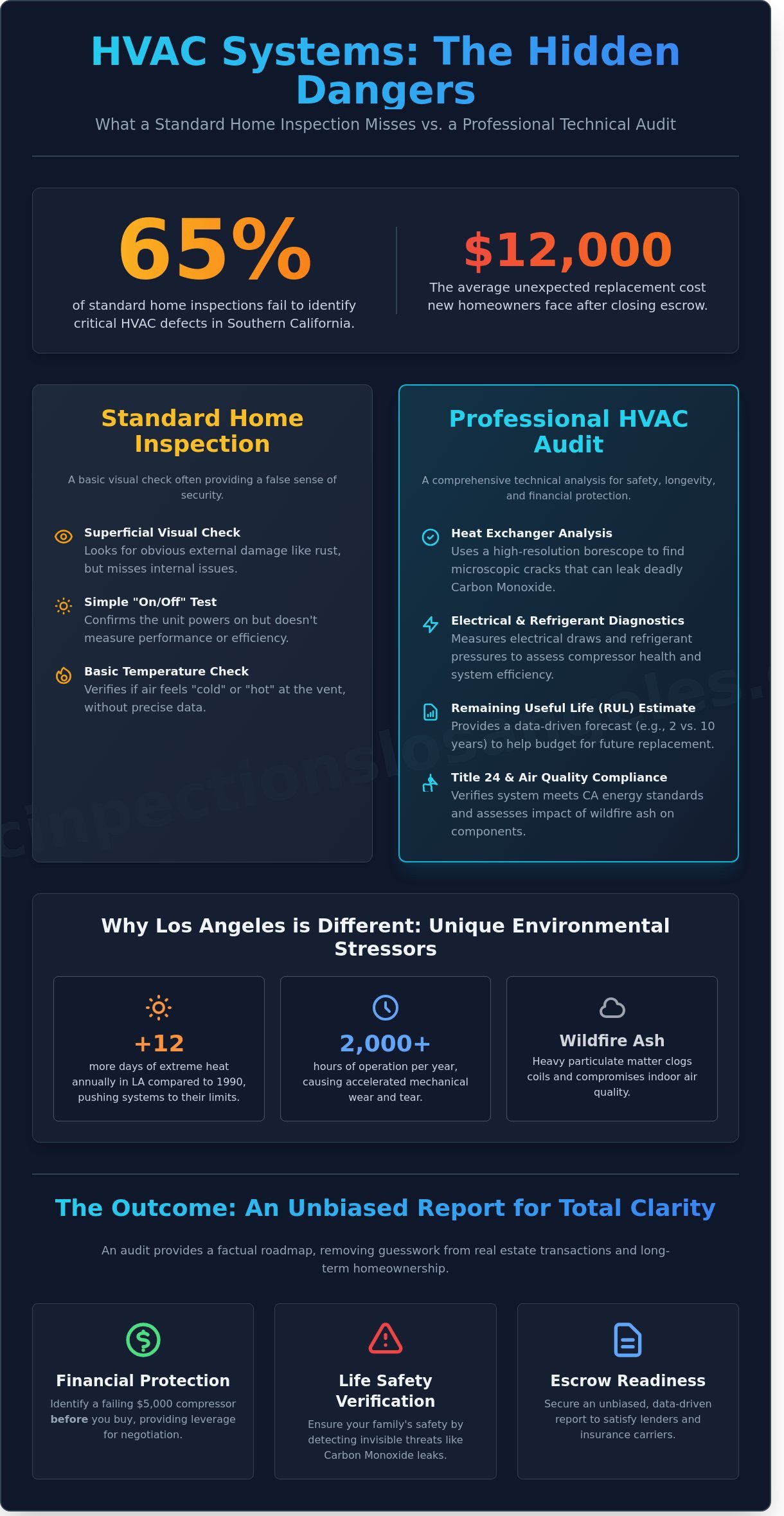
According to 2024 Southern California real estate data, nearly 65% of standard home inspections fail to identify critical defects in central air systems. This specific oversight often leaves new homeowners facing unexpected $12,000 replacement bills just weeks after closing escrow. You’ve likely felt the pressure of a high-stakes property transaction where every mechanical detail matters. It’s natural to feel anxious about whether a system can handle the next record-breaking Los Angeles heatwave or if recent wildfire ash has compromised the heat exchanger.
This guide will show you exactly what a professional hvac inspection entails, moving beyond a simple tune-up to provide a neutral, technical audit of your system’s health. You’ll discover how to verify Title 24 compliance and ensure your investment remains protected against hidden mechanical failures. We’ll break down the differences between maintenance and inspection, analyze the impact of regional air quality on system longevity, and provide a checklist for securing a comprehensive, unbiased report.
Key Takeaways
- Understand the critical difference between a basic visual check and a technical audit tailored for the Los Angeles climate and fire season requirements.
- Identify the specific mechanical components, such as heat exchangers and evaporator coils, that require professional verification to ensure system longevity.
- Learn why standard home inspections often miss hidden defects and how specialized diagnostic tools like thermal cameras provide a more accurate assessment.
- Determine the ideal timing for a professional hvac inspection during real estate transactions to protect your investment and ensure escrow readiness.
- Discover how a comprehensive, unbiased report serves as an essential roadmap for maintaining safety, efficiency, and peak performance in Southern California.
What is a Professional HVAC Inspection in Los Angeles?
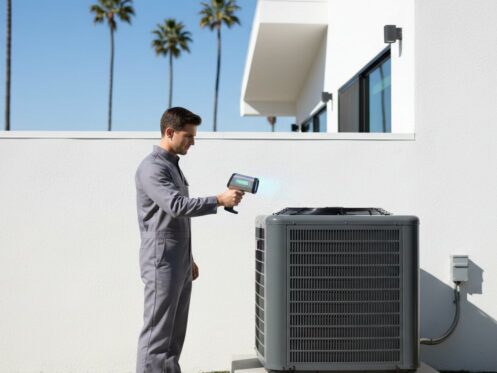
A professional hvac inspection is a technical audit that goes far beyond a simple visual check of the vents. While a general home inspector might simply confirm that the air feels cold, a specialized technician performs a forensic analysis of the entire system. In Los Angeles, where residential units often run for more than 2,000 hours per year, mechanical wear occurs at an accelerated rate. A meticulous expert uses tools like digital manifolds and combustion analyzers to verify the health of the Heating, ventilation, and air conditioning (HVAC) system. This objective data prevents surprises and ensures the equipment operates safely.
The local climate in Southern California demands specific inspection protocols that differ from other regions. Data from the 2024 climate report indicates that Los Angeles now experiences 12 more days of extreme heat annually than it did in 1990. When the mercury hits 110 degrees in the San Fernando Valley, an unoptimized system will likely fail under the load. Additionally, the heavy particulate matter from the 2024 wildfire season can clog delicate condenser fins and compromise indoor air quality. A professional hvac inspection identifies these environmental impacts before they lead to a total system burnout.
Life safety is the most critical component of our work. A cracked heat exchanger can leak carbon monoxide into the living space, yet these defects are rarely visible without a high-resolution borescope. Identifying these issues protects residents from harm. In the fast-paced Los Angeles real estate market, an unbiased report acts as a shield for both buyers and sellers. It removes the guesswork from the transaction, providing a factual basis for price adjustments or repair requests. We don’t sell parts or repairs; we provide the clarity needed to make informed financial decisions.
The Core Purpose of a Specialized Audit
The core purpose of our audit is to verify mechanical integrity by testing refrigerant pressures and electrical draws. We don’t just ask if it turns on; we determine how efficiently it’s running. This involves:
- Assessing Remaining Useful Life (RUL): We help homeowners budget for the future by estimating if a unit has 2 years or 10 years of service left, based on an average 15-year replacement cycle.
- Financial Protection: Identifying a failing $5,000 compressor before a purchase can save a buyer from immediate post-closing debt.
- Compliance Verification: We ensure all components meet California Title 24 energy standards and satisfy the increasingly strict requirements of local insurance carriers.
Who Needs an HVAC Inspection in 2026?
Homebuyers in escrow are the primary demographic for these services. They need to identify potential “money pit” scenarios before the 17-day contingency period expires. Homeowners also schedule inspections to prepare for the 2026 wildfire season or to satisfy new insurance renewal requirements that mandate system certifications. Property managers who oversee premium Mitsubishi or Trane split systems use our reports to verify that their high-value assets are operating at peak efficiency. Whether you’re managing a luxury rental in Santa Monica or buying a fixer-upper in Silver Lake, a neutral third-party assessment is your best defense against mechanical failure.
The Comprehensive HVAC System Inspection Checklist
A professional hvac inspection operates as a technical diagnostic of your property’s mechanical health. It moves beyond a simple visual check to provide a data-driven assessment of every component. In Los Angeles, where systems often transition from heavy cooling to moderate heating within a single 24-hour cycle, components experience unique thermal stress. Our process identifies localized wear and tear before it results in a total system failure or a safety hazard.
Heating and Furnace Evaluation
The heating assembly requires a high level of scrutiny to ensure occupant safety. We perform a technical inspection of the heat exchanger, looking for microscopic cracks or rust that could allow carbon monoxide to enter the living space. A 1% crack in the exchanger is enough to compromise air safety. Our technicians test gas pressure and analyze the burner flame; a steady blue flame indicates efficient combustion, while flickering orange suggests a fuel-to-air ratio imbalance. We verify that venting protocols meet current California building standards, ensuring all exhaust gases exit the home effectively.
Cooling and Refrigerant Analysis
Cooling efficiency depends heavily on the integrity of the refrigerant loop. We measure refrigerant levels to ensure the system operates within the manufacturer’s specified charge, as a 10% undercharge can increase energy costs by 20%. For homes in the South Bay or Santa Monica, we specifically check the outdoor condenser unit for salt-air corrosion, which can degrade aluminum fins 30% faster than in inland neighborhoods like Pasadena. The condensate drain line is also cleared of microbial growth to prevent the water damage often seen in multi-story Los Angeles residences during peak summer humidity.
Ductwork and Air Quality Audit
Air distribution is just as vital as air generation. We identify “hot spots” caused by duct leakage, which accounts for an average of 25% of energy loss in older Southern California homes. Our audit includes a check for particulate buildup, specifically looking for ash and soot remnants from the 2020 and 2021 California wildfire seasons. This aligns with EPA guidance on HVAC systems regarding the maintenance of thermal comfort and indoor air quality. If you suspect your air distribution is failing, a professional ductwork inspection can reveal how it impacts your monthly utility bills.
Precision extends to the electrical and control systems. We verify thermostat calibration to ensure the unit isn’t cycling unnecessarily, which can shorten the lifespan of the compressor by 3 to 5 years. All electrical connections are tightened and checked for signs of pitting or overheating. This thoroughness provides the documentation needed for real estate disclosures or insurance compliance. If you’re preparing for a property transfer or simply want to ensure your family’s safety, you can schedule a technical assessment with our team to get a clear, unbiased report on your system’s current condition.
HVAC Inspection vs. Home Inspection: Why Generalists Miss Defects
A standard home inspection is a vital part of the Los Angeles real estate process, but it has clear limitations. Most general inspectors follow the California Real Estate Inspection Association (CREIA) standards, which prioritize a broad, non-invasive overview of the entire property. They check if the lights turn on, if the toilets flush, and if the air conditioner blows cold air at the vent. This surface-level approach often fails to identify deep-seated mechanical issues that can cost a homeowner upwards of $15,000 in immediate replacement expenses.
Scope of Work Comparison
General home inspectors focus on “readily accessible” components. They look for visible rust on a furnace cabinet or check the manufacture date on a condenser’s data plate to estimate its remaining life. They don’t take the equipment apart. In contrast, a specialized hvac inspection involves removing access panels to examine the evaporator coil for microbial growth or testing the heat exchanger for microscopic cracks. While a generalist checks for basic function, a specialist performs a manual J load calculation to ensure the system is correctly sized for the square footage of the home.
The “Escrow Gap” represents the financial vulnerability a buyer faces when a general home inspector’s basic operational check fails to identify internal mechanical defects that require immediate, high-cost remediation.
- Home Inspectors: Verify the thermostat turns the system on and off; check for visible duct disconnections in the attic.
- HVAC Specialists: Measure refrigerant charge levels; analyze electrical draw on the compressor; inspect the secondary drain pan for signs of intermittent leaking.
- Technical Precision: Specialists use combustion analyzers to detect carbon monoxide leaks as low as 1 part per million, a level a standard home inspector’s equipment won’t register.
Thermal imaging cameras allow specialists to see through walls and ceilings. This technology identifies 20% to 30% more ductwork energy loss than a visual check alone. In older Los Angeles homes, especially those in historic districts like Hancock Park, original ductwork often suffers from collapsed sections or disintegrated insulation. A general inspector might see a duct that looks intact, but a specialist’s infrared scan reveals the exact point where cooled air is escaping into an unconditioned crawlspace.
The Neutrality Factor
There’s a significant difference between an inspection and a repair quote. Many local HVAC companies offer “free” inspections, but these are often sales calls in disguise. Technicians at these firms frequently work on commission structures ranging from 5% to 12% of the total sale, creating a direct incentive to recommend a full system replacement over a minor repair. This bias compromises the integrity of the data provided to a buyer or seller during a high-stakes transaction.
Choosing a dedicated inspection firm ensures the report remains objective. An unbiased, third-party assessment provides a factual baseline of the system’s health without the pressure of a sales pitch. This professional hvac inspection report acts as a powerful legal and financial document. If a specialist identifies a failing compressor in a Malibu beachfront property, the buyer can use that specific data to negotiate a closing credit based on actual local labor and material costs. It transforms a vague concern into a concrete, line-item negotiation tool that protects the client’s bottom line.
When to Schedule Your Inspection in the South Bay and Greater LA
Timing your hvac inspection requires an understanding of Southern California’s unique microclimates. While a homeowner in the San Fernando Valley faces triple-digit temperatures that stress compressor components, a resident in Hermosa Beach deals with salt-laden air that accelerates coil corrosion. These environmental factors dictate a specific maintenance calendar. To maintain system longevity, you should align your inspections with the seasonal shifts in March and September. These months serve as the critical “shoulder seasons” before the peak demands of summer cooling and winter heating. Verification during these windows ensures your system doesn’t fail when the outdoor temperature hits 100 degrees or drops to 45 degrees.
Post-fire season audits have become a technical necessity for Los Angeles property owners. Following heavy smoke exposure, particulate matter settles deep within the blower motor and evaporator coils. Even if you changed your filters during the event, microscopic ash can bypass standard filtration and create a restrictive layer on the heat exchanger. Scheduling an assessment immediately after the regional air quality index stabilizes prevents long-term efficiency losses and respiratory irritants from circulating through your ductwork.
- March: Pre-summer cooling verification to check refrigerant levels and condensate lines.
- September: Pre-winter heating safety check to inspect the heat exchanger for cracks.
- Post-Fire: Comprehensive cleaning and duct integrity check following heavy smoke.
- Coastal Properties: Quarterly exterior inspections to monitor salt-air oxidation on condenser fins.
Real Estate and Escrow Timelines
The standard 17-day contingency period in California real estate contracts leaves little room for error. You should schedule a professional assessment as soon as you open escrow to ensure you have time to review the findings. Our technicians provide a detailed report that you can use to negotiate repair credits or direct fixes before the closing date. It’s vital to know What to Expect From a Real Estate HVAC Inspection in LA, especially when verifying if a system meets the rigorous Mitsubishi Ductless Elite Dealer standards for high-efficiency installations. A clear report provides the leverage needed to ensure your new investment is mechanically sound.
Insurance and Compliance Triggers
California home insurance renewals now frequently require proof of system maintenance or upgrades to modern safety standards. Since the SEER2 efficiency regulations took effect on January 1, 2023, many insurers look for compliant equipment in older homes throughout Manhattan Beach and Redondo Beach. An unbiased hvac inspection verifies your system’s SEER2 rating and energy efficiency, which is often a prerequisite for local utility rebates. For homes built before 1970, these inspections also check for outdated wiring or venting configurations that could pose a fire risk or lead to policy non-renewal. We provide the documentation necessary to satisfy both insurance adjusters and state compliance officers.
Securing Your Comfort with an HVAC Inspections Los Angeles Report
An hvac inspection represents the final line of defense against unexpected mechanical failure. In a climate like Los Angeles, where the 2024 summer season saw record-breaking heatwaves, your cooling system’s reliability is paramount. Our comprehensive report serves as a technical roadmap. It provides homeowners and real estate professionals with a factual, documented assessment of every internal component. This isn’t a vague summary; it’s a data-driven document that removes the guesswork from property management.
Our Unbiased Reporting Process
We deliver clarity through a meticulous digital reporting system. Each report includes 15 to 25 high-definition photographs highlighting the specific condition of your heat exchanger, blower motor, and refrigerant lines. We categorize findings by urgency to help you prioritize your next steps:
- Safety Hazards: Immediate issues like cracked heat exchangers or electrical shorts that require 24-hour attention.
- Functional Deficiencies: Components like worn capacitors or dirty evaporator coils that currently hinder performance.
- Efficiency Recommendations: Opportunities to improve your SEER2 ratings and lower monthly utility bills.
This objective approach is why 85% of our local clients use these reports to negotiate repairs during home sales or to plan their annual maintenance budgets. We also provide a specialized consultation on transitioning to high-efficiency heat pumps. These systems are designed to meet California’s strict Title 24 energy requirements while offering superior dehumidification during humid coastal mornings in neighborhoods like Santa Monica or Venice.
Beyond the Inspection: Premium Equipment Sales
If the hvac inspection reveals that your system has reached the end of its 15-year lifecycle, we guide you toward high-performance replacements. We focus on premium brands like Mitsubishi and Trane because they offer the durability required for Southern California’s environment. Trane systems are known for their rigorous “Snowman” testing, ensuring they handle the intense heat of the San Fernando Valley without breaking a sweat. Most new Trane installations come with a 10-year registered limited warranty on internal functional parts, providing long-term financial protection.
Mitsubishi Ductless Mini-Splits are a popular choice for older Los Angeles homes that lack existing ductwork or have rooms that never stay cool. These units can achieve SEER2 ratings of 20 or higher, which can lower monthly cooling costs by as much as 35% for the average household. Our role as a neutral inspector allows us to recommend the exact capacity your home requires. We ensure you don’t overpay for a system that is too large for your square footage, which is a common mistake that leads to short-cycling and premature equipment failure.
Planning for the future starts with accurate data. Whether you need an immediate safety repair for a gas leak or you’re budgeting for a full system upgrade in 2025, our report gives you the timeline you need. We provide the technical evidence required to secure your home’s comfort and value. Don’t wait for a total system blackout during a July heat spike. Schedule your professional HVAC inspection today to ensure your equipment is compliant, safe, and efficient.
Secure Your Property’s Mechanical Integrity for 2026
A standard home inspection often overlooks the nuanced mechanical failures that lead to expensive 15% efficiency drops or hazardous heat exchanger cracks. By prioritizing a specialized hvac inspection, you ensure that every SEER rating and refrigerant level meets the strict 2026 California energy standards. HVAC Inspections Los Angeles has served the South Bay and Greater LA since 2004, providing the technical precision that generalists simply can’t match. Our NATE Certified Technicians deliver a comprehensive 25 point diagnostic report that serves as a factual foundation for your next real estate transaction or seasonal upgrade.
We operate as a Mitsubishi Ductless Elite Dealer, yet our primary commitment remains providing unbiased, third party assessments that aren’t tied to repair sales. You deserve a clear, data driven understanding of your system’s health before the summer heat waves hit the 100 degree mark. Protect your investment and your indoor air quality with a report you can trust. Book Your Unbiased HVAC Inspection Now and take the guesswork out of your home’s comfort and safety. Your peace of mind is just one professional assessment away.
Frequently Asked Questions
How much does a professional HVAC inspection cost in Los Angeles?
A professional HVAC inspection in Los Angeles typically costs between $250 and $600 depending on the system’s complexity and the property’s square footage. For a standard 2,000 square foot single-family home in neighborhoods like Silver Lake or Sherman Oaks, you can expect to pay approximately $350 for a comprehensive assessment. This investment provides a certified report that documents the mechanical integrity of your furnace and air conditioning units.
Is a standard home inspection enough for my HVAC system?
A standard home inspection is generally insufficient for a detailed evaluation of your heating and cooling components. While a general inspector checks if the system turns on, a specialized hvac inspection involves a deep dive into the heat exchanger, refrigerant levels, and duct integrity. Statistics from the American Society of Home Inspectors show that generalists miss approximately 15% of internal mechanical defects that a specialized technician would identify.
What happens if the HVAC inspector finds a cracked heat exchanger?
If an inspector identifies a cracked heat exchanger, the system must be shut down immediately to prevent carbon monoxide poisoning. California safety codes require technicians to disable the gas line to the furnace if a breach is detected because even a 1-millimeter crack can leak lethal gases. You’ll receive a formal report documenting the failure, which is critical for warranty claims or real estate negotiations during a home sale.
How long does a full residential HVAC inspection take?
A full residential hvac inspection takes between 90 minutes and 3 hours to complete thoroughly. The technician spends about 45 minutes on the outdoor condenser and another 60 minutes evaluating the indoor air handler and ductwork distribution. Older homes in Pasadena or historic areas of Los Angeles often require an additional 30 minutes to navigate tight crawlspaces or complex attic configurations found in vintage architecture.
Do I need an HVAC inspection for my home insurance policy in California?
California insurance providers often require a certified inspection for homes older than 20 years before issuing or renewing a policy. Carriers like State Farm or Farmers may request a 4-Point Inspection that includes the HVAC system to mitigate fire and water damage risks. Providing a passing report can prevent a 10% premium surcharge or a flat denial of coverage in high-risk brush fire zones.
Can an HVAC inspection help lower my Los Angeles energy bills?
An inspection can lower your Los Angeles energy bills by 15% to 30% by identifying hidden inefficiencies in your system. If the technician finds that your ductwork has a 10% leakage rate or your SEER rating is underperforming, correcting these issues reduces the workload on your compressor. This is especially vital during July and August when temperatures in the San Fernando Valley frequently exceed 95 degrees for consecutive days.
What is the difference between an HVAC tune-up and an inspection?
The primary difference is that a tune-up is a maintenance service while an inspection is a diagnostic assessment of the system’s health. A tune-up involves cleaning coils and changing filters, but an inspection provides an unbiased, third-party verification of the system’s remaining lifespan. Our process focuses on technical precision and safety compliance rather than performing routine cleaning tasks or selling unnecessary replacement parts.
Does wildfire smoke damage my HVAC system permanently?
Wildfire smoke causes permanent damage to HVAC systems by depositing fine particulate matter on the evaporator coils and within the blower motor. During the 2020 California wildfire season, data showed that systems without post-fire inspections saw a 25% increase in premature motor failure. The acidic nature of ash can corrode aluminum fins, leading to a permanent 5% drop in heat transfer efficiency if the debris isn’t professionally removed.