 Serving Ventura and LA County
 Years of Experience
The highest energy bill you paid last August likely wasn’t caused by a record-breaking heat wave, but by a minor mechanical inefficiency hidden within your system. While it’s easy to assume a struggling unit requires a total replacement, many performance drops stem from simple issues like a compromised refrigerant charge or failing capacitors. If you’re searching for reliable ac repair los angeles, you’ve likely noticed inconsistent temperatures across your home or a 15% spike in monthly utility costs that doesn’t align with your actual usage. Data from the Department of Energy suggests that replacing a clogged filter can alone improve system efficiency by up to 15%, yet many homeowners overlook these fundamental technical details.
You deserve a cooling system that operates with technical precision without the fear of being overcharged for unnecessary parts. This guide provides a structured framework to help you identify the root cause of your HVAC issues and decide whether a quick fix or a professional, unbiased evaluation is the right move for your property. We’ll walk through the specific troubleshooting steps for the 2026 season, focusing on system longevity, SEER efficiency, and the factual data you need to maintain a comfortable, cost-effective home in the Southern California climate.
Key Takeaways
- Understand how Southern California heatwaves and coastal salt air accelerate wear on critical components like capacitors and coils.
- Learn to identify the technical signs of refrigerant leaks and electrical faults to determine if you need immediate ac repair los angeles services.
- Apply the “Rule of 5,000” and SEER2 efficiency metrics to calculate whether a system repair or a full replacement is the most cost-effective decision for your home.
- Implement a rigorous maintenance schedule tailored to LA air quality and outdoor unit clearance to maximize system longevity and prevent failures.
- Discover why an unbiased professional inspection provides the essential data needed for high-stakes real estate transactions and major mechanical decisions.
Common AC Repair Issues in Los Angeles Homes (2026)
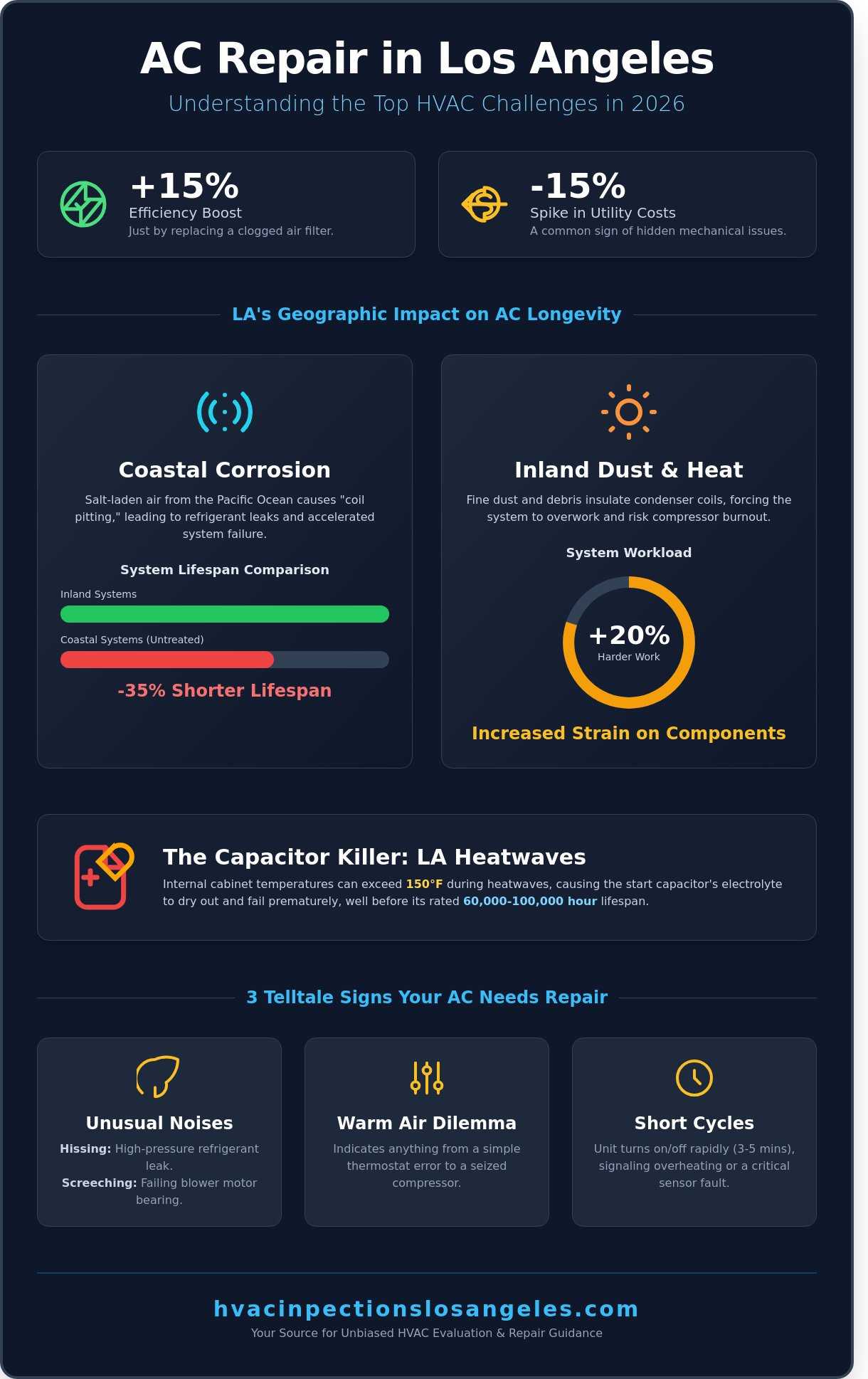
The 2026 cooling season has introduced unprecedented thermal demands on Southern California HVAC systems. As heatwaves become more frequent and intense, the mechanical components of your air conditioner face higher failure rates than in previous decades. A primary concern for homeowners seeking ac repair los angeles is the longevity of the start capacitor. These components are often rated for 60,000 to 100,000 hours, but internal cabinet temperatures exceeding 150°F during a July heatwave can cause the electrolyte to dry out prematurely. When the capacitor fails, your compressor cannot engage, leaving your home without cooling during the most critical hours of the day.
Geography plays a decisive role in the type of mechanical failure you’ll likely encounter. In coastal neighborhoods like Hermosa Beach and Manhattan Beach, salt air acts as a corrosive catalyst. Sodium chloride particles settle on the aluminum fins of your condenser coils, triggering galvanic corrosion. This process leads to “coil pitting,” where microscopic holes allow refrigerant to escape. By 2026, data from regional inspections shows that systems within two miles of the Pacific Ocean without protective treatments have a 35% shorter lifespan compared to their inland counterparts.
Environmental factors like the Santa Ana winds also contribute to the “short-cycling” phenomenon. During these high-pressure events, wind gusts can interfere with proper exhaust flow or cause pressure imbalances that trigger safety sensors. This results in the unit turning on and off in rapid succession, which significantly increases wear on the contactor and motor windings. Furthermore, coastal pockets often experience localized humidity spikes that lead to clogged condensate lines. If the drain line isn’t cleared of biological growth and debris, the safety float switch will shut the system down to prevent water damage to your drywall.
Coastal vs. Inland Cooling Challenges
In Redondo Beach and Torrance, the primary threat is salt-induced corrosion of the outdoor unit’s base pan and coils. Homeowners in these areas should prioritize systems with specialized factory coatings, such as Blygold or Heresite, to provide a barrier against the marine environment. Conversely, inland residents in the Greater LA area face issues with fine particulate dust and debris. This buildup acts as an insulator on the condenser coils, forcing the system to work 20% harder to reject heat, which eventually leads to a total compressor burnout if not professionally cleaned.
Signs Your System is Struggling
- Unusual Noises: Hissing typically indicates a high-pressure refrigerant leak, while screeching often points to a failing blower motor bearing.
- The Warm Air Dilemma: If your vents blow warm air, it’s vital to distinguish between a simple thermostat calibration error and a mechanical failure like a broken fan belt or a seized compressor.
- Short Cycles: A system that shuts off after only three to five minutes is likely overheating or experiencing a sensor fault.
If your unit continues to run without lowering the indoor temperature, you may be facing a specific set of mechanical hurdles. For a detailed breakdown, see our guide on AC Running But Not Cooling to identify the next steps for ac repair los angeles.
Diagnosing System Failures: From Refrigerant Leaks to Electrical Faults
Effective ac repair los angeles begins with a technical understanding of the stressors unique to Southern California. Systems in neighborhoods like Sherman Oaks or Pasadena often face high-cycle rates due to microclimates that trap heat. When a system fails to cool, the root cause is frequently a breakdown in the sealed refrigeration cycle or a failure in the electrical control circuit. Diagnosing these issues accurately prevents the common mistake of replacing expensive parts when a simple calibration or cleaning would suffice.
Airflow obstructions often mimic mechanical failures. If a homeowner neglects ductwork maintenance, the restricted volume of air passing over the evaporator coil prevents heat absorption. This creates a feedback loop where the system runs longer, consumes more energy, and eventually triggers a high-pressure limit switch. The evaporator coil performs the vital task of moisture removal; in the 65% average humidity of a coastal LA morning, a dirty coil can’t effectively dehumidify, leading to a “clammy” indoor environment even if temperatures seem low.
Refrigerant Levels and System Pressure
Refrigerant is a heat transfer medium, not a fuel. It isn’t consumed by the system. If levels are low, a physical leak exists. Since the EPA’s 2020 ban on R-22 production, “topping off” older units has become prohibitively expensive and technically irresponsible. California’s strict environmental regulations require technicians to prioritize leak detection and repair over simple recharging. Low pressure directly leads to frozen evaporator coils, as the remaining refrigerant drops below the freezing point, encasing the unit in ice and blocking all airflow. Homeowners should seek a detailed system evaluation to determine if a leak repair is a viable long-term investment.
The Anatomy of a Modern AC Compressor
The compressor acts as the heart of your home’s cooling system, pumping refrigerant through the entire cycle. In Los Angeles, power fluctuations during peak demand periods on the LADWP or Southern California Edison grids can damage sensitive electrical windings. A compressor that’s hard-starting often signals its struggle with a loud clicking sound or a persistent hum followed by a tripped breaker.
The compressor serves as the mechanical pump that circulates refrigerant under high pressure to facilitate the transfer of thermal energy from the indoor air to the outdoor environment.
- Capacitor Failure: 85% of electrical AC issues start with a blown capacitor, which provides the initial “kick” to start the compressor.
- Contactor Pitting: Arcing during high-heat days can weld contactors shut, causing the outdoor unit to run continuously.
- Acidic Oil: Long-term leaks introduce moisture, which reacts with refrigerant oil to create acid that eats away at motor windings.
Identifying these failures early prevents a total system seizure. Professional ac repair los angeles focuses on these electrical signatures to ensure the compressor operates within its designed amperage range, extending the equipment’s lifespan by 5 to 7 years.
The LA Homeowner’s Dilemma: Should You Repair or Replace Your AC?
Deciding whether to patch up an aging unit or invest in a new system is a common challenge for residents. When homeowners face a sudden breakdown, the initial instinct is to call for ac repair los angeles services to get the air moving again. However, a logical framework called the “Rule of 5,000” helps determine the most cost-effective path. To use this, multiply the age of your equipment by the quoted repair cost. If the result exceeds 5,000, the data suggests replacement is the better financial move. For instance, a 12-year-old unit requiring a $500 repair totals 6,000, signaling that your money is better spent on an upgrade.
Efficiency standards have changed significantly. Since January 1, 2023, the Department of Energy has required a minimum of 14.3 SEER2 for residential systems in the Southwest. If you’re running a system from 2010 with a SEER 10 rating, moving to a modern SEER2 16 model can reduce your cooling-related electricity consumption by roughly 30%. In the high-heat corridors of the San Fernando Valley, these savings often offset the monthly financing of a new unit within five to seven years.
Safety is the non-negotiable factor in this decision. In older package units, which are prevalent in Los Angeles ranch-style homes, the heat exchanger is a frequent point of failure. A cracked heat exchanger isn’t just a repair issue; it’s a life-safety hazard that allows carbon monoxide to leak into your ductwork. When our inspectors identify a crack in a system older than 15 years, we prioritize safety over temporary fixes. Furthermore, sourcing specialized parts for legacy Trane or Mitsubishi models becomes increasingly difficult after 15 years, often leading to extended downtime during peak summer months.
Analyzing Repair Costs vs. Long-Term Value
A simple fan motor or capacitor replacement is a sensible investment for a system under 10 years old. These repairs are routine and extend the life of a healthy machine. However, once a system hits the 12-year mark, component failures often happen in quick succession. Maintaining an obsolete system leads to “repair fatigue,” where the cumulative costs soon rival the price of a new installation. For a full assessment of your system’s health, including the heating components, consult our Furnace Tune-Up Guide to ensure your entire HVAC envelope is secure.
Modern Solutions: Mitsubishi and Trane Options
Modern HVAC technology has evolved to solve specific Southern California architectural challenges. Ductless mini-splits from Mitsubishi are now a leading choice for older LA homes where adding traditional ductwork is structurally impossible or too expensive. These systems provide targeted cooling with surgical precision. Additionally, Trane’s variable-speed technology has replaced the old “all or nothing” approach. These units adjust their output in increments as small as 1% to maintain a steady temperature. Selecting an Elite Dealer for these installations ensures that the high-precision sensors and refrigerant lines are calibrated to factory standards, protecting your long-term reliability.
Maximizing Efficiency and Preventing Future AC Repairs
Preventing a mid-summer breakdown requires more than reactive fixes. In Los Angeles, local air quality often carries higher levels of particulate matter and coastal salt air. This makes a strict filter replacement schedule essential for system longevity. Homeowners should replace standard 1-inch pleated filters every 30 to 60 days. If your property sits near high-traffic corridors like the 405 or the 101, monthly changes are mandatory to prevent static pressure buildup. High pressure strains the blower motor and frequently leads to avoidable ac repair los angeles service calls.
The outdoor condenser unit requires its own zone of protection. Maintain a minimum two-foot clearance of all vegetation, shrubs, and debris. Overgrown landscaping blocks the heat transfer process, which forces the compressor to run longer, hotter cycles. To manage these cycles effectively, utilize a smart thermostat. Programming your system to pre-cool the home before the 2:00 PM temperature peak reduces mechanical stress during the hottest hours of the day. This strategy limits the wear on the start capacitor and contactor, two components that fail most often during Southern California heatwaves.
The Importance of Routine Maintenance
A professional tune-up is a technical verification of the system’s safety and operational parameters, not just a surface cleaning. Technicians measure refrigerant charge levels and tighten electrical connections that naturally loosen due to thermal expansion. Scheduling this service in April or May is critical for reliability. Waiting until the first July heat spike often means facing long wait times and higher emergency service fees. For a complete breakdown of what a technical inspection entails, review this Essential Furnace & AC Maintenance Checklist.
Duct Integrity and Airflow
Efficiency leaks often hide in the unconditioned spaces of your home. Industry data indicates that typical duct systems lose 25% to 30% of conditioned air through leaks and poor connections. In many Los Angeles homes, especially those with accessible crawlspaces, rodents can cause significant damage to flex ducting. This results in your system working 30% harder to cool the home while simultaneously pulling attic dust or crawlspace contaminants into your breathing air. Ensuring duct integrity is the most effective way to lower utility bills and maintain high indoor air quality. If you suspect your system is underperforming, schedule a comprehensive system evaluation to identify hidden efficiency gaps.
Professional HVAC Evaluation: Beyond the Quick Fix
A technical assessment serves as the bridge between temporary fixes and long-term mechanical reliability. When homeowners search for ac repair los angeles, they often encounter contractors who prioritize immediate sales over system longevity. An unbiased evaluation identifies the root cause of component failure, such as a cracked heat exchanger or a failing compressor, without the pressure of a repair quote. This objective data is crucial because approximately 75% of HVAC systems installed in Southern California before 2016 fail to meet the 2023 Department of Energy SEER2 efficiency standards. By securing a neutral assessment, you gain a clear roadmap for your system’s health that is independent of any sales commission.
Ensuring insurance compliance is another critical factor for Los Angeles residents. Many homeowner insurance policies require certified mechanical evaluations to process claims related to fire hazards or water damage from clogged condensate lines. HVAC Inspections Los Angeles provides the documentation necessary to prove that a system was maintained according to manufacturer specifications. This level of technical precision is especially vital in high-stakes environments where safety and liability are the primary concerns.
The Value of an Unbiased HVAC Report
Traditional repair companies often use “free” inspections as a lead generation tool for new equipment sales. We eliminate this conflict of interest by providing a 100% neutral third-party assessment. In the South Bay real estate market, these reports are indispensable during the escrow period. A certified report allows buyers and sellers to negotiate repairs based on facts rather than estimates. For example, documenting a leak in the evaporator coil or poor duct integrity can lead to a specific repair credit during a transaction. A certified inspection protects your investment by verifying that the mechanical systems comply with the 2026 safety and efficiency mandates.
Next Steps for Your Los Angeles Home
Interpreting a 20-page technical report requires a clear understanding of priority levels. We categorize findings into safety hazards, immediate mechanical failures, and long-term efficiency recommendations. If your report indicates that you need ac repair los angeles, you can hand that document to any contractor to ensure they address the specific issues identified. This prevents the common error of installing an oversized unit that short-cycles and increases your monthly utility bills. Transitioning from a diagnostic report to premium equipment installation becomes a data-driven process rather than a guessing game.
Ready to verify the health of your cooling system? Schedule your professional HVAC inspection today to receive a comprehensive, unbiased analysis of your home’s climate control infrastructure.
Secure Your Home’s Cooling Reliability for 2026
Navigating the technical demands of a modern HVAC system requires more than a quick fix. As Southern California faces increasingly volatile temperature swings, maintaining your system’s SEER2 efficiency ratings is essential for both comfort and compliance with updated building standards. You’ve learned how to identify common mechanical failures and when a full system replacement outweighs the cost of ongoing maintenance. Accurate diagnostics prevent minor refrigerant leaks from escalating into total compressor failure, saving you from a preventable emergency.
HVAC Inspections Los Angeles brings over 20 years of local expertise to every assessment. As a Mitsubishi Ductless Elite Dealer, we provide technical precision that standard contractors often overlook. Whether you’re navigating a high-stakes real estate transaction or seeking an objective evaluation of your current unit, our specialized insurance and real estate inspections offer the transparency you need. Don’t settle for guesswork when it comes to your ac repair los angeles needs. We focus on safety and system longevity to ensure your home remains a sanctuary. Your peace of mind is our priority.
Get an Unbiased HVAC Inspection in Los Angeles
Frequently Asked Questions
How do I know if my AC needs a simple repair or a full replacement?
You should consider a full replacement if the cost of a single repair exceeds 50% of the unit’s total value or if the system is older than 12 years. Older units frequently suffer from degraded coil integrity and reduced SEER ratings. If you’ve required more than 3 service calls in the last 24 months, a new installation is often more cost-effective. Modern systems provide significantly higher energy efficiency compared to models manufactured before 2014.
Why is my air conditioner running but not blowing cold air?
A system that runs without cooling usually indicates a failed capacitor, a refrigerant leak, or a clogged condenser coil. When refrigerant levels drop by just 15%, your system’s cooling capacity can decrease by 30%. Check your outdoor unit for debris or ice buildup on the copper lines. If the fan is spinning but the air remains warm, you likely need professional ac repair los angeles to restore the chemical balance of the system.
What is the average lifespan of an AC unit in Los Angeles?
The average lifespan of an air conditioner in Los Angeles is 12 to 15 years. While the Department of Energy suggests units can last 20 years, the high particulate matter and heat cycles in Southern California accelerate component wear. Systems located in inland areas like the San Fernando Valley often experience a 20% faster degradation rate due to extreme summer temperatures compared to more temperate coastal zones.
Does salt air in coastal cities like Hermosa Beach damage my AC?
Salt air in coastal cities causes galvanic corrosion that can shorten an AC unit’s lifespan by 50% if it’s located within 5 miles of the ocean. Salt crystals accumulate on aluminum fins and copper tubing, leading to pitting and refrigerant leaks. Homeowners in these areas should rinse their outdoor condenser coils with fresh water every 30 days to remove corrosive deposits and maintain heat transfer efficiency.
Can I fix my AC myself or do I need a certified technician?
You can safely perform basic maintenance like changing 1-inch pleated filters every 90 days or clearing debris from the outdoor unit. However, California law and EPA Section 608 require a certified technician for any task involving refrigerant or high-voltage electrical components. Attempting to fix a compressor or evaporator coil yourself voids most manufacturer warranties and poses a 240-volt electrocution risk. Professional ac repair los angeles ensures your system remains compliant with Title 24 building standards.
What should I do if my AC starts leaking water inside the house?
If your AC is leaking water inside, you must turn the system off immediately to prevent structural damage to your drywall and flooring. This issue typically stems from a clogged condensate drain line or a cracked primary drain pan. A standard 3-ton unit can produce up to 20 gallons of water per day during a humid Los Angeles heatwave. Clearing the blockage with a wet-dry vacuum often resolves the immediate overflow.
How often should I have my HVAC system inspected in Southern California?
You should have your HVAC system inspected twice per year, once in the spring and once in the fall. Industry data shows that 80% of compressor failures are preventable through these bi-annual technical assessments. Regular inspections ensure that your system’s electrical connections are tight and its refrigerant charge meets the manufacturer’s specifications. This schedule is vital for maintaining the 10-year parts warranty offered by most major brands.
Is it worth repairing an older AC that uses R-22 refrigerant?
Repairing an older unit that uses R-22 refrigerant is rarely a sound investment because the EPA banned the production and import of R-22 on January 1, 2020. This regulation caused the cost of remaining R-22 stockpiles to increase by over 300% in the last 5 years. If your pre-2010 system has a major leak, the total repair cost often equals 40% of the price of a modern, eco-friendly R-410A or R-32 system.