
 Serving Ventura and LA County
 Years of Experience
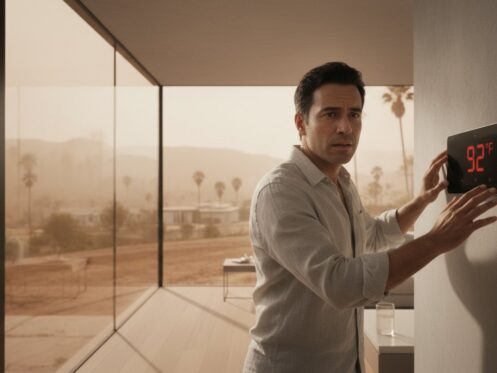
On a 98-degree afternoon in Sherman Oaks last August, a local family realized their electricity meter was spinning at record speeds while their indoor temperature refused to drop below 81 degrees. It’s incredibly frustrating to hear your system humming while the air from your vents feels like a lukewarm breeze. You’re likely worried about a massive repair bill or wondering if your 12-year-old unit has finally reached its limit. We understand that in the Los Angeles heat, a functional air conditioner isn’t a luxury; it’s a safety requirement for your household.
You deserve a factual diagnosis without the fear of predatory sales tactics or unnecessary upsells. This guide clarifies why you’re experiencing an ac running but not cooling and identifies which mechanical components require a certified technician’s attention. We’ll walk through five specific troubleshooting steps to help you determine if your system is safe to operate or if it’s time for a professional HVAC inspection. By the end of this article, you’ll have the technical clarity needed to restore your home’s comfort and protect your equipment’s longevity.
Key Takeaways
- Learn to distinguish between a simple airflow restriction and a mechanical failure by performing immediate checks on your thermostat and air filter.
- Discover the technical reasons why your ac running but not cooling might indicate a refrigerant leak or a frozen evaporator coil rather than a total system breakdown.
- Understand the unique impact of the Los Angeles climate, including how salt air in the South Bay and Santa Ana dust can compromise your condenser’s efficiency.
- Identify when to transition from DIY troubleshooting to a professional assessment to ensure your system remains safe, compliant, and efficient.
- Gain peace of mind by learning how an unbiased HVAC inspection provides a factual roadmap for system longevity, separate from a standard repair company’s sales pitch.
Why Your AC is Humming but the House is Hot: The Basics
You hear the steady drone of the outdoor condenser and feel air moving from the registers, yet the indoor temperature refuses to budge. This specific state of an ac running but not cooling is often more frustrating than a total power loss because the system continues to draw significant amperage without providing relief. It marks a distinct difference between a total electrical failure and a mechanical performance drop. In a total failure, nothing happens. In a performance drop, the cycle of heat exchange has been interrupted, even though the fans and motors remain active.
For residents in neighborhoods like Encino or Santa Clarita, where July temperatures often sustain 95°F for consecutive days, this inefficiency is a financial drain. A system that runs 24/7 without cooling can increase a monthly Southern California Edison bill by 40% or more while failing to protect your indoor air quality. Ignoring these symptoms doesn’t just lead to a hot house; it puts your compressor at risk of permanent burnout, which is the most expensive component to replace in any HVAC system.
Understanding the Cooling Cycle in Simple Terms
Your air conditioner doesn’t actually create cold air. It moves heat from inside to outside using a closed loop. The indoor evaporator coil absorbs thermal energy, which the refrigerant carries to the outdoor condenser unit to be released. Refrigerant is the messenger that makes this transfer possible. Airflow is the critical link in this cycle. If your system can’t move enough air over those coils due to a 90-day-old filter or a clogged unit, the heat exchange fails. This results in an ac running but not cooling as the compressor works harder while the air remains at room temperature.
Safety First: When to Turn Off Your System
Before you begin troubleshooting, you must identify if the system is at risk of catastrophic failure. Shut the unit down immediately if you observe any of the following:
- Visible ice buildup on the copper refrigerant lines or the outdoor unit.
- A persistent burning smell or electrical odors.
- Loud screeching or rhythmic banging noises from the cabinet.
Running a non-cooling AC can lead to compressor slugging, where liquid refrigerant enters the compressor pistons instead of gas. This typically results in a total mechanical seizure and can void your manufacturer’s 10-year parts warranty. Always verify the 240-volt circuit breaker is in the “on” position before you attempt to inspect any mechanical parts or open the service panels.
5 Quick Troubleshooting Steps You Can Do Today
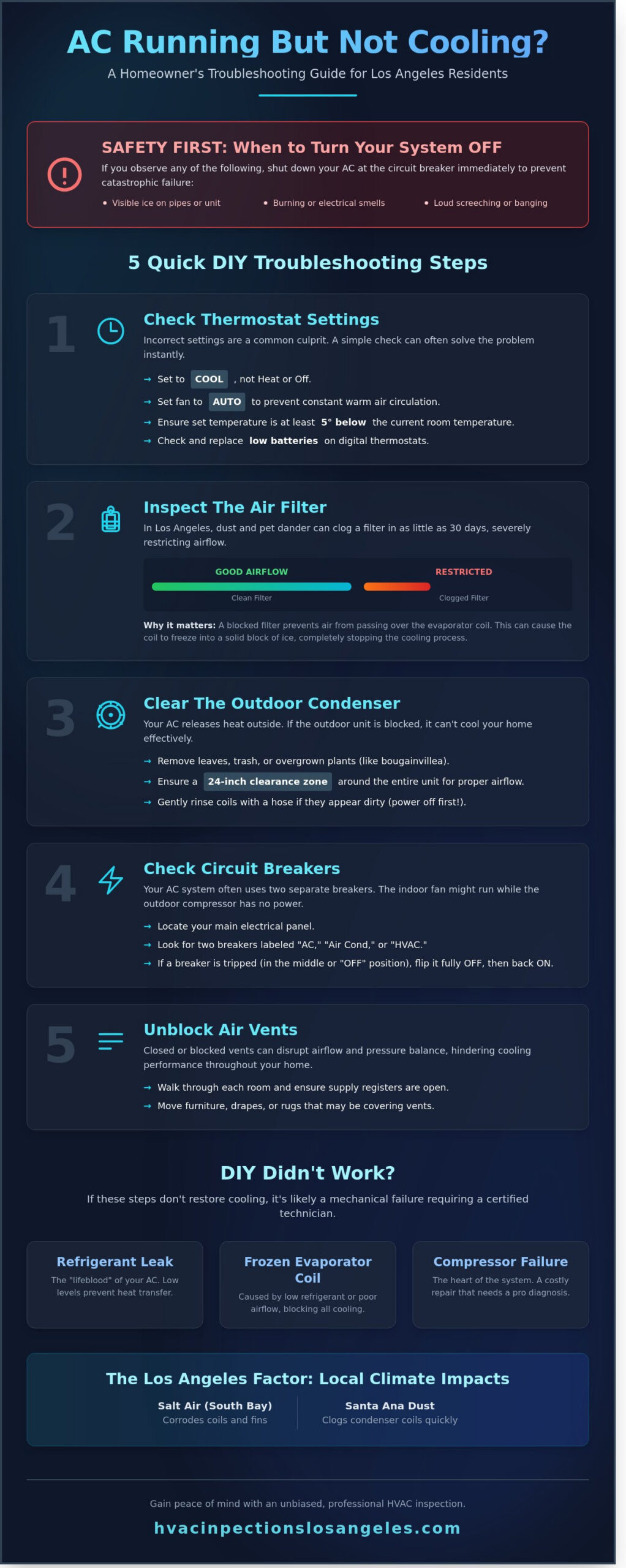
Finding your ac running but not cooling on a 95-degree afternoon in the San Fernando Valley is frustrating. Before calling for a professional inspection, follow these five methodical steps to identify common mechanical or settings-based failures that homeowners can often resolve independently.
- Verify Thermostat Settings: Ensure the system is set to “Cool” rather than “Heat” or “Off.” Set the fan to “Auto” to ensure the blower only runs when the system is actually cooling the air.
- Clear the Condenser: Inspect the outdoor unit for leaves, trash, or overgrown bougainvillea. A 24-inch clearance zone is required for proper heat exchange.
- Check Circuit Breakers: Locate your electrical panel. It’s common for the indoor blower motor to stay powered while the outdoor compressor’s 30-amp or 50-amp breaker has tripped.
- Unblock Air Vents: Walk through every room to confirm that heavy drapes or furniture aren’t obstructing the supply registers.
Thermostat and Battery Calibration
A low thermostat battery often prevents the device from sending a 24-volt signal to the outdoor contactor, leaving you with a fan that blows warm air. If you use a smart thermostat like a Nest or Ecobee, a simple software reset through the settings menu can often clear communication glitches between the Wi-Fi module and the control board. Always ensure your set point is at least 5 degrees below the current ambient room temperature to trigger a cooling cycle.
The Air Filter Impact on Cooling
Los Angeles air quality, combined with high pet dander levels, can clog a standard 1-inch pleated filter in as little as 30 days. When airflow is restricted, the evaporator coil drops below freezing temperatures, causing moisture to turn into ice and block all cooling capacity. For those with specialized systems, verify you have the correct media size. Trane systems often require a 5-inch thick Perfect Fit filter, while Mitsubishi ducted air handlers frequently use 20x25x1 dimensions. If your ac running but not cooling persists after these checks, it may be time for a comprehensive system assessment to verify the refrigerant charge and duct integrity.
Mechanical Failures: When DIY Troubleshooting Isn’t Enough
When your ac running but not cooling remains an issue after checking the filter, the source is typically a mechanical failure. These systems operate as a delicate balance of pressure and electrical current. A deviation in either can halt the cooling process entirely. Mechanical repairs require technical precision because modern units utilize specific electrical tolerances that a layperson cannot safely calibrate.
Refrigerant Levels and System Pressure
A common misconception is that refrigerant is a fuel that gets used up. It isn’t. Your AC is a closed system. If levels are low, you have a leak. Signs include hissing sounds or oily residue on copper connections. Modern R-410A systems are highly sensitive; a 10% drop in refrigerant can cause a 20% decrease in cooling capacity. California law and EPA Section 608 regulations require NATE-certified technicians to handle these chemicals. Topping off a leaking system is a temporary fix that ignores the permanent environmental damage and eventual compressor failure.
The Role of the AC Compressor and Capacitors
The capacitor is the most frequent point of failure during Los Angeles heatwaves. When temperatures in areas like Van Nuys or the San Fernando Valley exceed 100°F, capacitors work overtime to start the motor. You can often identify a failed capacitor by looking for a bulging top or leaking fluid in the outdoor unit cabinet. In older systems, a hard start kit can reduce the initial amperage draw by nearly 50%, potentially saving an aging compressor from burning out. These repairs involve high-voltage components and require professional diagnostic tools to ensure safety.
Other critical mechanical failures that result in an ac running but not cooling include:
- Frozen Evaporator Coils: If you see ice on the copper lines, turn the system off immediately. Let it thaw for 24 hours before a professional inspection to prevent water damage to your furnace or flooring.
- Clogged Condensate Lines: A 1/4-inch blockage in the drain line can trigger a safety float switch. This switch cuts power to the cooling cycle to prevent dozens of gallons of water from leaking into your home’s structure.
- Failed Fan Motors: If the outdoor fan isn’t spinning, the system cannot disperse heat. This quickly leads to the compressor overheating and shutting down as a safety precaution.
The Los Angeles Factor: How Local Climate Impacts Your AC
Los Angeles isn’t a single climate zone; it’s a collection of microclimates that stress mechanical systems in specific ways. If you find your ac running but not cooling, the culprit often depends on your zip code. From the salt spray of the South Bay to the thermal spikes in the San Fernando Valley, local environmental factors dictate how your system fails.
Beach Cities and Corrosion Challenges
Properties in Hermosa Beach and Manhattan Beach face “coil rot” at a rate 30% faster than homes located just five miles inland. Salt air is highly corrosive to aluminum fins. This leads to “pitting,” where microscopic holes allow refrigerant to escape. Homeowners in Redondo Beach and Torrance should rinse their outdoor condenser units with fresh water every 30 days to remove salt deposits. When upgrading, we recommend systems from Mitsubishi or Trane that feature specialized coastal-grade coatings. These protective layers can extend the life of a unit by 5 to 7 years in high-salinity environments.
Inland Heat and Sizing Realities
In the San Fernando Valley, temperatures frequently exceed 100°F. An undersized unit will struggle because of the “20-degree rule.” Most residential systems are designed to drop the indoor temperature by a maximum of 20 degrees compared to the outside air. If it’s 105°F in Woodland Hills, your AC might only reach 85°F indoors despite running all day.
Santa Ana winds also pose a significant threat. These gusts carry fine dust and debris that can clog a condenser coil in less than 24 hours, causing the system to overheat. Additionally, your cooling performance relies heavily on your indoor air handler. A regular furnace tune up ensures the blower motor is pushing the correct Cubic Feet per Minute (CFM) of air. Without proper furnace maintenance, a weak blower motor prevents cold air from reaching the far corners of your home, leaving your ac running but not cooling effectively.
- Coastal Areas: Rinse coils monthly to prevent salt-induced pitting.
- Inland Areas: Clear debris after Santa Ana wind events to maintain airflow.
- All Areas: Verify blower motor health, as it’s the heart of both your heating and cooling delivery.
Professional Inspection: The Key to Long-Term Cooling
When you’ve exhausted basic troubleshooting and find your ac running but not cooling, the next step requires more than a simple service call. Most repair companies operate on a commission-based model where technicians are incentivized to sell new equipment. A dedicated hvac inspection functions differently; it’s a technical audit designed to provide a factual roadmap for your system’s remaining 10 to 15 years of service life. This objective data is vital when you’re deciding between a $400 repair and a $12,000 replacement.
Professional evaluations are particularly critical during Los Angeles real estate transactions. In our local market, an ‘escrow-ready’ system is a significant asset. We verify that every component meets current California building standards, ensuring that insurance providers won’t flag your property for non-compliance. By identifying minor mechanical failures before they lead to total system collapse, you protect your home’s value and your daily comfort.
Unbiased Reporting vs. Repair Quotes
If a contractor tells you that a $15,000 replacement is the only option, don’t sign the contract without a third-party assessment. Our inspectors don’t sell parts or units, so our findings remain neutral. We use high-resolution thermal imaging to see through walls and detect ductwork leaks that a standard visual check misses. We also perform rigorous pressure testing to confirm the exact state of your refrigerant lines. This level of detail provides the evidence you need to hold repair companies accountable or to move forward with a replacement with total confidence.
Transitioning to High-Efficiency Cooling
If your ac running but not cooling is the result of an obsolete system, upgrading to modern technology is the most cost-effective path forward. Mitsubishi Ductless Mini-Splits have become the Los Angeles standard for older homes in neighborhoods like Silver Lake or Hancock Park where installing new ductwork is physically impossible. These units provide precision cooling and can lower monthly energy bills by 25% to 40%.
For homes with existing ducts, Trane heat pumps offer world-class SEER ratings that handle the intense heat of the San Fernando Valley with ease. These systems provide a dual-benefit of high-efficiency cooling in the summer and reliable heating during our cooler coastal nights. Your next step is simple: schedule a comprehensive evaluation today to determine which solution fits your home’s specific mechanical footprint and your budget.
Secure Your Home’s Climate Reliability
Finding your ac running but not cooling is more than an inconvenience; it’s a direct threat to your home’s energy efficiency and your family’s comfort. While basic troubleshooting like cleaning a condenser or replacing a 1-inch pleated filter can resolve minor airflow issues, persistent warmth often signals a mechanical failure or a refrigerant leak. Since 2004, we’ve served the South Bay and Greater Los Angeles by providing technical clarity when systems fail under the pressure of the Southern California sun. As a Mitsubishi Ductless Elite Dealer, our expertise extends beyond basic repairs to comprehensive system analysis.
We specialize in high-stakes real estate and insurance inspections where accuracy is non-negotiable. You don’t have to guess about the health of your HVAC system. Our methodical process ensures every component meets performance standards, giving you a factual roadmap for your next steps. Whether you’re closing a property deal or simply want to restore a 72-degree interior, an objective professional evaluation is your best tool. Schedule Your Unbiased HVAC Inspection Today to ensure your cooling system remains dependable all year long.
Frequently Asked Questions
Is it okay to run my AC if it’s not blowing cold air?
No, you should shut down the system immediately to avoid permanent mechanical damage. Running a unit when you notice the ac running but not cooling puts extreme stress on the compressor. If the compressor fails due to overheating, replacement costs in Southern California often exceed $2,500. Turning it off now preserves the internal components and prevents a total system collapse.
How much does it cost to fix an AC that is running but not cooling in LA?
Repairs in the Los Angeles area typically range from $150 for minor electrical issues to $2,000 for major component failures. A simple capacitor replacement might cost $250; however, fixing a refrigerant leak often averages $1,200. These prices reflect local labor rates and the cost of materials compliant with California’s Title 24 energy standards. Accurate pricing depends on a professional diagnostic of your specific unit.
Can a dirty air filter really stop my AC from cooling?
A restricted air filter is a primary cause of system failure and reduced cooling capacity. When a filter reaches 80% saturation with dust, it chokes the return air and prevents the heat exchange process. This causes the evaporator coil temperature to drop below 32 degrees Fahrenheit. Within 3 hours of operation, ice forms on the coil and blocks all airflow into your living spaces.
How do I know if my AC is low on refrigerant?
You can identify low refrigerant levels by checking for ice buildup on the outdoor brass valves or hearing bubbling noises. A standard 3 ton residential unit requires a precise refrigerant charge to move heat effectively. If the levels drop by even 10%, the system loses 20% of its cooling efficiency. This leads to higher LADWP bills and consistently warmer indoor temperatures despite the unit running.
Why is my AC running but the air feels humid and warm?
Warm, humid air usually signals that the compressor isn’t engaging even though the indoor fan is spinning. This is a common symptom of an ac running but not cooling due to a blown start capacitor or a tripped outdoor breaker. If your indoor humidity stays above 55%, the system isn’t reaching the dew point necessary to remove moisture from the air. This often happens when the condenser coil is 40% covered in debris.
What happens if my evaporator coil freezes up?
A frozen evaporator coil stops the heat exchange process and can cause significant water damage to your property. As the ice melts, it often overflows the primary drain pan, which can leak 5 to 10 gallons of water into your ceiling or closet. You must turn the system off for 24 hours to allow the ice to dissipate completely. A technician cannot perform a proper diagnostic until the ice is gone.
Should I replace my AC or just repair it if it stops cooling?
You should consider replacement if the repair cost exceeds 50% of the unit’s total value or if the system is over 15 years old. In Los Angeles, newer SEER2 rated units provide up to 30% better efficiency than models installed before 2010. If your system still uses R-22 refrigerant, which was phased out in 2020, a full replacement is usually the most financially sound decision for long-term reliability.
How long does a professional HVAC inspection take in Los Angeles?
A professional HVAC inspection in Los Angeles takes approximately 75 minutes to complete from start to finish. During this time, a certified technician examines 22 critical points, including duct integrity and electrical connections. This methodical approach ensures your system meets local safety codes. It’s an essential step for maintaining peak performance during the 90 degree heat waves common in the San Fernando Valley.