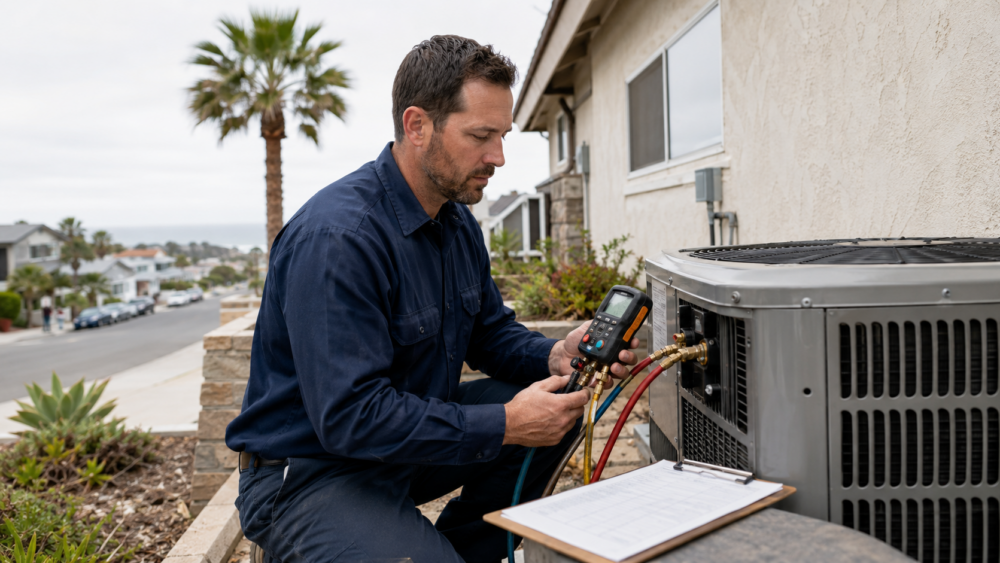
In July 2025, a buyer in Silver Lake moved into their new home only to face a $14,000 system failure during the first triple-digit heatwave of the season. This occurred because a standard home inspection often misses the internal wear that leads to immediate breakdowns. Utilizing a professional hvac inspection checklist for buyers is the most reliable way to verify if a unit is a long-term asset or an immediate financial burden. You’ve likely felt the stress of the fast-paced Southern California market where technical precision is often sacrificed for speed.

It’s important to have total confidence in your property’s mechanical integrity before you remove contingencies. This guide outlines the specific indicators of system health, including duct integrity and compliance with 2026 California energy standards. We’ll walk through the essential red flags to spot during your walkthrough and explain how to use technical findings to justify a specialized inspection or a credit in your final negotiations.

Key Takeaways

  • Learn why standard home inspections often overlook critical mechanical failures and how a specialized forensic evaluation ensures your long-term safety and financial protection.
  • Utilize our comprehensive hvac inspection checklist for buyers to identify hidden red flags, such as cracked heat exchangers, before they lead to costly post-closing repairs.
  • Understand how Los Angeles-specific environmental factors, including coastal salt air and wildfire smoke, accelerate equipment decay and impact your home’s indoor air quality.
  • Discover how to accurately verify a system’s true age and remaining lifespan using manufacturer data to avoid inheriting an inefficient, end-of-life unit.
  • Master the process of securing your investment by requesting specific HVAC contingencies and prioritizing high-risk repairs during your real estate negotiations.

The Buyer’s HVAC Inspection: Why General Reports Fall Short in Los Angeles

A specialized HVAC inspection is a non-invasive but deep-dive mechanical audit that provides a forensic evaluation of a property’s climate control equipment. While a standard home inspection covers a broad range of items from the roof to the plumbing, it often lacks the technical depth required to assess the true health of sophisticated mechanical systems. In the competitive Los Angeles real estate market, relying on a basic “on/off” test can lead to expensive surprises after the keys are handed over.

Understanding the complex components of modern HVAC systems requires more than a cursory glance at a thermostat. Many buyers fall into the “on/off” fallacy, assuming that if the vents blow cold air during a twenty-minute walkthrough, the system is functional. This is a dangerous misconception. A system can appear to operate while harboring a cracked heat exchanger, a failing compressor, or a slow refrigerant leak. These issues are safety hazards that can lead to carbon monoxide exposure or total system failure within months of purchase.

A professional report serves as a vital shield for your earnest money. By including a detailed mechanical assessment in your hvac inspection checklist for buyers, you gain the leverage needed to negotiate repairs or seller credits during the escrow period. Without this data, you risk inheriting a liability that could have been addressed before the contingency period expired.

General Home Inspector vs. HVAC Specialist

General inspectors are generalists by design. They check for basic operation and visible signs of wear, but they rarely open furnace cabinets or test the specific pressure of refrigerant lines. A specialist uses diagnostic tools to identify internal defects that generalists miss, such as micro-fractures in the combustion chamber. This is why Los Angeles real estate agents increasingly recommend independent professional HVAC inspections to provide a level of technical scrutiny that protects the buyer’s long-term interests.

The High Cost of HVAC Ignorance

In Southern California, the cost of a full system replacement can range from $12,000 to over $22,000 depending on the SEER2 efficiency ratings and the complexity of the ductwork. An unbiased report identifies these looming costs before you’re legally committed to the property. It’s also common to find unpermitted “handyman” installations in older Los Angeles homes, particularly in areas like Silver Lake or Echo Park. These installations often fail to meet California’s Title 24 energy standards, which can result in poor performance and future legal complications during a resale. Verifying the integrity of the system is a critical step in any comprehensive hvac inspection checklist for buyers.

The Essential HVAC Inspection Checklist for Home Buyers

Purchasing a home in Los Angeles is a high-stakes investment where the mechanical systems are just as vital as the foundation. While a comprehensive home inspection checklist covers the general structure, the heating and cooling components require a more technical lens. This hvac inspection checklist for buyers focuses on identifying immediate financial liabilities and safety hazards before you sign the closing papers.

Start with a thorough visual audit of both the indoor and outdoor units. Look for visible rust on the heat exchanger or soot near the burner access points, as these often indicate improper combustion. You must also verify the system’s age. Locate the manufacturer serial number on the data plate; most systems in Southern California have a functional lifespan of 12 to 15 years. If the unit was manufactured before 2010, it likely uses R-22 refrigerant. Since the EPA banned R-22 production in 2020, any leak in these older units typically necessitates a full system replacement due to the exorbitant cost of recycled gas.

Listen closely during the startup cycle. Mechanical distress sounds like grinding, high-pitched squealing, or heavy cabinet vibration are red flags. These noises often point to failing bearings or a blower motor reaching the end of its life. A healthy system should operate with a consistent, low-level hum.

Walkthrough Checklist: Indoor Unit and Furnace

Review the physical service tags attached to the cabinet to verify the furnace maintenance history. A lack of documented service within the last 12 months suggests potential neglect. Inspect the area around the burners for scorch marks or heavy corrosion. These signs indicate “rollout,” a dangerous condition where flames escape the combustion chamber. Finally, identify the energy source. Whether the home uses gas, electric, or modern heat pump technology will directly dictate your monthly utility obligations in the 2026 energy market.

Walkthrough Checklist: Outdoor Condenser

The outdoor unit requires breathing room to function efficiently. Ensure the condenser has at least 24 inches of clearance from landscaping, fences, or storage sheds. Inspect the compressor for oil staining at the base, which is a primary indicator of a sealed system leak. You should also check that the concrete pad is level. When a condenser sits at an angle, the internal lubricants can’t protect the motor properly, which often leads to a catastrophic failure within 18 to 24 months of the shift.

Special Considerations for Ductless Mini-Splits

Many modern Los Angeles homes utilize ductless technology for zoned cooling. Look for premium branding such as Mitsubishi or Trane, as these systems generally indicate the previous owner invested in high-quality property maintenance. Use the remote or wall controller to verify that each indoor head responds individually. Check the drywall directly beneath the indoor units for water stains or bubbling paint. This evidence suggests the condensate drainage system is clogged or improperly installed, which can lead to expensive interior wall repairs. If you notice these red flags, an unbiased professional assessment can help you negotiate repairs before the contingency period ends.

HVAC Inspection Checklist for Buyers: The 2026 Los Angeles Real Estate Guide

Red Flags and Deal Breakers: Evaluating System Health

Identifying mechanical failures during a property transaction requires a clinical approach to the equipment’s physical state. While cosmetic issues are manageable, certain structural and operational defects indicate a system that is no longer safe or viable for long-term use. A thorough hvac inspection checklist for buyers helps you avoid inheriting these expensive mechanical failures during the escrow process.

The most critical component to verify is the heat exchanger. If this component has even a microscopic crack, it can leak carbon monoxide into the home’s airflow. Because this poses an immediate life-safety risk, a cracked heat exchanger is the #1 safety deal-breaker in LA real estate. When our technicians identify a breach in the heat exchanger, the unit is typically red-tagged, meaning it must be decommissioned immediately until the entire furnace is replaced.

System age is another objective metric that dictates future liability. Equipment exceeding 15 years of service is considered at its end-of-life stage. Even if the unit is currently cooling, the mechanical fatigue on the compressor and the declining efficiency of the motors make it a financial burden. In the Mediterranean climate of Southern California, an aging system often fails during the first record-breaking heatwave of the summer, leaving new homeowners with an emergency replacement cost they didn’t budget for.

You should also watch for short cycling, which occurs when the system turns on and off every few minutes. This behavior isn’t just an annoyance; it’s a symptom of a major underlying issue. Short cycling is usually caused by:

  • Improper Sizing: The unit is too powerful for the square footage, leading to rapid temperature swings and premature wear.
  • Electrical Faults: Failing capacitors or control boards that can no longer maintain a steady run cycle.
  • Airflow Restrictions: Severe blockages that cause the system to overheat and shut down as a safety precaution.

Identifying Obsolete Refrigerants

Systems using R-22 refrigerant, commonly known as Freon, are ticking time bombs for new homeowners. Production and importation of R-22 became illegal in the United States on January 1, 2020. If an older unit develops a leak, the cost of the remaining reclaimed gas is prohibitively expensive. California regulations have further accelerated the transition to environmentally compliant standards like R-32 or R-454B. Identifying these chemical standards is a core component of any comprehensive hvac inspection checklist for buyers, as an R-22 system often requires a full equipment upgrade rather than a simple repair.

Ductwork Integrity and Airflow

Los Angeles attics often hide a “ductopus,” which is a disorganized tangle of poorly designed or disconnected flex ducts. These configurations restrict airflow and force the blower motor to work twice as hard. Leaky or uninsulated ducts can waste up to 30 percent of the energy used to cool the home. For properties older than 30 years, a professional ductwork inspection is critical. We frequently find original ducting that has degraded to the point of collapse, or worse, contains materials that no longer meet modern health and safety codes.

Los Angeles Local Factors: Coastal Air and Fire Season

Los Angeles real estate is defined by its microclimates. A property in the South Bay faces mechanical stressors that are entirely different from those in the San Fernando Valley. When you review an hvac inspection checklist for buyers, you must prioritize geography. Salt air is the primary threat for homes within three miles of the Pacific. Sodium chloride particles accelerate the oxidation of aluminum fins on outdoor condensers. In Manhattan Beach and Hermosa Beach, untreated units often show signs of “white rust” or fin crumbling in as little as 5 to 7 years. This corrosion restricts airflow and forces the compressor to run at higher temperatures, shortening its overall service life.

Coastal Maintenance Realities

Buyers looking at beachside properties should check the condenser for “Seacoast Protection” or specialized epoxy coatings. These factory-applied barriers can extend a unit’s lifespan by 30% in high-salinity environments. The “South Bay effect” also involves higher coastal humidity, which can lead to biological growth on evaporator coils if the system’s drainage isn’t perfect. Maintaining high air quality in Hermosa Beach requires a proactive approach to filtration. We recommend using MERV 13 filters to capture salt spray and fine particulates without overworking the blower motor.

Fire season introduces a secondary, more seasonal risk to HVAC integrity. Wildfire smoke carries fine particulate matter (PM2.5) and heavy ash that can bypass low-grade filters. This debris coats the internal evaporator coil in a sticky residue, reducing heat transfer efficiency by up to 15%. If a home was located near a recent burn scar, your hvac inspection checklist for buyers should include a specific request to inspect the blower housing and secondary heat exchanger for ash infiltration.

Efficiency Standards and SEER2

California’s Title 24 standards dictate strict energy efficiency requirements that every buyer needs to understand. As of 2026, any new AC installation in Los Angeles must comply with SEER2 ratings, which replaced the older SEER standard in 2023 to provide more accurate real-world testing. For Southern California, the minimum requirement for residential split systems is 14.3 SEER2.

  • Heat Pump Incentives: California is aggressively pushing for a transition from gas furnaces to electric heat pumps. Buyers can often leverage federal tax credits that cover up to $2,000 of the installation cost.
  • Duct Leakage Testing: Title 24 often requires HERS (Home Energy Rating System) testing. If the ducts leak more than 5% to 15% depending on the project type, they must be sealed or replaced to pass inspection.
  • System Sizing: In inland LA areas like Torrance, an undersized system will fail during a 100-degree heatwave. We verify that the cooling capacity matches the square footage and insulation levels of the home.

The transition to SEER2 means that older systems are becoming obsolete faster. If the home you’re eyeing has a unit manufactured before 2015, you’re likely looking at a full system replacement rather than a simple repair. This is because modern high-efficiency components are often incompatible with older, low-efficiency air handlers and refrigerants like R-22.

Ensure your potential home is compliant and efficient before you close. Schedule a specialized local HVAC inspection today.

Securing Your Investment: Professional Verification Steps

Moving from a general home inspection to a specialized HVAC assessment is a critical step in the 2026 Los Angeles market. While a standard home inspector provides a broad overview, they rarely possess the diagnostic tools to measure refrigerant pressure or verify heat exchanger integrity. You should request a specialized HVAC contingency in your purchase agreement. This allows for a dedicated 7 to 10 day window to have a certified professional evaluate the system before the deal becomes binding.

The value of an unbiased third-party assessment cannot be overstated. Sales-driven companies often offer “free” inspections as a lead generation tool for equipment replacement. A neutral firm provides a factual, evidence-based report without the conflict of interest associated with equipment sales. This objective data ensures your hvac inspection checklist for buyers serves as a shield against unforeseen mechanical failures and high energy costs after closing.

Negotiating Repairs and Credits

Once you receive the inspection report, prioritize safety hazards and imminent mechanical failures. If a system is over 12 years old, repairing a major component like a compressor or evaporator coil is often a waste of capital. It’s more effective to use professional repair estimates to secure a replacement credit or an escrow holdback. Los Angeles buyers should pay close attention to unpermitted work. If the inspection reveals a system installed without a City of Los Angeles Department of Building and Safety (LADBS) permit, it can lead to future fines or insurance claim denials. Demand that the seller provides a permit of record or a financial credit to cover the cost of bringing the system to current Title 24 standards.

Choosing a Local Expert

Selecting the right professional is about more than just finding a contractor. Look for firms where technicians hold NATE (North American Technician Excellence) certification. These experts understand the specific environmental stressors of Southern California, from the corrosive salt air in Santa Monica to the extreme thermal loads in the San Fernando Valley. Specialized firms provide the technical precision required for high-stakes real estate transactions, ensuring every component meets safety and efficiency benchmarks. This level of detail transforms your hvac inspection checklist for buyers from a simple list into a comprehensive roadmap for long-term home maintenance.

Secure Your Investment with Technical Precision

Buying a home in Southern California requires more than a visual walkthrough. While a general home inspector might check if the air feels cold, they often overlook the duct integrity or the specific wear caused by coastal salt air and seasonal fire ash. Using a professional hvac inspection checklist for buyers ensures you identify potential heat exchanger cracks or refrigerant leaks before they become your financial burden. Since 2004, we’ve served the South Bay with a commitment to technical accuracy and safety.

As a Mitsubishi Ductless Elite Dealer, we provide the specialized expertise needed for modern Los Angeles HVAC systems. Our reporting is strictly unbiased and non-sales driven; we don’t use inspections as a pretext for repair upsells. You receive a factual, evidence-based assessment of the system’s health to use during your real estate negotiations. We’ve spent over 20 years helping buyers move forward with confidence and clarity.

Book Your Unbiased Real Estate HVAC Inspection

Take the next step in your home-buying journey with the peace of mind that comes from professional verification.

Frequently Asked Questions

Is an HVAC inspection required for a home purchase in Los Angeles?

A specialized HVAC inspection isn’t legally mandated by California state law for a residential sale. However, the California Association of Realtors (CAR) residential purchase agreement strongly recommends a comprehensive hvac inspection checklist for buyers to identify latent defects. Most lenders also require a functional heating system to meet FHA or VA loan requirements. This ensures the property meets basic habitability standards before you close escrow.

How much does a professional HVAC inspection cost in the South Bay area?

Inspection costs in South Bay neighborhoods like Manhattan Beach or Torrance vary based on the number of units and the home’s square footage. While we don’t set a universal price, industry data from HomeAdvisor suggests that specialized mechanical inspections often range between 200 and 500 dollars. Factors like dual-fuel systems or multiple zones will influence the final quote. We provide transparent pricing after reviewing your specific property details.

What is the average lifespan of an HVAC system in the Los Angeles climate?

An HVAC system in Los Angeles typically lasts between 15 and 20 years. Coastal environments like Santa Monica or Redondo Beach often see shorter lifespans of 10 to 12 years due to salt air corrosion on condenser coils. Systems with high SEER ratings that receive biannual maintenance tend to reach the 20 year mark. Monitoring the manufacturing date on the data plate is essential for determining the remaining service life.

Can I do my own HVAC inspection before making an offer?

You can perform a basic visual assessment, but it won’t replace a technical evaluation by a certified technician. A DIY hvac inspection checklist for buyers might include checking the air filter or testing the thermostat. However, a layperson cannot safely measure refrigerant charge or inspect the internal combustion chamber. Professional diagnostic tools are required to verify the system’s mechanical integrity and safety compliance before you commit to a purchase.

What happens if the HVAC inspector finds a cracked heat exchanger?

A cracked heat exchanger is a critical safety failure that presents a direct risk of carbon monoxide poisoning. If our inspector identifies this defect, the system is typically red-tagged and decommissioned immediately for safety. This finding usually requires a full furnace replacement rather than a simple repair. It serves as a significant negotiating point during the real estate due diligence period because of the high replacement cost.

Will a home warranty cover an HVAC system that was flagged during inspection?

Most home warranty companies exclude coverage for systems with documented pre-existing conditions. If an inspection report identifies a defect like a failing compressor or a leaking coil, the warranty provider will likely deny future claims related to those components. This is why buyers must resolve these issues with the seller before the close of escrow. Relying on a warranty for a flagged system is a common financial mistake in real estate.

How long does a specialized HVAC inspection take to complete?

A comprehensive HVAC inspection for a standard 2,000 square foot home takes approximately 60 to 90 minutes. This timeframe allows the technician to cycle the system through both heating and cooling modes safely. We also take this time to inspect the attic components and outdoor condenser units. Larger estates with multiple zones or complex VRF systems will require additional time for a thorough and accurate assessment.

Does the HVAC inspection include checking the ductwork?

Yes, a professional inspection includes a visual assessment of all accessible ductwork to identify leaks or collapses. We look for disconnected sections and degraded insulation that can cause a 30 percent loss in energy efficiency. If we suspect significant hidden issues, we may recommend a specialized duct leakage test or a camera scope. Ensuring duct integrity is vital for maintaining indoor air quality and overall system performance in a new home.

Charles Thompson

company icon