 Serving Ventura and LA County
 Years of Experience
Your HOA board often prioritizes the silence of a shared courtyard and the visual aesthetic of a property line over your personal indoor comfort. It’s a frustrating reality for homeowners in Redondo and Manhattan Beach, where dense housing means a single noisy condenser can quickly trigger a cascade of fines. You want a cool home, but the confusing language in your CC&Rs regarding mechanical equipment often feels like a barrier. Mastering HOA compliant HVAC design is about more than just picking a high-end brand. It’s a technical challenge that requires balancing acoustic performance with the strict energy standards required by California law.
We recognize that securing architectural approval can feel like a high-stakes gamble with your home’s value. This article explains how to navigate CC&R restrictions to design a system that satisfies the board while providing superior cooling. You’ll learn about the professional documentation needed to guarantee approval and how to meet the 50 dBA noise ordinances common in the South Bay. We’ll also look at how the 2025 California Building Codes are shifting the landscape toward quiet, efficient heat pump technology that simplifies the compliance process.
Key Takeaways
- Learn how HOA compliant HVAC design balances strict aesthetic requirements with the technical performance needed for South Bay coastal homes.
- Discover why slim-line condensers and Mitsubishi ductless mini-split systems are the preferred solution for meeting narrow side yard and balcony clearance restrictions.
- Understand the critical role of decibel (dB) ratings and how a 5-decibel difference can be the deciding factor in meeting local Redondo and Manhattan Beach noise ordinances.
- Follow a structured framework for navigating the Architectural Review Committee (ARC) process using professional documentation and objective system defect reports.
- Identify the advantages of utilizing a Mitsubishi Ductless Elite Dealer to access high-compliance equipment that satisfies both board members and 2025 California Building Codes.
What is HOA Compliant HVAC Design?
A professional HOA compliant HVAC design is far more than a simple equipment replacement. It is a specialized engineering approach where every component of a heating and cooling system is selected and positioned to satisfy the legal and aesthetic requirements of a Homeowner Association (HOA). In the South Bay, these organizations use Covenants, Conditions, and Restrictions (CC&Rs) to maintain property values and neighborly peace. When you deviate from these rules, you risk costly fines or a legal mandate to remove the non-compliant equipment at your own expense.
Standard installations often fail inspections in Redondo and Manhattan Beach because they prioritize the contractor’s convenience over the community’s standards. A typical technician might mount a condenser in the most accessible spot, ignoring the fact that it blocks a common walkway or creates a visual eyesore. True compliance requires a meticulous evaluation of the site before a single tool is lifted. This process ensures that the system meets the 2025 California Building Codes, specifically Title 24 energy efficiency standards, while simultaneously adhering to the hyper-local bylaws of your specific complex.
The Three Pillars of HOA Compliance
Successful designs focus on three critical areas to ensure the board grants approval without delay:
- Visual Impact: All refrigerant line sets must be concealed within professional grade covers that match the building’s exterior paint. Outdoor condensers should be positioned out of the direct line of sight from the street or common areas.
- Acoustic Performance: Equipment must operate within strict decibel limits. In many Los Angeles coastal zones, this means staying below 50 dB(A) at the property line to prevent noise complaints.
- Structural Integrity: If a unit is mounted on a roof or balcony, the design must include specific mounting brackets and waterproofing measures. This prevents damage to the building envelope that could lead to shared liability issues.
Ensuring structural integrity is a priority in any professional renovation; firms like HMJ Contracting exemplify how expert attention to detail protects the building’s envelope during complex installations.
Common Restrictions in Los Angeles Condos
Homeowners in high-density areas like Manhattan Beach face unique challenges. Most HOAs strictly prohibit window-mounted air conditioners or portable units that require venting through a street-facing window. These are viewed as temporary, unsightly solutions that detract from the building’s architectural uniformity. Additionally, coastal height restrictions often limit how high a roof-mounted unit can sit to protect the “view corridors” of neighboring units. For upper-floor installations, boards frequently mandate the use of high-density vibration isolation pads. These specialized mounts are essential; they stop mechanical hums from vibrating through the floor and into the living space of the neighbor below.
Solving the Visibility and Space Challenge
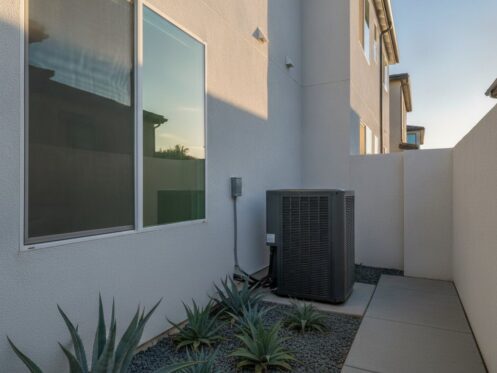
South Bay properties, particularly in Manhattan Beach, often feature narrow setbacks and shared walls. These spatial constraints make traditional, bulky condensers a non-starter for most boards. A successful HOA compliant HVAC design utilizes slim-line condensers that are roughly half the depth of standard units. Mitsubishi ductless mini-split systems have emerged as the gold standard in these environments. Their side-discharge design allows them to operate efficiently even when tucked into a narrow side yard or a discreet balcony corner.
Property owners must understand the architectural application and approval process before finalizing their equipment choice. For instance, a recent retrofit of a Manhattan Beach townhome required three zones of cooling across different floors. By using a multi-zone Mitsubishi heat pump, we kept the exterior footprint to a single slim condenser. Instead of running plastic line set covers across the facade, we routed the refrigerant lines through interior wall cavities. This “invisible” installation technique is often the deciding factor for boards that are hesitant about aesthetic changes. If you’re unsure about the structural feasibility of your project, a professional HVAC inspection can identify the best routing paths for your specific floor plan.
Discreet Indoor Air Handlers
The indoor components of a ductless system provide several aesthetic options. Ceiling cassettes are a popular choice because they mount flush against the ceiling, leaving only a small trim panel visible. For homes with existing crawlspaces or drop ceilings, low-profile ducted units allow the HVAC system to remain completely hidden. If you’re replacing an old gas wall heater, floor-mounted units are an ideal alternative. They sit low to the ground and stay well below window lines, preserving your coastal views.
Exterior Unit Placement Strategies
Managing the outdoor unit’s visibility is just as critical. When exterior line sets are unavoidable, we use custom-painted covers that match the building’s exact facade color. For roof decks with strict height limits, low-profile Trane condensers provide a powerful cooling solution that won’t violate “view corridor” bylaws. In some cases, we recommend integrating architectural screens or strategic landscaping. These barriers provide a secondary layer of sound buffering and visual concealment that reassures cautious neighbors.
Meeting Los Angeles and South Bay Noise Ordinances
In the high-density neighborhoods of the South Bay, sound travels quickly and lingers between closely set structures. Noise is the most frequent catalyst for HOA disputes, making acoustic performance a cornerstone of HOA compliant HVAC design. For homeowners in Redondo Beach and Manhattan Beach, a difference of just 5 decibels can determine whether a system receives board approval or triggers a formal violation notice. While a standard air conditioner might operate at 55 to 60 dB(A), local ordinances often require exterior equipment to stay below 50 dB(A) during the day, with even stricter limits at night.
The physics of sound in Southern California coastal architecture creates unique challenges. Narrow side yards and paved alleys act as “echo chambers,” where mechanical hums reflect off stucco and brick surfaces, amplifying the perceived volume for your neighbors. If a condenser is placed poorly, the sound pressure levels can double simply due to geographic reflection. To mitigate this, we utilize advanced sound dampening tools such as custom-fitted compressor blankets and heavy-duty vibration-absorbing feet. These components decouple the mechanical energy from the mounting surface, preventing low-frequency rumbles from vibrating through shared walls.
Mitsubishi Inverter Technology and Silent Operation
A significant portion of noise complaints stems from the “hard start” of traditional compressors. Mitsubishi inverter technology solves this by ramping up motor speeds gradually, eliminating the jarring clatter associated with older systems. Indoors, these units are virtually silent, with some air handlers operating at a library-quiet 19dB. For outdoor compliance, the “Night Mode” feature allows homeowners to program reduced fan speeds during late hours. This ensures the system remains within the 40 dB(A) nighttime thresholds mandated by several Redondo Beach residential zones.
Acoustic Engineering for High-Density Living
Placement geometry is a critical factor in acoustic engineering. We avoid positioning units where sound can bounce between parallel walls, which significantly reduces the decibel load on the property line. Before installation, checking the specific Hermosa Beach municipal code for HVAC noise thresholds is a mandatory step in our process. Providing the board with a professional pre-approval noise report can save thousands in potential relocation costs. This data-driven approach transforms a subjective neighbor concern into a verifiable technical success, ensuring your cooling system remains a silent asset rather than a community nuisance.
The HOA Approval Process: A Step-by-Step Framework
Obtaining the most recent Covenants, Conditions, and Restrictions (CC&Rs) is the mandatory first step for any South Bay homeowner. These documents, along with the Architectural Review Committee (ARC) guidelines, define the specific boundaries for your HOA compliant HVAC design. Skipping this step often leads to expensive mid-project corrections. Once you have the rules in hand, you can move through a structured framework designed to secure board approval on the first attempt.
- Step 1: Review the latest CC&Rs to identify prohibited equipment types or specific location mandates.
- Step 2: Schedule a professional HVAC inspection to document existing system defects. This provides an objective baseline for why an upgrade is necessary.
- Step 3: Develop a load-calculation-based design. We prioritize Mitsubishi or Trane equipment to ensure the system is sized correctly for South Bay humidity and heat loads.
- Step 4: Submit a formal proposal to the board. This package must include manufacturer spec sheets, verified dB ratings, and a clear map of all line-set paths.
- Step 5: Secure necessary municipal permits from Redondo or Manhattan Beach building departments and schedule the final compliance inspection.
Schedule your compliance-focused HVAC evaluation today to ensure your project starts on firm legal ground.
Why an HVAC Inspection is Your Best Defense
A detailed inspection report does more than identify broken parts. It serves as a professional justification for your project. By documenting that a current system is a safety hazard, such as a cracked heat exchanger or failing electrical components, you provide the board with a logical reason to approve a modern upgrade. This third-party verification of system efficiency is often the most persuasive document in your application. We use the same rigorous standards found in a HVAC inspection for real estate to ensure every technical detail is beyond reproach.
Working with the Architectural Review Committee (ARC)
ARC members are typically volunteer neighbors, not mechanical engineers. Presenting technical data in a clear, visual format is essential. Highlighting the use of NATE-certified technicians signals to the board that the installation will meet high professional standards. Common reasons for denial include “excessive visual clutter” or “potential for noise.” If the board raises these concerns, you must be prepared to pivot the design quickly. This might involve switching to a slimmer Trane unit or proposing an alternative refrigerant routing path that keeps the exterior of the building clean and uniform.
Expert HVAC Design and Inspection in Los Angeles
HVAC Inspections Los Angeles operates as a specialized technical partner for homeowners facing the unique pressures of South Bay property management. Designing a system for a condo in Hermosa Beach or a townhome in Redondo Beach requires more than just mechanical knowledge; it demands a deep understanding of local architectural constraints and municipal noise limits. As a Mitsubishi Ductless Elite Dealer, we provide direct access to the high-compliance equipment necessary to satisfy even the most restrictive Architectural Review Committees. This status ensures that your HOA compliant HVAC design utilizes the latest inverter technology and slim-line footprints discussed in previous sections.
Our process bridges the gap between a neutral assessment and a high-precision execution. By combining our foundational inspections with expert AC installation, we ensure the final system is identical to the design approved by your board. This continuity eliminates the risk of installation drift, where a contractor makes field changes that inadvertently violate CC&R height or sound requirements. We focus on technical precision from the initial load calculation to the final mounting of vibration-absorbing feet, ensuring your comfort never comes at the cost of a neighbor’s peace.
Neutral Inspections, Accurate Assessments
The Meticulous Expert approach is our operational standard. We provide objective facts regarding your current system’s health and its alignment with the 2025 California Building Codes. This neutrality is vital during high-stakes property transactions, where an accurate assessment can satisfy both insurance underwriters and escrow requirements. We don’t use inspections as a pretext for sales. Instead, we focus on ensuring your installation is code-compliant and protects your long-term property value. If a system is failing, we document it with the technical detail required to justify an upgrade to your HOA board.
Ready to Upgrade Your Condo HVAC?
Upgrading a multi-family or high-density residence requires a balance of high-performance Trane or Mitsubishi systems and local environmental awareness. Whether you need a multi-zone ductless mini-split or a high-efficiency heat pump, we offer custom solutions tailored to the Southern California climate. Our team understands the urgency of South Bay cooling needs and the precision required by your specific HOA guidelines. We prioritize safety, longevity, and cost-savings in every design we produce. Contact us to schedule a consultation that respects your community’s standards while maximizing your home’s efficiency.
Secure Your South Bay Indoor Comfort
Navigating the intersection of coastal ordinances and community standards requires a disciplined approach to mechanical engineering. A successful HOA compliant HVAC design isn’t achieved through luck. It’s the result of precise load calculations, strategic equipment placement, and high-performance technology. By prioritizing silent operation and minimal visual impact, you can enjoy a high-efficiency cooling system that meets both your personal needs and the board’s strict requirements.
With over 20 years of local inspection expertise, we understand the specific noise thresholds and architectural nuances of Redondo and Manhattan Beach. As a Mitsubishi Ductless Elite Dealer, we offer specialized solutions that satisfy even the most rigorous South Bay noise ordinance compliance standards. You don’t have to choose between a cool home and a peaceful relationship with your HOA. Professional verification ensures your system remains a silent, invisible, and efficient asset for years to come.
Schedule Your HOA Compliance HVAC Inspection Today
Frequently Asked Questions
Can my HOA legally prevent me from installing an air conditioner?
California Senate Bill 222 and Assembly Bill 1684 significantly limit an HOA’s ability to prohibit cooling systems or heat pumps. While they can’t outright ban the technology, they retain the power to regulate the aesthetic and acoustic details of the installation. This means you must still follow an HOA compliant HVAC design process to ensure your unit meets community standards. Failure to adhere to these design guidelines can still result in fines despite the legal protections for the equipment itself.
What is the maximum noise level (dB) allowed for an outdoor HVAC unit in Los Angeles?
In residential zones of Los Angeles County, the standard exterior noise limit is 50 dB(A) during the day and 40 dB(A) at night. Manhattan Beach specifically mandates that new equipment must not exceed 50 dBA unless a timer deactivates it between 10 p.m. and 7 a.m. These measurements are taken at the property line. Selecting a system with a low decibel rating is the most effective way to avoid neighbor grievances and formal board violations.
Do I need a city permit if my HOA has already approved the HVAC design?
Yes, obtaining a city permit is a separate and mandatory requirement from HOA approval. Redondo Beach and Manhattan Beach building departments require permits for all full system replacements and significant ductwork modifications. HOA approval only confirms that your project meets community aesthetic and acoustic rules. It doesn’t verify that the installation complies with the 2025 California Building Codes or safety standards. You must secure both to ensure a legal and safe installation.
Are ductless mini-splits allowed in most Los Angeles condo associations?
Ductless mini-splits are widely accepted in Los Angeles condos because they offer a non-invasive way to add cooling without extensive ductwork. However, boards often have strict rules regarding the placement of the outdoor condenser and the visibility of the refrigerant lines. Utilizing an HOA compliant HVAC design that includes interior line routing or custom-painted covers is usually required for approval. These systems are often preferred by boards because their inverter technology operates much more quietly than traditional units.
What happens if I install an HVAC system without HOA approval?
Installing a system without prior authorization is a violation of your CC&Rs that can lead to significant legal and financial consequences. The board can levy daily fines or even initiate a lawsuit to force the removal of the non-compliant equipment. This becomes a major hurdle during property transactions, as unapproved modifications can stall escrow and decrease your home’s marketability. It’s always more cost-effective to secure professional documentation and approval before starting any mechanical work.
How do I hide the copper pipes (line sets) on the outside of my building?
The most common method involves installing professional-grade line set covers that are custom-painted to match your building’s exterior. For a more discreet look, we often route the copper piping through interior wall cavities, attics, or crawlspaces during the design phase. This approach keeps the facade of the building entirely clean and is often the preferred choice for high-end Manhattan Beach townhomes. Proper planning during the initial evaluation prevents the need for unsightly exterior plastic “gutters.”
Will a new HVAC system increase my property value in an HOA community?
A modern, high-efficiency HVAC system is a major selling point that can significantly boost your home’s value and transactional preparedness. Quiet, compliant systems reassure potential buyers that they won’t face future HOA fines or neighbor disputes. In competitive markets, having a documented, code-compliant installation makes your property stand out during the inspection and appraisal process. Experts like Integrity Estates Realty emphasize that this level of technical precision and high-quality maintenance are essential for maximizing a home’s long-term market value.
Who is responsible for HVAC maintenance in a condo: me or the HOA?
In most condo associations, the individual homeowner is responsible for the maintenance and repair of the HVAC equipment that serves their specific unit. This usually includes the furnace, air handler, and the outdoor condenser. However, the HOA might be responsible for shared components like central boiler lines or ductwork located within common area walls. You should always consult your specific CC&Rs to determine the exact maintenance boundaries for “exclusive use” mechanical systems in your complex.