 Serving Ventura and LA County
 Years of Experience
That weak breeze coming from your vents isn’t just a sign of a dirty filter; it’s a warning that your system is fighting an invisible battle against static pressure. You’ve likely noticed one room stays stifling while another feels like an icebox, or perhaps you’re seeing dust settle around your registers faster than you can clean it. It’s frustrating to watch your utility bills climb while your comfort levels drop, especially as Los Angeles temperatures become more unpredictable. We understand that you want a solution that doesn’t involve a high-pressure sales pitch for a new unit you might not even need.
A professional hvac inspection for poor airflow los angeles provides the technical clarity required to stop the guesswork. Our objective evaluation identifies the root cause of your system’s inefficiency, whether it’s a ductwork leak, a failing blower motor, or a configuration that fails to meet 2026 Title 24 efficiency standards. This guide explains the diagnostic process, covers the impact of the R-410A refrigerant phase-out, and outlines the specific steps needed to restore balanced, high-performance cooling to every corner of your home.
Key Takeaways
- Understand why poor airflow is often a symptom of static pressure imbalance rather than just a dirty filter, particularly in the unique microclimates of the South Bay.
- Discover how technical tools like manometers and anemometers provide a factual, data-driven map of your home’s air distribution.
- A professional hvac inspection for poor airflow los angeles identifies whether your comfort issues stem from leaking ductwork in the attic or a mechanical failure in the blower motor.
- Master the “20-degree rule” checklist to perform a basic health assessment of your cooling system before scheduling a professional.
- Explore how high-efficiency upgrades from manufacturers like Trane and Mitsubishi can correct long-standing airflow deficiencies in older Los Angeles properties.
Understanding Poor Airflow: Why Your Los Angeles Home Feels Stuffy
Poor airflow isn’t a vague feeling; it’s a measurable restriction within the supply or return side of your system’s cycle. When we perform an hvac inspection for poor airflow los angeles, we look at the entire pressure loop. If your return vents are blocked or undersized, the system can’t “inhale” enough air to satisfy the “exhale” at your registers. This creates a vacuum effect that strains mechanical components and spikes energy costs. Understanding the mechanics of Heating, ventilation, and air conditioning (HVAC) is the first step toward diagnosing why a home feels stagnant despite the thermostat being set to a low temperature.
It’s vital to distinguish between “weak air” and “warm air” to help focus the diagnostic process. If your vents are blowing forcefully but the air isn’t cold, you likely have a refrigerant or compressor issue. However, if the air is cold but barely trickling out, you’re dealing with a flow restriction. A neutral inspection provides a factual baseline to solve this without the pressure of an immediate repair quote, ensuring that the solution is based on data rather than a sales commission.
The Impact of LA Microclimates on System Performance
Los Angeles homes face environmental stressors that vary significantly by ZIP code. In coastal communities like Redondo Beach and Manhattan Beach, salt-laden air accelerates the corrosion of outdoor condenser coils, which can lead to restricted heat transfer and system “slugging.” In multi-story homes common in Torrance, the “stack effect” often pulls conditioned air toward the upper floors while leaving the ground level stuffy. Additionally, late-summer humidity in the South Bay forces blower motors to work harder to move denser air, often exposing existing ductwork leaks that go unnoticed in drier months.
Common Symptoms of Airflow Restriction
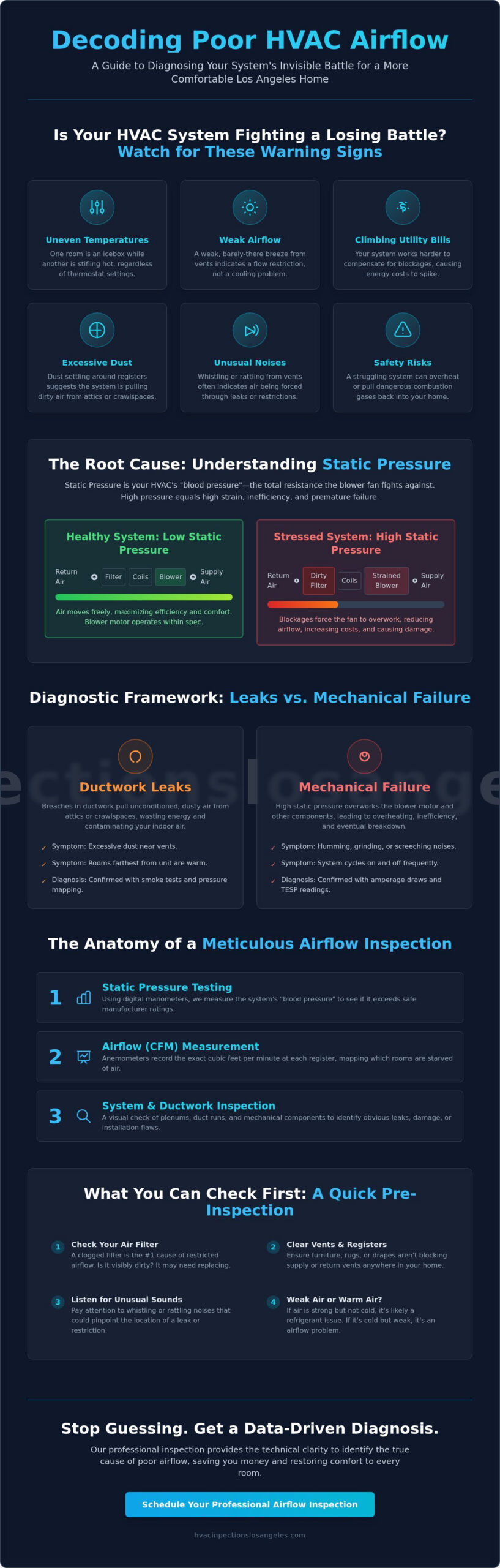
Identifying a problem early can prevent a total mechanical failure. Keep an ear out for ghostly whistling or rattling noises coming from your vents. These sounds often indicate that air is being forced through a narrow gap in the ductwork or that a damper is restricted. You might also notice significant temperature variances where the living room feels comfortable but the bedrooms remain uncomfortably warm. Finally, if you see excessive dust accumulation around your supply registers despite regular filter changes, it’s a strong indicator that your system is pulling unconditioned air from attics or crawlspaces through duct breaches. An hvac inspection for poor airflow los angeles is the most reliable way to verify these leaks with technical precision.
The Anatomy of a Meticulous Airflow Inspection
Mapping airflow requires a methodical approach that captures real-time data from every branch of your mechanical system. Our inspectors don’t rely on visual guesses; they begin by measuring the pressure differential between the return and supply plenums. This identifies if the bottleneck exists before or after the air handler. By using digital anemometers, we record the exact cubic feet per minute (CFM) at each register to see which rooms are being neglected. This level of detail is a standard part of a comprehensive hvac inspection for poor airflow los angeles, allowing us to see exactly where the distribution fails.
Safety is never secondary to performance. A struggling system doesn’t just waste energy; it can become a significant hazard if left unaddressed. When a blower motor can’t move enough air, it can cause the heat exchanger to overheat or create negative pressure that pulls combustion gases back into the living space. This is a critical factor in maintaining a healthy Introduction to Indoor Air Quality. A meticulous evaluation ensures these risks are documented and addressed before they become safety emergencies.
Static Pressure Testing: The Blood Pressure of Your HVAC
Total External Static Pressure (TESP) functions as the “blood pressure” of your mechanical system. It measures the total resistance the blower motor must overcome to circulate air through the filter, coils, and ductwork. To find this number, we insert pressure probes into the system’s supply and return plenums. When TESP exceeds the manufacturer’s specific rating, the motor works at higher temperatures and draws more amperage. This leads to premature blower failure and significantly higher electricity bills. TESP is the resistance the blower must overcome to move air.
Inspecting Ductwork Integrity in Older LA Properties
Older properties across the Los Angeles basin often feature ductwork that is fundamentally mismatched for modern high-efficiency cooling. Many of these homes were originally built with small-diameter ducts intended only for gravity-fed heating. When a high-powered AC unit is attached to these narrow passages, the resulting friction kills airflow. We often find collapsed flex ducts or disconnected elbows in attics that have been disturbed by other contractors over the decades. A comprehensive hvac inspection for poor airflow los angeles is particularly vital for these older properties. A professional ductwork inspection reveals these hidden blockages that visual checks miss. If you suspect your ducts aren’t up to the task, a neutral system assessment provides the evidence needed to plan a proper fix without the pressure of a sales pitch.
Diagnostic Framework: Ductwork Leaks vs. Mechanical Failure
Determining whether an airflow issue is a plumbing problem or a mechanical failure is the core objective of a professional evaluation. We treat the ductwork as the plumbing and the air handler as the engine. If your ducts are leaking in a vented attic or crawlspace, you’re effectively paying to cool the outdoors while your living rooms stay stuffy. Conversely, a mechanical restriction often occurs right at the source. A dirty evaporator coil acts as a dense physical barrier, preventing air from passing through the system regardless of how fast the fan spins. This diagnostic logic aligns with ASHRAE Standard 180, which provides the industry benchmark for inspecting and maintaining residential systems. While the blower moves the air, the AC compressor must maintain precise refrigerant flow to keep those coils at the correct temperature. If the compressor or refrigerant levels are off, the resulting thermal imbalance can lead to coil icing, which completely chokes the airflow.
Identifying Duct Blockages and Design Flaws
Flexible ducting is common in many Los Angeles homes, but it’s prone to installation errors. If a duct is kinked or compressed, it acts exactly like a pinched garden hose. Air velocity drops, and the room at the end of that run stays warm. We also frequently debunk the myth that closing registers in unused rooms saves energy. Doing this actually damages your system. It spikes the internal pressure, forcing the blower to work harder and potentially causing joints to fail. A thorough hvac inspection for poor airflow los angeles also examines the return air side. If your return vents are too small or blocked by furniture, your system is essentially starving for air, which prevents it from ever reaching peak efficiency.
Evaluating Blower Motor and Coil Health
The blower motor is the heart of your air distribution. We check for signs of a failing capacitor or a worn blower belt, as these components often degrade before the motor itself fails. When airflow is restricted for too long, the evaporator coil can drop below freezing, causing condensation to turn into a solid block of ice. Once this happens, airflow stops entirely. This lack of movement is particularly dangerous during the heating season. Without enough air to carry heat away from the furnace, the heat exchanger can overheat and crack, creating a risk of carbon monoxide leaks. A technical hvac inspection for poor airflow los angeles ensures these mechanical barriers are identified before they lead to costly repairs or safety hazards.
Pre-Inspection Checklist: What Homeowners Can Check First
Before scheduling a professional hvac inspection for poor airflow los angeles, you can perform several non-invasive checks to narrow down the potential causes of your system’s inefficiency. One of the most reliable indicators of system health is the “20-degree rule,” also known as the temperature split. To test this, measure the temperature of the air entering your return vent and compare it to the air exiting the supply register closest to the unit. A system operating within technical specifications should show a difference of approximately 16 to 22 degrees. If your split falls within this range but the air coming from the vents feels weak, the issue is likely a physical restriction in the ductwork or a blower motor losing its torque.
We encourage homeowners to be proactive with maintenance, but it is vital to avoid attempting internal mechanical repairs. Opening a furnace cabinet or adjusting high-voltage components without proper training creates significant safety risks. Instead, focus on accessible components. You should review our furnace maintenance checklist to ensure that basic seasonal requirements have been met before seeking a more advanced diagnostic report.
Filter Maintenance and Register Clearance
The air filter is the most common point of failure for airflow. Verify that you are using the correct Minimum Efficiency Reporting Value (MERV) rating for your specific blower motor. While a MERV 13 filter captures more allergens, it also creates higher resistance. If your system was designed for a lower MERV rating, the high-density filter will act as a bottleneck, causing the blower to overheat. Additionally, walk through your home to ensure furniture, rugs, or heavy drapes are not obstructing return air grilles. Even a partial blockage of a return vent can starve the system of the air it needs to function. Finally, check the area around your air handler for visible gaps or disconnected joints in the ductwork that might be bleeding conditioned air into your attic or crawlspace.
When to Call a Certified Inspector in the South Bay
There is a clear “point of no return” where DIY troubleshooting can no longer provide answers. If your filters are clean and your registers are clear but you still experience hot spots or high electricity bills, a professional hvac inspection for poor airflow los angeles is the only way to get a factual diagnosis. This is especially critical during real estate transactions in high-value zip codes across the South Bay. Buyers and sellers require a neutral, third-party report that documents the exact state of the mechanical systems without the conflict of interest inherent in a repair quote. For homeowners dealing with insurance compliance or warranty claims, a technical evaluation provides the verified data needed to move forward with confidence. If your system’s performance remains stagnant after these checks, request a neutral HVAC system evaluation to identify the root cause of your airflow restriction.
Modern Solutions: Resolving Airflow Issues with Mitsubishi and Trane
If the data from your hvac inspection for poor airflow los angeles indicates that your existing ductwork is structurally undersized or improperly routed, mechanical repairs to your old unit will only offer diminishing returns. Modern technology provides a way to bypass these architectural limitations. Upgrading to a high-efficiency AC installation is often the most cost-effective long-term strategy for older Los Angeles homes. Systems from Mitsubishi and Trane represent the gold standard in Southern California, specifically because they utilize variable-speed blowers. Unlike traditional single-stage motors that operate at 100% or 0%, variable-speed technology ramps up gradually to maintain consistent static pressure. This ensures that even the furthest rooms in your home receive the precise amount of conditioned air required for comfort.
Why Ductless Mini-Splits Are the Ultimate Fix for Hot Rooms
Mitsubishi ductless mini-split systems are particularly effective for resolving “hot room” issues in legacy properties across the South Bay. These systems bypass problematic ductwork entirely by delivering conditioned air directly to individual rooms via small, unobtrusive indoor units. This allows for precise “zoning,” where you only cool the spaces you are currently using, significantly reducing energy costs in the face of rising Los Angeles utility rates. As a Mitsubishi Ductless Elite Dealer, we have the technical expertise to design these systems to meet the specific load requirements of your home, ensuring that your installation complies with all 2026 Title 24 efficiency standards while providing relief to rooms that central air simply cannot reach.
Investing in High-Efficiency Trane Systems
For homeowners who prefer a centralized system, Trane offers unmatched durability in our unique coastal climate. Their furnaces and air conditioners are engineered to withstand the corrosive salt air found in neighborhoods like Manhattan Beach and El Segundo. Modern Trane systems feature advanced onboard diagnostics that monitor airflow in real-time, alerting you to potential restrictions before they cause a system lockout or mechanical failure. By choosing a high-efficiency heat pump, you can also reduce your home’s carbon footprint while taking advantage of LADWP rebates that can reach up to $2,500 per ton for qualifying installations as of June 2026. A neutral hvac inspection for poor airflow los angeles provides the technical roadmap to determine if these modern solutions are the right investment for your property’s long-term health and efficiency.
Restoring Balanced Comfort to Your Los Angeles Home
Effective air distribution is a matter of technical balance, not just thermostat settings. We’ve explored how static pressure serves as the system’s blood pressure and why localized microclimates in the South Bay can accelerate mechanical wear. Identifying whether your discomfort stems from restricted ductwork or a failing blower motor requires the precision of specialized diagnostic tools. A professional hvac inspection for poor airflow los angeles eliminates the guesswork, providing a neutral, factual assessment of your system’s health without the pressure of an immediate sales pitch.
With over 20 years of local LA inspection expertise, our team understands the unique demands of regional building standards. As a Mitsubishi Ductless Elite Dealer and a Trane Authorized Provider, we bring deep technical knowledge to every evaluation. We prioritize your safety and long-term efficiency, ensuring you have a clear path toward a more comfortable and cost-effective home environment. Schedule Your Meticulous HVAC Airflow Inspection Today to regain control over your indoor climate. You deserve a system that performs with reliability and precision through every season.
Frequently Asked Questions
Why is air coming out of some vents but not others in my house?
Uneven airflow usually indicates a physical blockage, a disconnected duct joint, or a failing damper within the distribution system. In many Los Angeles homes, flexible ducting can become kinked or crushed in tight attic spaces, which restricts air to specific rooms. This imbalance can also be caused by a zoning system failure where the motorized dampers no longer respond to the thermostat’s commands, effectively “locking” air out of certain branches.
Can a dirty air filter really cause poor airflow throughout the whole system?
Yes, a heavily soiled air filter acts as a solid barrier that prevents the blower motor from pulling enough air into the system. This restriction creates high static pressure, which forces the motor to work harder and eventually leads to a significant drop in air velocity at every register. If airflow remains weak after you change the filter, a professional hvac inspection for poor airflow los angeles is necessary to check for secondary issues like a clogged evaporator coil or a failing blower motor.
How much does a professional HVAC airflow inspection cost in Los Angeles?
The cost of a technical evaluation in the Los Angeles area depends on the size of the property and the complexity of the mechanical system. While general industry data suggests a range for basic diagnostic visits, a comprehensive airflow analysis involves specialized labor and precision tools like manometers and anemometers. Homeowners should prioritize neutral inspections that provide a factual report rather than those bundled with immediate repair sales to ensure an objective assessment of the system’s condition.
Is poor airflow a sign that I need a new air conditioner?
Not necessarily, but it is a sign that your system is operating outside of its designed specifications. Poor airflow can often be resolved by repairing duct leaks or replacing a failing blower capacitor. However, if an hvac inspection for poor airflow los angeles reveals that the ductwork is fundamentally undersized for your equipment, or if the unit is over 15 years old, an upgrade to a modern variable-speed system may be the most logical and cost-effective solution.
What is a “static pressure test” and why do I need one?
A static pressure test measures the internal resistance within your HVAC system, similar to checking blood pressure. High static pressure indicates that the blower motor is struggling to push air through the filter, coils, and ducts. You need this test because it provides the technical evidence required to diagnose invisible bottlenecks that cause mechanical strain, high energy bills, and premature component failure.
How often should I have my ductwork inspected in the South Bay?
We recommend a professional ductwork evaluation every three to five years for homes in coastal areas like Manhattan Beach and Redondo Beach. The salt air and high humidity levels in these microclimates can accelerate the degradation of duct seals and insulation. Regular inspections ensure that small leaks or structural shifts in the attic don’t evolve into major efficiency losses or air quality concerns.
Will cleaning my ducts fix my airflow problems?
Duct cleaning is rarely a permanent fix for poor airflow because it doesn’t address underlying mechanical or structural issues. While removing heavy debris can help, most airflow restrictions are caused by leaking joints, crushed ducts, or an undersized return plenum. A technical inspection identifies these root causes, whereas cleaning only addresses surface-level accumulation without improving the system’s static pressure profile.
Can I use a higher-rated MERV filter to improve my air quality?
You should only use a high-MERV filter if your system’s blower motor is specifically designed to handle the increased resistance. Many older systems in Los Angeles are equipped with motors that can’t overcome the pressure drop created by a MERV 13 or higher filter. Using a filter that is too restrictive will actually decrease your air quality by reducing the number of air exchanges per hour and potentially causing the evaporator coil to freeze.