 Serving Ventura and LA County
 Years of Experience
Did you know that salt air exposure in coastal cities like Hermosa Beach can degrade your condenser’s exterior components up to 10 times faster than inland systems? For Los Angeles homeowners, a standard approach to climate control isn’t enough to combat the specific challenges of 2026, from record-breaking heatwaves to seasonal ash infiltration. You likely recognize that your home’s comfort depends on a system that is both efficient and resilient. This professional-grade hvac maintenance checklist provides the technical framework you need to master your home’s environment while lowering utility costs and improving indoor air quality.
By following this systematic guide, you’ll gain the peace of mind that comes with a verified, inspection-ready system. We’ll walk through the essential steps for verifying refrigerant charges, assessing duct integrity, and neutralizing the corrosive effects of the South Bay’s marine layer. This methodical review ensures your HVAC system remains a reliable asset during high-stakes real estate transactions and the most demanding Southern California summers.
Key Takeaways
- Learn how to implement a professional-grade hvac maintenance checklist designed to navigate the specific temperature fluctuations and air quality demands of Los Angeles.
- Identify the essential DIY tasks that protect system longevity, from managing South Bay air filter cycles to maintaining outdoor condenser clearance.
- Understand the technical benchmarks for professional deep-cleaning and refrigerant testing to ensure your system operates at peak efficiency year-round.
- Discover specialized protocols for mitigating the corrosive effects of coastal salt air and flushing wildfire smoke from your home’s ventilation system.
- Master the documentation process to bridge the gap between routine maintenance and professional inspection, ensuring your HVAC system is fully prepared for real estate transactions.
Your 2026 HVAC Maintenance Checklist for Los Angeles Homes
Los Angeles homeowners face a unique set of atmospheric challenges that demand a 365-day maintenance cycle. Unlike regions with distinct dormant periods, Southern California systems remain active nearly year-round. This continuous operation increases the mechanical load on every internal component. A proactive hvac maintenance checklist ensures that your Heating, ventilation, and air conditioning (HVAC) system operates within its designed safety parameters while maintaining peak energy efficiency.
Safety remains the highest priority for any mechanical inspection. Small electrical issues can escalate into significant fire hazards if left unaddressed; for instance, a failing capacitor can cause wires to overheat and melt. We focus on identifying carbon monoxide leaks from cracked heat exchangers and checking for faulty wiring before they cause a system-wide failure. Regular verification helps you avoid the high costs of emergency ac repair los angeles services during the peak of a July heatwave. This guide provides a high-level overview of the electrical, mechanical, and airflow components essential to your home’s health.
The Cost of Neglect in Southern California
Environmental factors in the South Bay and inland valleys significantly impact equipment life. Santa Ana winds carry abrasive dust that clogs sensitive condenser coils and blower motors. This buildup is a primary cause of ac running but not cooling issues that plague many households during the first warm weeks of spring. In the 2026 real estate market, a poorly maintained system can decrease a property’s valuation by 3% to 5% during a home inspection. Documented maintenance provides the transparency and peace of mind that modern buyers demand.
Defining Your Maintenance Schedule
Precision timing maximizes your mechanical investment. Homeowners should perform basic filter checks every 30 days to ensure unobstructed airflow. However, professional semi-annual inspections are most effective when scheduled in March and September. These months provide the ideal window to prepare for the upcoming peak loads of summer and winter. Keeping a log of your system’s performance metrics, such as cycle length and energy consumption, allows you to spot trends. A 10% decrease in cooling efficiency is often the first sign that your hvac maintenance checklist needs a professional’s attention to prevent a total shutdown.
- Monthly: Inspect air filters and clear debris from the outdoor unit perimeter.
- Semi-Annually: Schedule professional calibration of thermostats and refrigerant charge checks.
- Annually: Conduct a full ductwork integrity test and heat exchanger safety sweep.
Essential DIY Steps: What Every South Bay Homeowner Can Do
Maintaining a high-performing cooling system in Los Angeles requires consistent attention to detail. While professional inspections are necessary for technical calibration, several tasks fall directly under the homeowner’s responsibility. Following a structured hvac maintenance checklist prevents minor issues from escalating into expensive mechanical failures or safety hazards.
Air Filter Mastery for Fire Season
Air filtration is your first line of defense against Southern California’s fluctuating air quality. MERV ratings are a measure of a filter’s ability to capture particles between 0.3 and 10 microns. For most Los Angeles residences, a MERV 8 to 11 filter provides an ideal balance between indoor air quality and system airflow. During the peak fire months of August through November, check your filter every 20 to 30 days. If you notice a greyish ash or black soot buildup, replace it immediately to prevent the blower motor from working against excessive static pressure.
Condenser Unit Protection
Outdoor units in Hermosa Beach and Manhattan Beach face unique challenges from salt spray and windblown sand. These elements accelerate the corrosion of aluminum fins and can clog the coil. You should rinse the exterior of the unit with low-pressure water from a garden hose every 90 days to remove salt deposits. Adhere to the two-foot rule by keeping all landscaping, shrubs, and storage items at least 24 inches away from the unit. This clearance ensures the compressor can reject heat efficiently without straining the electrical components.
Beyond the primary components, your hvac maintenance checklist must include these three functional checks to ensure long-term reliability:
- Thermostat Health: Replace batteries annually, even if the low-battery indicator hasn’t appeared yet. A failing battery can cause erratic cycling or complete system lockouts during a heatwave.
- Ductwork Integrity: Conduct a visual sweep of accessible ducts in your attic or crawlspace. Look for “sweating” or condensation on the exterior, which often indicates compromised insulation or air leaks. Ensure all joints are sealed tight with mastic or foil tape.
- Condensate Line Maintenance: Locate the PVC drain line near your indoor coil. Pouring one cup of distilled white vinegar through the line every six months prevents algae growth. This simple step protects your home from the water damage caused by a backed-up primary drain pan.
Taking these steps ensures your system remains reliable during the hottest months of the year. If you notice persistent issues or unusual noises during your DIY check, it’s wise to schedule a professional assessment to verify your system’s safety and mechanical integrity.
Professional Technical Maintenance: Beyond the Air Filter
While swapping a filter is a simple DIY task, a professional hvac maintenance checklist requires deep technical calibration to ensure system longevity. Dirty evaporator and condenser coils reduce heat transfer efficiency by 21% or more, forcing the system to run longer cycles. Technicians use specialized alkaline or self-rinsing cleansers to dissolve the grime that standard vacuuming cannot reach. This process is essential for maintaining the thermal exchange rates necessary for Los Angeles summers.
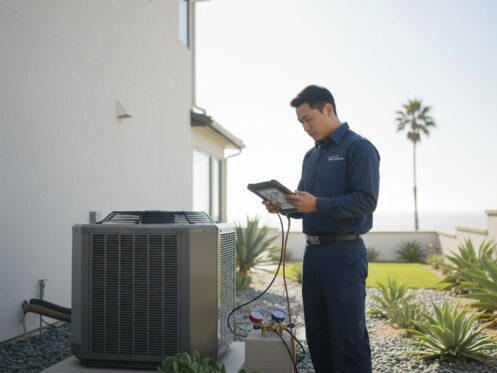
Refrigerant levels must remain precise to avoid mechanical strain. A system undercharged by 10% can increase operating costs by 20% while significantly raising the risk of a frozen coil. Professionals, such as the technicians at RMI Heating and Air Conditioning, use digital manifolds to identify slow leaks and verify that the refrigerant charge matches the manufacturer’s subcooling or superheat specifications. They also tighten all electrical terminals. Loose connections create resistance, which leads to burnt wires and expensive control board failures. Lubricating motors and bearings reduces friction, preventing the mechanical wear that often shortens a system’s expected 15 year lifespan.
The Meticulous Expert’s Component Check
Technicians prioritize the compressor ac compressor to detect early electrical or mechanical fatigue. By measuring voltage and amperage, an expert can compare actual performance against the data plate ratings. If a motor draws 12% more power than its rating, it’s a clear indicator of internal friction or failing capacitors. Testing the starting cycle ensures safety controls engage correctly, protecting the unit from power surges.
Furnace and Heat Pump Specifics
A comprehensive furnace tune up is vital for verifying heat exchanger integrity and preventing carbon monoxide leaks. For homeowners utilizing Mitsubishi or Trane heat pump systems, specialized diagnostic tools check the reversing valve and defrost cycles for 2026 compliance standards. Technicians clear soot from burners and align ignition systems to prevent delayed ignition, ensuring the unit starts quietly and operates at peak fuel efficiency during cooler coastal nights.
LA Climate Challenges: Managing Salt Air and Fire Season IAQ
Los Angeles homeowners face environmental stressors that vary significantly by ZIP code. A standard hvac maintenance checklist designed for the Midwest won’t suffice here. In coastal areas like Redondo Beach and Torrance, the primary threat is sodium chloride. Salt air accelerates the oxidation of aluminum fins and copper tubing, often shortening a condenser’s lifespan by 30 to 50 percent compared to inland units. Conversely, residents in the San Fernando Valley must contend with UV index ratings that frequently exceed 10 during summer months. This intense radiation degrades plastic components and wire insulation on outdoor equipment, leading to electrical shorts and housing cracks.
The need for specialized monitoring in high-corrosion environments is a challenge shared by other sectors; for example, Mechnician provides advanced diagnostic software for marine vessels and heavy equipment, helping operators identify early signs of wear before they lead to mechanical failure.
Coastal Corrosion Mitigation
Beach-front properties require specialized intervention to prevent premature system failure. Applying a factory-approved epoxy or phenolic coating to the condenser coils provides a barrier against salt-laden moisture. Homeowners should implement a quarterly rinsing schedule. Use a low-pressure garden hose to wash away salt deposits; never use a high-pressure washer, as it can flatten delicate fins and restrict airflow. Watch for “white rust,” a powdery zinc oxide buildup on galvanized surfaces. If you spot these white spots, it indicates the protective layer is compromised. Maintaining optimal air quality in Hermosa Beach starts with ensuring the exterior unit isn’t pulling corrosive particulates into the system’s proximity.
Wildfire Readiness and Recovery
Fire season in Southern California introduces heavy particulate matter that bypasses basic fiberglass filters. During active smoke events, set your thermostat to “Recirculate” rather than “Auto.” This keeps air moving through the filtration system without drawing in fresh, smoke-filled air from outside. Post-fire recovery is a critical part of your hvac maintenance checklist. Smoke leaves a greasy, acidic residue on evaporator coils that attracts dust and promotes microbial growth.
- Filter Upgrades: Switch to MERV 13 or HEPA-rated filters during the high-risk months of August through November. These capture 90 percent of fine smoke particles.
- Coil Flushing: If your neighborhood experienced heavy ash fall, a professional coil cleaning is mandatory. Ash is alkaline and can etch the metal surfaces of your system.
- Duct Inspection: Fine soot often settles in duct bends, recirculating odors long after the fires are extinguished.
Protecting your investment requires more than just a filter change once a year. It demands a strategy tailored to the specific atmospheric chemistry of your neighborhood. Ensure your system is prepared for the next heatwave or smoke event by scheduling a comprehensive HVAC inspection today.
When Maintenance Becomes Inspection: Preparing for Escrow
A standard tune-up focuses on immediate performance, but a professional hvac inspection evaluates the long-term viability and safety of the entire system. During a real estate transaction in Los Angeles, your documented hvac maintenance checklist serves as a critical asset. It proves you’ve managed the equipment responsibly and provides a paper trail for potential buyers. If a system is over 15 years old or requires repairs that cost 50% of its total value, routine maintenance is no longer the solution. You need a factual assessment to determine if the unit is a liability or a functional asset.
Transitioning from a DIY checklist to a professional evaluation is necessary when the stakes involve property value and legal disclosures. While a homeowner can change filters, they cannot verify the integrity of a heat exchanger or the precision of a refrigerant charge. Professional inspectors provide the technical data required to move a deal forward without delays. This shift ensures that all parties have a clear, evidence-based understanding of the mechanical systems before any contracts are finalized.
Escrow and Insurance Compliance
General home inspectors in Los Angeles often identify surface-level issues, but they frequently miss specialized technical failures like micro-leaks or internal electrical degradation. Our evaluations provide unbiased reporting that insurance companies and lenders require. Many sellers claim their system works fine because it blows cold air, but 20% of systems that “work fine” actually have underlying safety violations or code non-compliance issues. We provide the neutral verification needed to settle these objections during the contingency period.
Planning for Upgrades
When your system reaches the end of its life cycle, continuing to invest in repairs is a poor financial strategy. If your repair bills over a 12-month period exceed half the cost of a new unit, it’s time to explore modern ac installation options. Modern ductless mini-splits offer high SEER ratings and zoned cooling, which are ideal for older Los Angeles homes with limited attic space. Replacing an inefficient unit before listing your home can often yield a higher return on investment than simple cosmetic fixes.
Don’t leave your real estate transaction to chance. Ensure your system meets California standards and provides the safety your family deserves. Schedule your professional evaluation today to secure your peace of mind.
Secure Your System Performance for 2026
Adhering to a rigorous hvac maintenance checklist is the most effective way to prevent costly mechanical failures and maintain indoor air quality during the 2026 fire season. Your efforts to clear outdoor debris and replace filters every 90 days provide a solid foundation for system longevity. However, technical precision requires a deeper look into refrigerant charges and duct integrity, especially for homes exposed to corrosive salt air in the South Bay. These proactive steps ensure your equipment remains compliant with California energy standards and operates at its designed SEER rating.
With over 20 years of Southern California expertise, we provide the objective data you need for peace of mind or real estate readiness. As a Mitsubishi Ductless Elite Dealer, our focus remains on safety and technical accuracy through unbiased, third-party reporting. We don’t use inspections as a sales pitch for repairs; we provide a factual assessment of your system’s health. Taking action now protects your investment and ensures your home stays comfortable regardless of the temperature outside.
Schedule Your Professional HVAC Inspection with the Meticulous Experts Today
Your family’s safety and comfort are worth the precision of a professional evaluation.
Frequently Asked Questions
How often should I change my HVAC filter in Los Angeles?
You should replace your HVAC filter every 30 to 90 days depending on your specific location and household needs. Homes near high-traffic corridors like the 101 or 405 freeways often require monthly changes because of increased urban dust and soot. If you use a standard 1 inch pleated filter, it typically reaches maximum particulate capacity at the 60 day mark.
Is a professional HVAC maintenance check-up worth the cost?
Professional maintenance is a verified investment that prevents 85 percent of all mechanical failures. The U.S. Department of Energy states that routine servicing can improve system efficiency by 15 percent, which directly lowers monthly utility costs. A certified technician identifies small issues like a failing capacitor before they lead to a total system shutdown during a July heatwave.
What should be included in a standard furnace maintenance visit?
A standard visit includes a 20 point safety inspection that focuses on the heat exchanger and burner assembly. Technicians perform a combustion analysis to check for carbon monoxide leaks and verify that gas pressure meets the manufacturer’s specifications. This process ensures your heating system is compliant with California safety standards and operates at its rated efficiency levels.
Can salt air really damage my air conditioner in Hermosa Beach?
Salt air causes rapid galvanic corrosion on aluminum condenser coils for any property located within 5 miles of the Pacific Ocean. In coastal neighborhoods like Hermosa Beach, salt deposits can reduce the functional lifespan of an outdoor unit by 40 percent compared to inland systems. Applying specialized anti-corrosive coatings and rinsing the exterior cabinet with fresh water every 90 days helps mitigate this environmental degradation.
How do I know if my AC needs a simple cleaning or a professional repair?
You need a professional repair if the system fails to reach the thermostat set point within 20 minutes or if the circuit breaker trips during startup. A simple cleaning is appropriate for removing surface dust from vents or clearing debris from the outdoor cabinet. If you hear grinding noises or detect an electrical burning odor, these are technical indicators of mechanical failure that require a certified diagnostic.
What is the difference between HVAC maintenance and an HVAC inspection?
HVAC maintenance involves active cleaning, lubricating, and tuning of components to optimize performance. An HVAC inspection is an unbiased, third party evaluation of the system’s health, typically used during real estate transactions to verify safety and code compliance. Following a comprehensive hvac maintenance checklist keeps the system running, while an inspection provides the factual documentation needed for property sales.
Does regular maintenance help with allergies during LA’s fire season?
Regular maintenance improves indoor air quality during the 4 month peak of the Southern California wildfire season. Upgrading to a MERV 13 filter during your service visit captures 90 percent of fine smoke particles and PM2.5 pollutants. Ensuring duct integrity prevents unfiltered outdoor air from bypassing the filtration system and entering your living spaces through leaks in the attic or crawlspace.
How long does a typical professional HVAC maintenance visit take?
A typical professional maintenance visit for a standard residential system takes between 60 and 90 minutes. This timeframe allows the technician to complete every step of the hvac maintenance checklist, including electrical testing and refrigerant charge verification. Complex multi zone systems or older units in historic Los Angeles properties may require up to 120 minutes for a thorough technical assessment.