 Serving Ventura and LA County
 Years of Experience
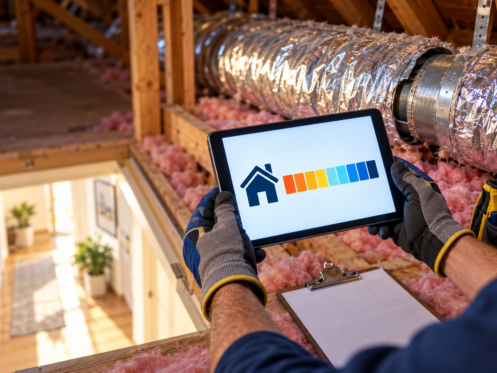
HVAC Inspections Los Angeles now offers official Home Energy Score assessments, the U.S. Department of Energy’s 1–10 rating of how efficiently a home uses energy. Matt Alba is a certified Home Energy Score Assessor, and we deliver scores through the statewide Home Energy Score California program.
For years, clients have called us when something feels wrong: an upstairs that never cools down, a bill that keeps climbing, a system that runs all afternoon and still can’t keep up. We find the cause, document it, and explain what to do. Now we can also answer a bigger question: how efficient is your whole home, and what should you improve first?
What is a Home Energy Score?
A Home Energy Score rates a home’s expected energy use from 1 to 10, after accounting for local climate. According to the DOE, a 10 is expected to use less energy than 90% of U.S. homes, a 5 performs like an average home, and a 1 uses more energy than 85% of U.S. homes.
The score is based on the house itself: its size, insulation, windows, ducts and mechanical systems. It is not based on how one family sets the thermostat. The DOE compares it to a miles-per-gallon rating for a car, which makes it a fair way to compare homes and a clear way to see which upgrades matter most.
In California, the program is administered by the Bay Area Regional Energy Network (BayREN) with Earth Advantage, and funded by PG&E, SDG&E, SoCalGas and Southern California Edison ratepayers under the California Public Utilities Commission.
What you get
After a walk-through of about 45 to 90 minutes, you receive:
- Your official 1–10 score
- Estimates of your home’s energy use, cost and greenhouse gas emissions
- A step-by-step upgrade pathway, from weatherization to electrification, showing the score your home could reach
- Information on programs and rebates that may apply in your area
Typical recommendations include adding insulation, sealing air leaks, sealing leaky ducts, moving to a heat pump, and switching to efficient electric appliances.
Why it matters who does the assessment
In most Los Angeles homes, heating, cooling and ductwork are where the upgrade money goes. They are also where we see the most expensive mistakes: oversized equipment, starved return air, ducts leaking into attics and garages, and new systems connected to old, undersized ductwork.
A Home Energy Score will tell you a home can improve. An HVAC inspector can tell you why, and in what order to act. When a report recommends a heat pump, we can tell you whether the ducts need work first, and size the new system with a Manual J load calculation. When it flags duct leakage, we can show you where it is.
That is the combination we are bringing: a standard, official score, backed by a licensed HVAC contractor (CA C-20 #1075723) with NATE and NCI certifications.
Who should get one
- Homeowners planning a remodel or upgrade who want to spend where it counts
- Anyone living with hot rooms, drafts or uneven temperatures
- Sellers who want to show buyers how efficient a home is
- Buyers who want to know what a home will need
- Anyone who wants lower bills or a smaller carbon footprint
Help with the cost
Through Home Energy Score California, $250 per scored home is passed to eligible homeowners as an instant discount. The program lists two conditions: the home is a single-family detached house or side-by-side duplex, and it is served by PG&E, Southern California Edison, SoCalGas or SDG&E.
Book your score
Call or email to book your Home Energy Score. We will check your utility bills first so you know whether the $250 discount applies. You can also download the program brochure (PDF).
Home Energy Score® is a program of the U.S. Department of Energy. Learn more at HomeScoreCA.org. Incentive terms are set by the program and may change.